Hello! Welcome back to our focused study of the Indian Economy.
In our last lesson, we explored the RBI's policy rates, which act as the primary signals for its monetary policy stance. We learned how the repo rate serves as the anchor, with the MSF and SDF forming a corridor around it to manage the price of money.
Today, we shift our focus from the price of money to its quantity. This lesson will cover the RBI's reserve and liquidity tools, which directly influence the amount of funds available in the banking system. We will define and differentiate the Cash Reserve Ratio (CRR), the Statutory Liquidity Ratio (SLR), Open Market Operations (OMOs), and the key components of the Liquidity Adjustment Facility (LAF), including the Variable Rate Repo (VRR) and Variable Rate Reverse Repo (VRRR). Mastering these concepts is crucial, as they are fundamental to how the RBI implements its policy on the ground.
The Foundation: Reserve Ratios (CRR and SLR)
Before banks lend money, the RBI requires them to set aside a certain portion of their total deposits. This is a direct, quantitative way to control the money supply. The base for calculating these reserves is the Net Demand and Time Liabilities (NDTL) of a bank, which is essentially the total deposits it holds (both demand deposits like current/savings accounts and time deposits like FDs) minus the deposits it holds from other banks.
Let's break down the two main reserve ratios.
1. Cash Reserve Ratio (CRR)
The CRR is the first-line requirement that directly impacts the lendable funds of a bank.
- Definition: CRR is the percentage of a bank's NDTL that it must keep with the Reserve Bank of India.
- Form: This reserve must be maintained in the form of cash.
- Interest: Banks do not earn any interest from the RBI on their CRR balances.
- Impact: When the RBI increases the CRR, banks have less money available to lend, which reduces credit creation and absorbs liquidity from the economy. A decrease in CRR has the opposite effect, injecting liquidity.
2. Statutory Liquidity Ratio (SLR)
The SLR is another reserve requirement, but it is maintained differently and serves a slightly different purpose.
- Definition: SLR is the percentage of a bank's NDTL that it must maintain with itself.
- Form: These reserves must be held in the form of safe and liquid assets, such as cash, gold, or approved government securities (G-Secs).
- Interest: Since a large part of SLR is held in government securities, banks earn interest on these assets.
- Impact: A high SLR limits the funds a bank can lend to the private sector and simultaneously creates a captive market for government borrowings. Reducing the SLR frees up more funds for banks to lend.
For a clearer understanding of these concepts and the calculation of NDTL, the following video provides an excellent explanation.
Monetary Policy Tools & Key Concepts Explained for UPSC Prelims 2026 | Economy | Drishti IAS English
This video from Drishti IAS English breaks down the concepts of CRR and SLR very effectively for the UPSC exam.
Please watch the segment from this timestamp. The instructor clearly explains NDTL and then uses a simple trick (C for Central, S for Self) to help you remember the core difference between CRR and SLR.
The infographic below provides a concise summary of the key differences between CRR and SLR, which is perfect for quick revision.

The Dynamic Tool: Open Market Operations (OMOs)
Unlike the fixed reserve ratios, OMOs are a dynamic tool used by the RBI to manage liquidity on a more frequent basis.
- Definition: OMOs involve the buying and selling of government securities (G-Secs) by the RBI in the open market to adjust the overall money supply.
The mechanism is straightforward:
- To Inject Liquidity (Expansionary): The RBI conducts an OMO Purchase. It buys G-Secs from banks. In return, it pays the banks in rupees, thus increasing the cash available in the banking system. This tends to lower short-term interest rates.
- To Absorb Liquidity (Contractionary): The RBI conducts an OMO Sale. It sells G-Secs to banks. The banks pay the RBI in rupees, thus reducing the cash in the banking system. This tends to raise short-term interest rates.
It's important for the Prelims to distinguish between two types of OMOs:
- Outright OMOs: This is the outright purchase or sale of G-Secs with no promise to reverse the transaction. This is used for managing durable or long-term liquidity.
- Repo and Reverse Repo Operations: These are also a form of OMO, but they come with a repurchase agreement. They are used for managing short-term liquidity needs and are the primary mechanism within the LAF.
RBI Liquidity Management Guide | Banking System Tools Explained
This guide from India Macro Indicators provides a detailed explanation of the RBI's liquidity management tools.
Please read the section on Open Market Operations. Focus on how buying and selling securities manages liquidity and how OMOs are used to signal the RBI's monetary policy stance.
Fine-Tuning Liquidity: VRR and VRRR
In the previous lesson, we discussed the LAF corridor, anchored by the fixed policy repo rate. However, for more flexible, day-to-day liquidity management, the RBI primarily uses auction-based variable rate instruments.
1. Variable Rate Repo (VRR)
- Purpose: To inject liquidity into the system for a short tenor (e.g., up to 14 days).
- Mechanism: Instead of lending at the fixed repo rate, the RBI conducts an auction. Banks bid for funds, quoting the interest rate they are willing to pay. The rate is thus market-determined, giving the RBI flexibility to inject funds based on current market conditions without changing the main policy rate.
2. Variable Rate Reverse Repo (VRRR)
- Purpose: To absorb surplus liquidity from the system.
- Mechanism: The RBI conducts an auction where banks bid to park their surplus funds, quoting the interest rate they are willing to accept. The rate is market-determined. In recent times, the VRRR has become the RBI's main tool for absorbing large amounts of excess liquidity, especially for tenors longer than overnight (e.g., 7, 14, 28 days).
This distinction is vital: while the fixed-rate repo signals the overall policy stance, VRR and VRRR are the primary operational tools for managing the actual quantity of liquidity in the system on a dynamic basis.
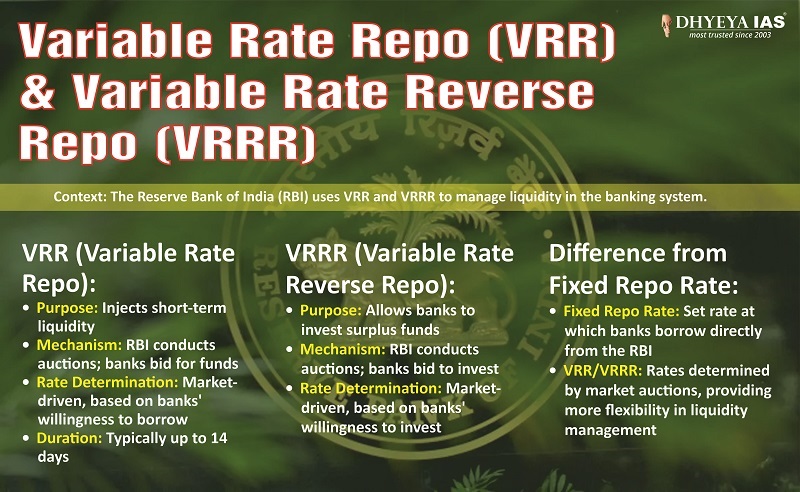
To understand the auction mechanism that makes these rates "variable," the following explanation is very helpful.
RBI Monetary Policy- Variable Repo, VRRR, CRR-ASISO, E-Rupi Reforms, TREDS-NACH etc Feb-2022 Updates
Mrunal Patel is a well-known educator for the UPSC CSE, and his explanations are highly exam-oriented.
In this clip, he explains the auction process for VRRR. Watch from this section where he walks through a hypothetical auction, showing how bids are placed and how the cut-off rate is determined. This will give you a practical understanding of how "variable rate" auctions work.
Conclusion
In this lesson, we have covered the RBI's main quantitative and liquidity management tools, complementing our understanding of the policy rates from the previous lesson.
Here are the key takeaways for your Prelims preparation:
- CRR and SLR are mandatory reserve requirements that reduce the pool of lendable funds for banks. Remember the key differences: CRR is cash held with the RBI with no interest, while SLR comprises liquid assets held by banks themselves, which earn interest.
- OMOs are the RBI's tool for managing overall liquidity by buying (injecting) or selling (absorbing) government securities.
- LAF is the main framework for daily liquidity management. Within it, VRR (injection) and VRRR (absorption) are auction-based, market-determined tools that provide the RBI with flexibility in managing liquidity without altering the main policy repo rate.
The table below summarizes the tools we've discussed in this lesson:
| Tool | Primary Function | Nature | Key Feature |
|---|---|---|---|
| CRR | Absorb Liquidity | Reserve Requirement | Percentage of NDTL as cash with RBI, no interest. |
| SLR | Absorb Liquidity | Reserve Requirement | Percentage of NDTL as liquid assets with self, earns interest. |
| OMO | Inject/Absorb | Market Operation | Outright buying/selling of G-Secs for durable liquidity. |
| VRR | Inject Liquidity | LAF Auction | Short-term liquidity injection at a market-determined rate. |
| VRRR | Absorb Liquidity | LAF Auction | Short-term liquidity absorption at a market-determined rate. |
In our next lesson, we will step back from the RBI's operational tools and look at its own finances. We will explore the rationale behind the RBI's surplus transfer to the central government, guided by the recommendations of the Bimal Jalan Committee's economic capital framework.