Welcome to the next lesson in our rapid review of the Indian Economy.
In our previous session, we delved into the RBI's quantitative tools like CRR, SLR, and OMOs, understanding how the central bank manages the volume of money in the banking system. Today, we shift our perspective from the RBI's actions on the economy to the RBI's own finances. We will examine the often-discussed topic of the RBI's surplus transfer to the Central Government.
This lesson will explain the rationale, the intricate mechanism, and the recent record-breaking quantum of this transfer. Crucially, we will anchor our discussion in the Economic Capital Framework (ECF), a rule-based system established on the recommendations of the Bimal Jalan Committee. Understanding this topic is essential as it lies at the intersection of monetary policy, central bank autonomy, and the government's fiscal health—a frequent point of focus in the UPSC Prelims.
Why Does the RBI Transfer its Surplus?
To begin, it's important to clarify what this transfer is. Unlike a company paying dividends to its shareholders, the RBI's payment to the government is called a 'surplus transfer'. This is because the RBI is not a commercial entity but a statutory body, fully owned by the Government of India. The legal mandate for this transfer comes from Section 47 of the RBI Act, 1934, which states that after making provisions for bad debts and other contingencies, the remaining profit (the 'surplus') "shall be paid to the Central Government."
To understand this better, let's watch a short video that clarifies the distinction between a dividend and a surplus transfer and outlines the primary ways the RBI earns its income.
Why RBI Transfers Surplus to Govt? | Economic Capital Framework and CRB | Perspective
This video from Vajiram and Ravi Official provides a clear, foundational explanation of why the RBI transfers money to the government and where this money comes from.
Please watch the first two segments. The first segment, "Why RBI transfers funds", explains the relationship between the RBI and the government and clarifies why it's a surplus transfer, not a dividend. The second segment, "How RBI earns money", details the main sources of the RBI's income, such as seigniorage (profit from printing currency), interest from foreign and domestic securities, and foreign exchange operations.
As the video explained, the RBI's income primarily comes from:
- Interest on Foreign Currency Assets (FCAs): Earnings from holding foreign government bonds (like US Treasury bills).
- Interest on Domestic Assets: Earnings from holding Government of India securities (G-Secs) acquired during Open Market Operations.
- Interest on Loans: Interest earned on short-term lending to banks (under Repo) and to central/state governments.
- Foreign Exchange (Forex) Gains: Profits made from buying and selling foreign currencies.
After deducting its operational expenses (like currency printing costs, staff salaries), the remaining amount constitutes the RBI's net income. The crucial question then becomes: how much of this net income should be kept by the RBI for its own stability, and how much should be transferred to the government?
The "How": Economic Capital Framework and the Bimal Jalan Committee
The question of how to divide the surplus was a point of friction for many years between the RBI, which wanted to maintain strong buffers, and the government, which needed funds for its fiscal expenses. To resolve this and create a transparent, rule-based system, the RBI formed an expert committee in 2018 chaired by its former governor, Dr. Bimal Jalan.
The committee's recommendations, adopted in 2019, established the Economic Capital Framework (ECF). The ECF is the methodology the RBI now uses to decide the surplus amount to be transferred.
The most critical recommendation of the Bimal Jalan Committee was to distinguish between two types of profits, which determines what can be distributed. The following video provides a superb explanation of this concept using a simple analogy.
What is Economic Capital Framework? | ECF | Reserve Bank Of India | StudyIQ IAS English
This video from StudyIQ IAS English brilliantly breaks down the ECF and the Bimal Jalan Committee's recommendations. The analogy used is particularly helpful for grasping a key concept.
Please watch the video from the beginning. First, watch the explanation of realized vs. unrealized profit. The speaker uses an excellent analogy of owning a house to differentiate between rental income (realized) and the appreciation in the house's market value (unrealized). This is the foundation of the ECF. Then, continue watching the next segment, "The Bimal Jalan Committee Framework". This part explains how these profits are used to build two different buffers and how the final surplus is calculated. Pay close attention to the numerical example provided.
As you just saw, the ECF works on a few key principles:
-
Segregation of Profits:
- Realized Profit: Actual cash profits earned, like interest income from bonds or gains from selling forex. This is distributable.
- Unrealized Gains: Notional profits from the appreciation in the value of assets that are still held by the RBI, like the rising price of gold or foreign currencies in its reserves. These are not distributable.
-
Two Types of Reserves:
- Contingency Risk Buffer (CRB): This is the country's primary financial stability fund, meant to cover unexpected risks. It is built from realized profits.
- Revaluation Reserves: These accounts hold the unrealized gains. They fluctuate with market prices and are not used for transfers.
-
The CRB Rule: The Bimal Jalan Committee recommended that the CRB should be maintained within a specific range: 5.5% to 6.5% of the RBI's total assets (balance sheet size).
The surplus transfer mechanism, therefore, follows these steps:
- RBI calculates its net income.
- Unrealized gains are transferred to the Revaluation Reserves.
- From the realized profits, the RBI assesses its CRB level.
- If the CRB is below the mandated 5.5-6.5% range, a portion of the realized profit is used to top it up.
- After the CRB is adequately funded, the entire remaining realized profit is transferred to the Government of India as surplus.
The "How Much": Recent Quantum and Its Significance
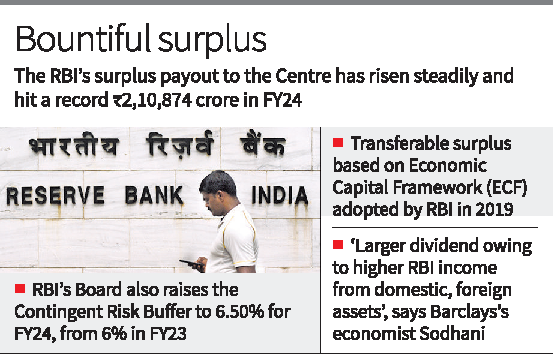
For the accounting year 2023-24, the RBI approved a record-breaking surplus transfer of ₹2.11 lakh crore to the Central Government.

This was more than double the transfer of the previous year (₹87,416 crore). Several factors contributed to this "bountiful surplus."
RBI Surplus Transfer to Government-Explained Pointwise |ForumIAS
This article from ForumIAS provides a clear, pointwise summary of the surplus transfer mechanism and the reasons behind the recent record amount.
Please read two sections from this article. First, read the section "What is the source of RBI surplus?". This part recaps the sources of earnings and explicitly mentions the legal basis (Section 47) and the ECF's CRB range. Next, read the section titled "What are the reasons behind Increase in RBI surplus?". This explains the specific drivers of the high profits in FY24.
As the article explains, the primary reasons for the record surplus in 2023-24 were:
- High Interest on Foreign Assets: Global central banks, especially the U.S. Federal Reserve, had raised interest rates. This meant the RBI earned significantly higher interest on its massive holdings of foreign government bonds.
- Gains from Forex Trading: The RBI intervened in the forex market by selling dollars to stabilize the rupee. Since it had acquired these dollars at a lower price earlier, the sale resulted in substantial realized profits.
- Lower Provisioning Needs: With the CRB already at a healthy level, and the RBI deciding to maintain it at the upper bound of 6.5%, a smaller portion of the income was needed for provisioning, leaving a larger share as transferable surplus.
For the government, this record transfer provides a significant fiscal cushion, potentially helping it to reduce its borrowing, meet its fiscal deficit targets, and increase capital expenditure on infrastructure projects.
Conclusion
Let's consolidate what we've learned about this important topic.
Key Takeaways:
- Rationale: The RBI transfers its surplus profits to its owner, the Government of India, as mandated by Section 47 of the RBI Act, 1934.
- Mechanism: The transfer is governed by the Economic Capital Framework (ECF), based on the Bimal Jalan Committee's recommendations.
- Core Principle: The framework distinguishes between realized profit (distributable) and unrealized gains (not distributable).
- The Buffer: The RBI must first maintain a Contingent Risk Buffer (CRB) between 5.5% and 6.5% of its assets. The surplus is the amount of realized profit left over after this provisioning.
- Recent Quantum: For FY 2023-24, the RBI transferred a record ₹2.11 lakh crore, driven by high earnings from its foreign currency assets and forex trading.
We have seen how the RBI's management of its own balance sheet, particularly its foreign assets, directly impacts its surplus. In our next lesson, we will take a closer look at these assets. We will explore the composition, current size, and significance of India's foreign exchange (forex) reserves and the RBI's crucial role in managing them.