Hello! Let's dive into our next lesson on the Indian Economy.
In our last session, we explored how the Reserve Bank of India generates and transfers its surplus profits to the government, a process heavily influenced by earnings from its assets. A significant portion of these assets are foreign ones. This naturally leads us to today's topic: India's foreign exchange (forex) reserves. We will examine what these reserves are, their composition, their current size, and why they are a critical pillar of India's economic stability.
By the end of this lesson, you will be able to identify the composition, current size, and significance of India's forex reserves and explain the RBI's crucial role in managing them. This is a fundamental topic for the UPSC Prelims, as questions frequently test your understanding of the components and importance of these reserves.
What are Forex Reserves and What Do They Comprise?
Foreign exchange reserves, or forex reserves, are assets held by a country's central bank, denominated in foreign currencies. In India, the RBI acts as the custodian and manager of these reserves. They serve as a crucial financial buffer, backing the nation's currency and ensuring it can meet its international obligations.
India's forex reserves are composed of four main elements. This diagram gives you a clear overview.

Now, let's understand each of these components in detail. The following video provides an excellent, systematic explanation of each part, which is essential for building a strong conceptual foundation. Although the narration is in Hindi, the concepts are explained with great clarity, which is highly beneficial for exam preparation.
Forex Reserves | Lec 36 | Indian Economy for UPSC | StudyIQ IAS
This video from StudyIQ IAS is one of the clearest explanations available on the components of forex reserves. It breaks down complex topics like SDRs and RTP into easily understandable parts.
Please watch the video in four segments: Introduction and Components (02:46 to 05:53): This part introduces the concept and lists the four components, explaining the primary one, Foreign Currency Assets (FCAs). It correctly points out that FCAs are the largest part of our reserves and include assets like US government bonds. Gold Reserves (19:48 to 24:16): Watch this segment to understand why central banks hold gold. It explains gold's role as a "safe haven" asset that acts as a hedge against currency fluctuations and uncertainty. Special Drawing Rights (SDRs) (09:08 to 18:21): This is a crucial section. Pay close attention to how it explains that an SDR is an international reserve asset created by the IMF, not a currency or a direct claim on the IMF. It clarifies how a country can exchange its SDRs with another member country for hard currencies like dollars. Reserve Tranche Position (RTP) (24:27 to 26:20): This final segment explains the RTP. Understand it as a portion of a country's required contribution (quota) to the IMF that it can withdraw at any time without conditions, acting as an emergency fund.
To summarise the key points from the video:
- Foreign Currency Assets (FCA): These are the largest component. They consist of assets like bonds and treasury bills issued by foreign governments, primarily held in US dollars, but also in other major currencies like the Euro, Pound Sterling, and Japanese Yen.
- Gold: The second-largest component. The RBI holds a significant amount of gold, which is considered a safe and liquid asset. Its value tends to increase during times of global economic uncertainty, providing a cushion when currency values are volatile.
- Special Drawing Rights (SDRs): These are potential claims on the freely usable currencies of IMF members. They are allocated to countries by the IMF based on their quota. SDRs are not a currency themselves, but they can be exchanged for actual currency when needed.
- Reserve Tranche Position (RTP): This represents the part of a member country's quota paid to the IMF that it can access on demand without any conditions or service fees. It is essentially an emergency fund a country can tap into.
Current Size and Global Standing
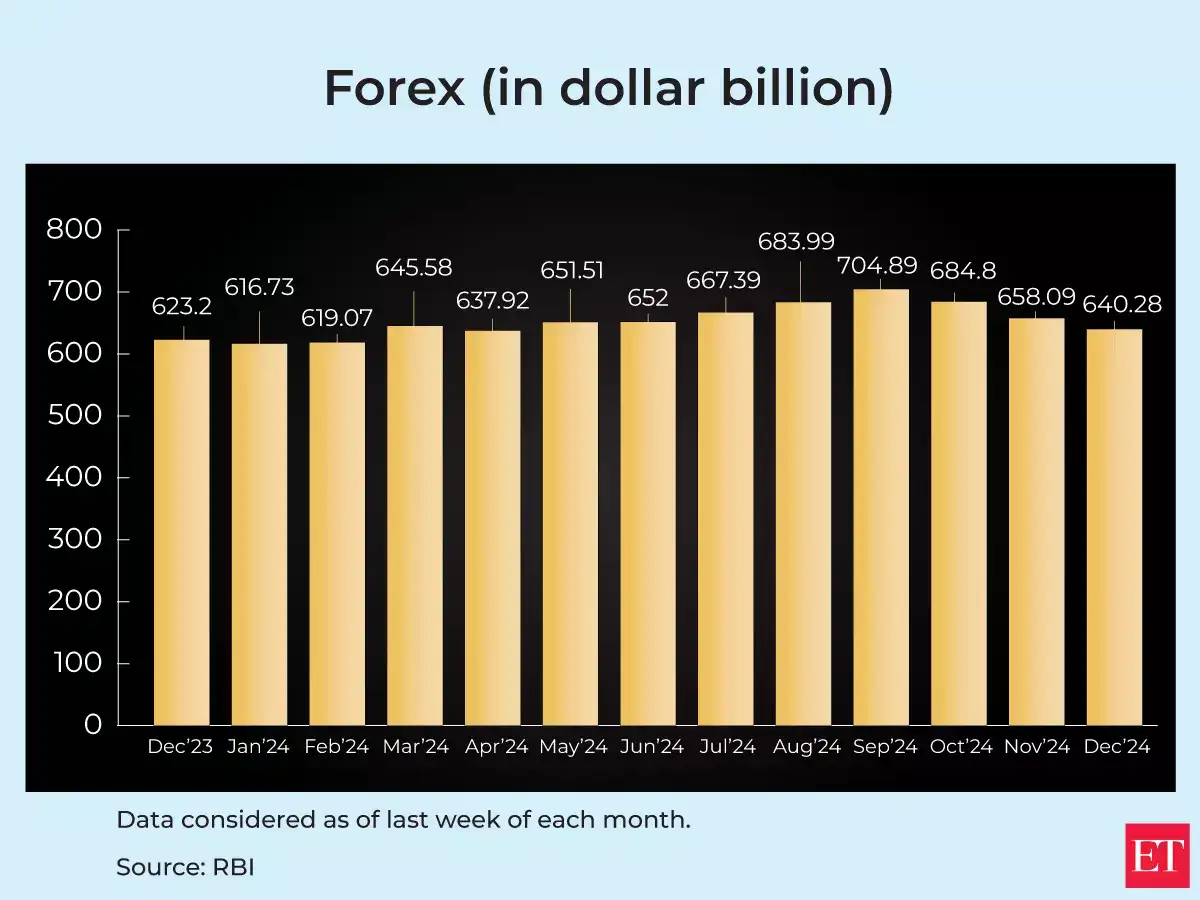
India's forex reserves fluctuate based on capital flows and the RBI's market interventions. As of late 2024, India's reserves stood at over $640 billion, making it one of the largest reserve holders in the world, typically ranking 4th or 5th globally after China, Japan, and Switzerland.
The chart below shows the trend in India's forex reserves over recent months.
The Significance of Forex Reserves
Having a large stock of forex reserves is a sign of a country's economic strength and resilience. Let's explore why these reserves are so important for India.
Foreign Exchange Reserves in India: Components, RBI’s Role
This article from Padhai.ai clearly outlines the importance of forex reserves and provides a concise summary of their current status.
Please read the section titled "Importance & Significance". Focus on the five key reasons provided: balance of trade, currency stability, external vulnerability, investor confidence, and credit ratings. After that, read the brief Conclusion section which provides a neat summary.
As detailed in the article, the significance of forex reserves can be understood through these five key functions:
- Financing Imports (Import Cover): The reserves are a critical buffer for paying for the country's imports, especially essential goods like crude oil. A common metric is "import cover," which measures how many months of imports the reserves can finance. India's current reserves provide an import cover of about 11 months, which is well above the traditional safety norm of 3-6 months.
- Maintaining Currency Stability: A healthy level of reserves empowers the RBI to intervene in the foreign exchange market. When the rupee depreciates sharply, the RBI can sell dollars from its reserves to increase the supply of dollars, thus strengthening the rupee. This "lean against the wind" policy helps prevent excessive volatility.
- Limiting External Vulnerability: Large reserves act as a self-insurance policy against external shocks, such as a sudden stop in capital inflows or a global financial crisis. It ensures India can service its external debt obligations even in stressful times, preventing a balance of payments crisis like the one faced in 1991.
- Boosting Investor Confidence: Robust reserves are a signal of macroeconomic stability to the world. They reassure foreign investors (both FDI and FPI) that the country's economy is stable and that their investments are safe from sudden currency collapses.
- Supporting Sovereign Credit Rating: International credit rating agencies like S&P, Moody's, and Fitch view a country's forex reserve levels as a key indicator of its ability to meet external debt payments. Strong reserves can contribute to a better sovereign credit rating, which in turn lowers the cost of borrowing for the government and Indian corporations in international markets.
The RBI's Role in Managing Reserves
The Reserve Bank of India Act, 1934 legally empowers the RBI to act as the custodian and manager of the country's foreign exchange reserves. Its management strategy is guided by the principles of safety, liquidity, and return, in that order of priority.
The RBI's key management functions include:
- Intervention in the Forex Market: As discussed, this involves buying or selling foreign currency (mostly US dollars) to manage the rupee's exchange rate and curb excess volatility.
- Investment and Diversification: The RBI does not simply hold the reserves as cash. It invests them in highly safe and liquid assets, such as top-rated foreign government securities (like US Treasury Bills) and deposits with other central banks. This generates returns, which, as we saw in the last lesson, form a major part of the RBI's income. The RBI has also been diversifying its reserves by increasing its holdings of gold and including other currencies in its portfolio.
- Augmenting Reserves: The RBI also takes proactive steps to increase the inflow of foreign currency. This includes measures like adjusting interest rates on Foreign Currency Non-Resident (FCNR-B) deposits to make them more attractive to NRIs, and establishing bilateral currency swap lines with other countries (e.g., Japan) to secure access to foreign currency during times of stress.
Conclusion
Let's wrap up today's discussion on India's forex reserves.
Key Takeaways:
- Composition: India's forex reserves consist of four main components: Foreign Currency Assets (FCA), Gold, Special Drawing Rights (SDRs), and the Reserve Tranche Position (RTP) with the IMF.
- Size: India holds over $640 billion in reserves, making it one of the top five reserve-holding countries globally.
- Significance: These reserves are vital for maintaining economic stability. They provide import cover, enable the RBI to manage the rupee's exchange rate, act as a buffer against external shocks, boost investor confidence, and support the country's credit rating.
- RBI's Role: The RBI is the legal custodian and manager of the reserves, guided by the principles of safety, liquidity, and return. It intervenes in the market, manages investments, and takes measures to augment the reserve stock.
Having covered the RBI's core monetary and external sector management functions, we will now shift our focus to its role in consumer protection. In the next lesson, we will examine the RBI Integrated Ombudsman Scheme, 2021, exploring its scope, coverage, and the mechanism it provides for grievance redressal for bank customers.