Welcome to our next lesson. In our previous discussion, we examined India's foreign exchange reserves and the RBI's macroeconomic role in managing them to ensure external stability. Today, we shift our focus from the macro to the micro, exploring the RBI's function as a protector of the common consumer of financial services.
A robust financial system requires not only stable institutions but also effective and accessible mechanisms for customers to resolve grievances. This lesson delves into the Reserve Bank – Integrated Ombudsman Scheme (RB-IOS), 2021. We will explore why this scheme was introduced, which institutions it covers, and the precise step-by-step process for seeking redressal. By the end of this 60-minute session, you will be able to outline the scope, coverage, and grievance redressal mechanism of this crucial scheme—a frequent topic in UPSC Prelims questions related to banking and governance.
From Fragmentation to Integration: The Need for "One Nation, One Ombudsman"
Before 2021, if a customer had a complaint, the path to resolution was fragmented. There were separate ombudsman schemes for banking, non-banking financial companies (NBFCs), and digital transactions. This created confusion about jurisdiction, led to inconsistent handling of similar complaints, and was often inefficient for the average person.
To address these challenges, the RBI consolidated these separate frameworks into a single, unified scheme. The following video provides an excellent background on the problems with the old system and the rationale behind creating the Integrated Ombudsman Scheme.
Integrated Ombudsman Scheme | One Nation One Ombudsman | ForumIAS | News Simplified | English
This video from ForumIAS clearly explains the concept of an ombudsman and the historical context that led to the creation of the RB-IOS, 2021. It effectively breaks down the 'why' behind this major reform.
Please watch the following segments to understand the evolution and purpose of the scheme: What is an Ombudsman? (00:50 - 02:55): This section introduces the general concept of an ombudsman as an independent grievance redressal authority. The Previous Fragmented System (03:14 - 04:40): Pay attention to the discussion of the three separate schemes that existed before 2021 and the problems they posed, such as jurisdictional confusion and varying compensation limits. The 'One Nation One Ombudsman' Idea (05:14 - 06:58): This part explains the core idea of the new scheme—to create a single platform for all complaints against RBI-regulated entities, thereby enhancing transparency and accountability.
The key takeaway is that the RB-IOS, 2021, was launched to simplify the process under a "One Nation, One Ombudsman" approach, providing a single point of reference for customers to file their complaints, get them resolved, and feel empowered.
The Reserve Bank – Integrated Ombudsman Scheme (RB-IOS), 2021
Let's look at the formal structure of the scheme. Your primary study material provides a concise overview of its key features.
This section from the PT365 compilation gives you a quick, exam-oriented summary of the scheme's objective, legal basis, and coverage.
Please read the subsection titled "Reserve Bank – Integrated Ombudsman Scheme". Focus on the "About", "Formation", "Objective", and "Coverage" points.
As the text highlights, the scheme was established to provide cost-free redress of customer complaints regarding ‘deficiency in service’ provided by entities regulated by the RBI.
Scope and Coverage: The 'What' and 'Who'
For the Prelims, it is vital to know exactly which entities are covered and what constitutes a valid complaint. The RBI's official FAQ page provides the most authoritative details on this.
This official FAQ from the RBI website is the definitive source for understanding the scheme's operational details. We will use it to clarify the scope and grounds for complaint.
First, read the answer to question 11, titled "Which REs are covered". This section provides a comprehensive list of the financial institutions included. Next, read the answers to questions 13 and 14, which define the basis for complaints. Pay close attention to the definition of 'deficiency in service' and, equally important, the list of complaints that are considered "non-maintainable".
Let's crystallise the key points on scope and coverage:
1. Who is covered? (Regulated Entities - REs)
The scheme is very broad and includes:
- All Banks (Commercial, RRBs, SFBs, Payment Banks, Urban Co-operative Banks with deposits ≥ ₹50 crore).
- All NBFCs with asset size ≥ ₹100 crore and having a customer interface.
- All Payment System Participants (like issuers of PPIs, UPI operators).
- All Credit Information Companies (CICs).
2. What can you complain about? (Grounds)
- The sole ground for complaint is ‘deficiency in service’. This is broadly defined as any shortcoming or inadequacy in a financial service that an RE is supposed to provide, whether it causes financial loss or not.
3. What complaints are NOT covered? (Non-Maintainable Complaints)
This is a critical area for MCQs. A complaint will be rejected if:
- You have not first approached the bank/RE with the complaint.
- You filed with the Ombudsman before 30 days have passed since you complained to the RE (unless you received a final, unsatisfactory reply).
- The complaint is made more than one year after receiving the RE's reply.
- The issue relates to the RE's commercial decision (e.g., rejecting a loan application).
- The matter is already pending in a court or tribunal.
- The complaint is frivolous or lacks sufficient details.
The Grievance Redressal Mechanism: A Step-by-Step Guide
The process is designed to be sequential and straightforward.
Step 1: Complain to the Regulated Entity
Before approaching the Ombudsman, you must first file a written complaint with the concerned bank, NBFC, or payment operator. The entity has 30 days to resolve your issue.

Step 2: File a Complaint with the RBI Ombudsman
You can escalate the complaint to the RBI Ombudsman only if:
- You do not receive a reply from the RE within 30 days.
- You are not satisfied with the reply you received.
Step 3: The Redressal Process
Once a complaint is filed, the process unfolds as follows. For a detailed breakdown of this procedure, including compensation and the appeals process, we will refer back to the RBI's FAQ page.
This is the most crucial part of the process, covering how to file, what happens next, and what remedies are available.
Please read the following sections from the RBI FAQ page: Filing the Complaint: Read the answers to questions 15 and 16 to understand when and how to file a complaint. Note the different methods: online portal, physical mail, and email. Resolution and Compensation: Read the answers to questions 22, 23, 24, and 28. Focus on the process of resolution, which can be through mutual agreement (settlement) or a binding decision (Award) by the Ombudsman. Critically, note the compensation limits: up to ₹20 lakh for direct loss and an additional ₹1 lakh for mental anguish. Appeals: Finally, read the answers to questions 31 and 32 to understand the appellate mechanism. Note who can appeal and, importantly, which decisions are non-appealable.
Let's summarize the mechanism:
- Filing: Complaints are filed centrally via an online portal (CMS), email, or physical mail to the Centralised Receipt and Processing Centre (CRPC) in Chandigarh. You don't need to know which Ombudsman office has jurisdiction.
- Resolution: The Ombudsman first attempts to facilitate a settlement between you and the RE. If that fails, the Ombudsman will examine the case and may issue an Award.
- Award: An Award is a binding directive to the RE. You have 30 days to accept it. The RE must comply with it within 30 days of your acceptance.
- Compensation: The Ombudsman can award compensation up to ₹20 lakh for financial loss and up to ₹1 lakh for harassment.
- Appeal: If you are not satisfied with the Ombudsman’s decision (either an Award or a rejection of your complaint), you can appeal to the Appellate Authority, who is an Executive Director of the RBI, within 30 days.
Significance of the RB-IOS
The integrated scheme represents a significant step forward in consumer protection in India's financial sector.
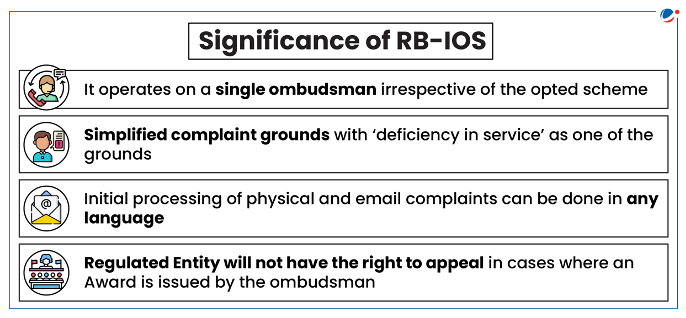
As the image summarizes, the scheme's significance lies in:
- A Single Ombudsman: A unified structure, irrespective of the type of financial institution.
- Simplified Grounds: Focusing on the single, broad concept of 'deficiency in service'.
- Language Flexibility: Initial complaints can be processed in any language, improving accessibility.
- Limited Appeal for REs: While complainants can appeal most decisions, the Regulated Entity's right to appeal is restricted, particularly against an Award issued for non-cooperation. This strengthens the Ombudsman's authority.
Conclusion
We have now covered the essentials of the RBI's flagship consumer protection mechanism. Let's recap the key takeaways for your Prelims preparation.
Key Takeaways:
- Objective: The RB-IOS, 2021, integrates three former schemes into a 'One Nation, One Ombudsman' framework for cost-free, speedy grievance redressal.
- Grounds: The single ground for complaint is 'deficiency in service' by an RBI-regulated entity.
- Coverage: The scheme covers a wide range of entities, including all banks, specified NBFCs, payment system participants, and credit information companies.
- Mechanism: A complainant must first approach the regulated entity. If unresolved after 30 days, they can file with the RBI's centralized system. The Ombudsman can facilitate a settlement or issue an Award.
- Compensation: The Ombudsman can award up to ₹20 lakh for direct loss and ₹1 lakh for mental anguish.
- Appeal: An appellate mechanism is available to the complainant (and in some cases, the RE) before an Executive Director of the RBI.
In our next lesson, we will continue exploring major RBI initiatives by turning our attention to the future of money. We will discuss the concept, architecture, and significance of the e-Rupee, India's Central Bank Digital Currency (CBDC).