Welcome to your first lesson in the Economy course. Given your goal of preparing for the UPSC CSE 2026 Prelims, we will begin with a topic that is fundamental to understanding India's macroeconomic management and a recurring theme in the examination: the Reserve Bank of India's monetary policy.
This lesson will address the first learning outcome of our course: to describe the RBI's monetary policy framework and the role, composition, and mandate of the Monetary Policy Committee (MPC). We will explore how India's approach to managing inflation and growth has evolved, and we'll dissect the institutional mechanism—the MPC—that lies at the heart of these critical economic decisions. Understanding this structure is the first step towards mastering the more complex topics that will follow.
The Foundation: What is Monetary Policy?
At its core, monetary policy refers to the set of tools and actions that a nation's central bank—in our case, the Reserve Bank of India (RBI)—uses to regulate the money supply in the economy. The primary objectives are to maintain price stability (i.e., control inflation), ensure an adequate flow of credit to productive sectors, and achieve sustainable economic growth.
Until 2016, the RBI Governor had the final say on these policy decisions. However, a major shift occurred to bring more transparency, accountability, and a diversity of expert opinion into the process. This led to the adoption of a new framework and the creation of a special committee to oversee it.
India's Monetary Policy Framework: Flexible Inflation Targeting
The modern monetary policy framework in India is known as Flexible Inflation Targeting (FIT). It was formally adopted in 2016 following an amendment to the RBI Act, 1934, based on the recommendations of the Urjit Patel Committee.
To understand this framework, let's turn to your primary study material.
Please read the introductory section from your Vision IAS PT365 document. This will provide the official definitions and the statutory basis for India's current monetary policy.
Focus on the definitions of Monetary Policy and the details under the framework itself. Pay close attention to the specific inflation target and the tolerance levels mentioned.
As you've just read, the FIT framework establishes a clear, quantitative target for inflation. Let's break down the key roles and responsibilities within this system, as this division of labour is a crucial concept for your exam:
- The Government of India: In consultation with the RBI, the government sets the inflation target once every five years. This target is defined in terms of the Consumer Price Index (CPI).
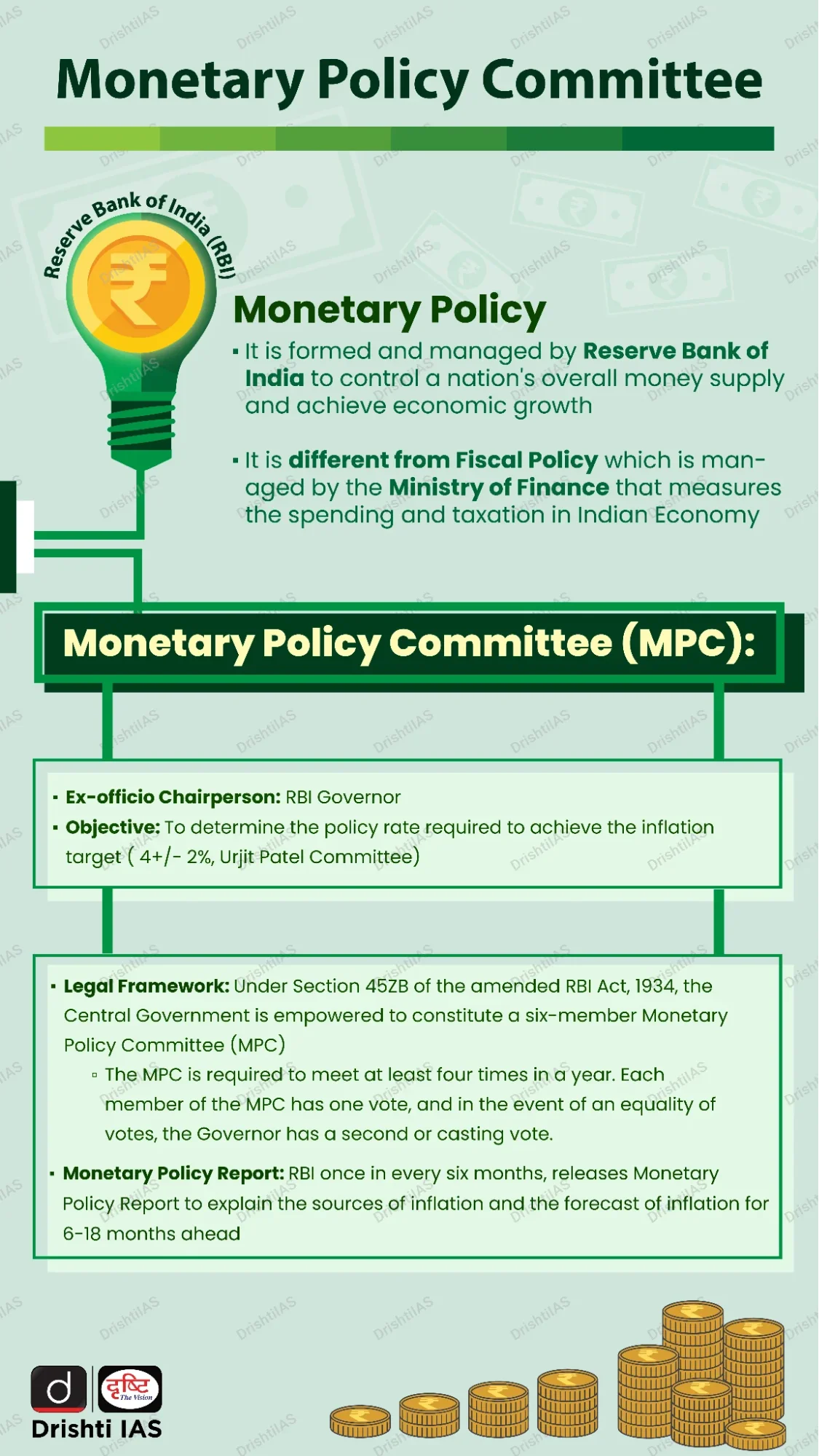
- The Target: The current target, which is effective from April 1, 2021, to March 31, 2026, is 4% CPI inflation, with a tolerance band of +/- 2%. This means the RBI is mandated to keep inflation within the range of 2% to 6%.
- The Monetary Policy Committee (MPC): This is the body tasked with deciding the specific policy actions, primarily setting the key policy interest rate (the repo rate), to achieve the inflation target.
- The Reserve Bank of India (RBI): The RBI is responsible for implementing the decisions made by the MPC.
This structure ensures that while the government sets the long-term goal, the operational decisions to achieve that goal are made by an independent expert committee, free from short-term political pressures.
The Decision-Maker: The Monetary Policy Committee (MPC)
The MPC is the cornerstone of the FIT framework. It is a statutory body, meaning it was established by an Act of Parliament through the amendment of the RBI Act, 1934 (specifically, under Section 45ZB).
Mandate and Objectives
The MPC has a dual mandate, which is critical to remember:
- Primary Objective: To maintain price stability while keeping in mind the inflation target.
- Secondary Objective: To support economic growth.
The committee must balance these two objectives. For instance, aggressively raising interest rates to curb inflation might slow down economic growth, and vice-versa. The MPC's decisions reflect its collective judgment on this trade-off at any given point.
For a comprehensive understanding of the MPC's structure and role, the following video provides an excellent and detailed breakdown.
Monetary Policy Committee | Important Economy Topics for Prelims 2024 | StudyIQ IAS English
This video from StudyIQ IAS English offers a detailed analysis of the MPC's establishment, composition, and functions, which is highly relevant for Prelims.
Please watch the following segments carefully: Establishment and Composition: The first part explains the MPC's origin and its six-member structure. Government Appointee Details: This section discusses the selection criteria for government-appointed members. Tenure of Members: Pay close attention to the distinction made in this segment between RBI members and government appointees. Function and Decision-Making: This part details the MPC's main function and how decisions are made, including the casting vote. Roles of Government, MPC, and RBI: Finally, watch this crucial explanation of how the three bodies collaborate in the monetary policy process.
Key Facts about the MPC: A Prelims-Ready Summary
Based on the video and other resources, let's consolidate the most important facts about the MPC that are frequently tested in exams.
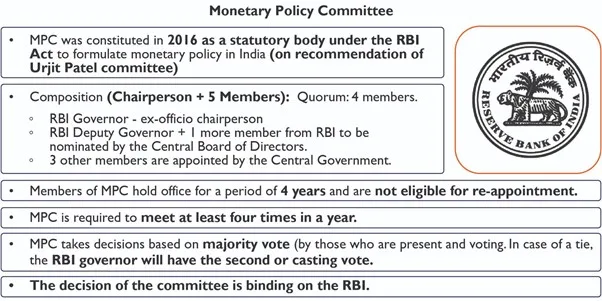
Composition (6 Members):
- Three Internal Members from the RBI:
- The Governor of the RBI (serves as the ex-officio Chairperson).
- A Deputy Governor of the RBI in charge of monetary policy.
- One officer of the RBI nominated by its Central Board.
- Three External Members:
- Appointed by the Central Government.
- These are persons of ability, integrity, and standing, with knowledge and experience in the field of economics, banking, or finance.
- They are selected by a Search-cum-Selection Committee chaired by the Cabinet Secretary.
Tenure:
- RBI Members: Their term is not fixed; they are part of the MPC as long as they hold their respective posts in the RBI.
- Government-appointed Members: They hold office for a fixed period of four years and are not eligible for re-appointment. This rule is designed to ensure their independence.
Operational Procedures:
- Meetings: The MPC is required to meet at least four times a year.
- Quorum: A minimum of four members are required for a meeting to take place.
- Decision-Making: Decisions are taken by a majority vote.
- Casting Vote: In the event of a tie (3-3), the RBI Governor has a second or casting vote. This is a powerful provision that ensures a decision is always reached.
- Transparency: The resolution adopted by the MPC is published after each meeting. Furthermore, the minutes of the proceedings must be published within 14 days, including the vote of each member and their statement of reasons.
Conclusion
In this introductory lesson, we have established the architecture of India's monetary policy. We have seen how the country moved to a more institutionalized and transparent Flexible Inflation Targeting (FIT) framework.
Here are the key takeaways:
- The primary goal of India's monetary policy is to maintain price stability (inflation control) while supporting growth.
- The framework is Flexible Inflation Targeting, with a government-set target of 4% (+/- 2%) CPI inflation.
- The Monetary Policy Committee (MPC) is a six-member statutory body responsible for setting the policy repo rate to achieve this target.
- The MPC's composition is a blend of three RBI insiders and three external experts appointed by the government.
- Decisions are made by majority, with the RBI Governor holding a crucial casting vote in case of a tie.
This foundational knowledge of the 'who' and 'why' of monetary policy is essential. In our next lesson, we will explore the 'how' by examining the specific tools and policy rates—such as the repo rate, reverse repo rate, and MSF—that the MPC uses to translate its decisions into action and influence the entire economy.