In our previous lesson, we examined the critical security vacuum that emerged in Manipur and how it was filled by a proliferation of armed actors, from resurgent insurgent outfits to newly empowered ethnic militias. We saw how the collapse of the Suspension of Operations (SoO) framework created a vicious cycle of mistrust and violence. As we concluded, these developments are often justified by narratives that point to external forces.
Today, we will directly engage with those narratives, fulfilling our next learning objective: to evaluate the argument that the conflict is exacerbated by the cross-border drug economy and complex regional geopolitics. This lesson invites you to step into the role of a critical analyst. We will dissect the potent claims that cast the conflict as a "war on drugs" or a battle against "illegal immigrants" from Myanmar. Your appreciation for sifting through competing narratives will be essential as we weigh the evidence for and against these powerful, and politically charged, arguments.
Part 1: Deconstructing the "Narco-Terrorism" Narrative
A dominant narrative, advanced by the Manipur state government under former Chief Minister Biren Singh and amplified by many Meitei civil society groups, frames the conflict not as an ethnic clash, but as a necessary "War on Drugs." This argument posits that the violence is a response to large-scale poppy cultivation in the hills, allegedly orchestrated by Kuki-Zo "narco-terrorists" to fund their operations and political demands.
Let's first visualize the geographical basis of this claim.
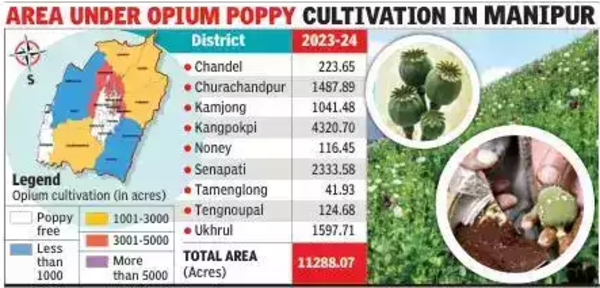
From this perspective, state actions such as evicting villagers from forest areas and withdrawing from the SoO agreement with Kuki militants were legitimate steps to curb an illicit economy that threatened the state's security and environment. The term "narco-terrorism" itself is a powerful rhetorical tool, combining the threats of drug trafficking and insurgency to label the Kuki-Zo's political aspirations and armed resistance as fundamentally criminal.
This argument connects local cultivation to a much larger geopolitical phenomenon: the Golden Triangle.

The political instability and weak governance in Myanmar, especially since the 2021 military coup, have created a perfect environment for the drug trade to flourish, with devastating spillover effects for India's Northeast.
The following video provides an excellent overview of this dynamic, explaining how Myanmar became a global hub for illicit drug production and how this fuels chaos in Manipur.
How Trouble In Myanmar Is Fueling Chaos In Manipur | Watch
This video from Mint, titled "How Trouble In Myanmar Is Fueling Chaos In Manipur," provides the broad geopolitical context for the drug economy.
Please watch the following segments to understand the scale of the cross-border drug trade: The Golden Triangle context: This introduction explains why Northeast India is vulnerable due to its proximity to Myanmar's drug-producing regions. Myanmar's drug economy: This part details how political upheaval in Myanmar has led to a surge in opium and synthetic drug production, making it the world's top opium producer in 2023. Fuelling insurgency: Here, the analyst explains how the money generated from drug smuggling is allegedly used to finance insurgent activities and corrupt state institutions in the Northeast.
Having established the official narrative and its geopolitical underpinnings, we must now turn a critical eye to its claims.
Part 2: A Politically Motivated "War on Drugs"?
The counter-narrative argues that while the drug economy is a serious problem, the "War on Drugs" has been politically weaponized. It contends that the state government has selectively targeted the Kuki-Zo community to delegitimize their political rights, justify land appropriation in the hills, and distract from the involvement of other communities, including powerful Meitei actors.
A detailed academic paper, "Ethnic Stereotypes of the Meitei-Kuki Conflict in Manipur," systematically dissects this official narrative and presents compelling counter-evidence.
[PDF] Ethnic Stereotypes of the Meitei-Kuki Conflict in Manipur
This paper by N. Pautunthang provides a robust, evidence-based critique of the dominant narratives surrounding the conflict.
Please read the following sections carefully, focusing on the evidence presented to challenge the "narco-terrorism" framework: "Poppy Plantation" (starts on page 2): This is the core section. Pay close attention to: The arrest data under the Narcotics Drugs and Psychotropic Substances (NDPS) Act, which shows the arrest breakdown by ethnicity. The high-profile case of police officer Thounaojam Brinda, who accused the Chief Minister himself of protecting a drug lord. The allegation, citing a police website, that the majority of opium processing labs are in the valley, not the hills. The evidence of Kuki community bodies taking action against poppy cultivation. The argument by social scientists that a wealthy Meitei segment plays a significant role in funding cultivation. "Narco-Terrorism" (starts on page 4): This section directly tackles the linking of drugs to Kuki armed groups. Note the points about: The state government's unilateral withdrawal from the SoO agreement, seen as a prelude to violence. The Ministry of Home Affairs data showing that all listed terrorist groups in the state are Meitei-affiliated. The refutation by Army sources of claims that SoO camps were empty or that ground rules were broken. "Summary and Conclusion" (starts on page 7): This section synthesizes the argument. Focus on the conclusion that despite the media portrayal, the conflict's root cause is not drugs but is land-related.
The debate over who truly controls and benefits from the drug economy is central to the conflict. This next video presents two opposing viewpoints that encapsulate the entire debate.
Manipur Violence | Decoded | The Political Economy of Poppy Cultivation | News9
In this NEWS9 discussion, Professor Kham Khan Suan Hausing and Colonel Laishram Jitendra Singh (Retd.) offer conflicting analyses of the political economy of poppy.
Watch these two segments back-to-back to appreciate the competing claims: The Valley Funding Argument: Professor Hausing argues that the funding for poppy cultivation originates in the valley, that the "War on Drugs" is used to victimize a specific community, and that the entire supply chain—not just the growers—must be considered. The Open Border Argument: Colonel Sapam counters that funding sources are complex and cannot be solely attributed to the valley. He points to the open border with Myanmar and potential foreign involvement as key factors.
Taken together, the evidence suggests that while poppy cultivation is rampant in the hills, the narrative of a Kuki-driven "narco-terrorist" enterprise is a gross oversimplification. The drug economy appears to be a deeply entrenched, multi-ethnic network where capital from the valley likely funds cultivation in the hills, with processing and trafficking involving actors from all communities, allegedly including a corrupt political-security nexus.
Part 3: Geopolitics, Refugees, and the "Illegal Immigrant" Trope
The second major external factor used to explain the conflict is the geopolitical situation in neighboring Myanmar. The argument, again promoted by the state government and Meitei groups, is that a large-scale influx of "illegal immigrants" from Myanmar—who are ethnically Chin-Kuki-Zo—is altering the state's demography, encroaching on forest land, and fueling the drug trade. This has led to a fervent demand for a National Register of Citizens (NRC) to identify and deport these so-called foreigners.
The International Crisis Group provides a succinct analysis of how these geopolitical factors have been weaponized.
Finding a Way Out of Festering Conflict in India's Manipur
This report explains how the former Chief Minister leveraged regional geopolitics to escalate tensions.
Please read the following excerpts from the report: In the section "B. Escalating Tensions: Land, Drugs and State Power" (page 5), read from this paragraph and the one immediately following it. Focus on how Chief Minister Biren Singh used the "tropes of illegal immigration" and allegations about the drug trade to drive a wedge between the communities. In the same section, note the analysis of how conflict in Myanmar was weaponized, with claims that arriving Chin refugees were setting up new villages and engaging in the drug trade. In the Executive Summary (page ii), read the paragraph that begins "The Myanmar conflict..." to see a concise summary of this geopolitical dimension. Finally, in the section "Strengthening New Delhi’s Response" (page 17), read the paragraph that describes the decision to scrap the Free Movement Regime as a direct policy outcome of this narrative.
Just as with the drug narrative, the "illegal immigrant" argument requires critical evaluation. The paper on "Ethnic Stereotypes" again provides a powerful, data-driven rebuttal.
[PDF] Ethnic Stereotypes of the Meitei-Kuki Conflict in Manipur
This paper also addresses the claims of a demographic invasion from Myanmar.
Please read the section titled "4.1.3. Illegal Immigration" (starts on page 3). As you read, focus on these key counter-arguments: The historical context that the Kuki presence in the region predates modern international borders. The distinction made between a small number of refugees and a mass influx of illegal immigrants. The census data analysis from 1901 to 2011, which shows that there has been no extraordinary rise in the Kuki population.
Conclusion: Evaluating the Arguments
In this lesson, we have evaluated the argument that the Manipur conflict is exacerbated by the cross-border drug economy and regional geopolitics. Our analysis reveals a complex picture where real external factors are systematically manipulated for internal political ends.
Here are the key takeaways:
- Real Factors, Weaponized Narratives: The cross-border drug trade originating from the Golden Triangle and the instability in Myanmar are undeniably significant external pressures. They provide a steady flow of illicit funds, arms, and refugees into the region.
- The Politics of Blame: The core issue is not the existence of these problems, but their political weaponization. A narrative has been constructed to selectively blame the Kuki-Zo community for these complex, multi-actor phenomena, branding them as "narco-terrorists" and "illegal immigrants."
- A Pretext for Internal Goals: These narratives serve as a powerful pretext to advance specific political goals within Manipur. They are used to justify a crackdown on tribal land rights, legitimize the state's withdrawal from peace processes like the SoO, and criminalize the Kuki-Zo community's political aspirations for autonomy.
- Evidence vs. Narrative: A critical evaluation of the evidence reveals a reality far more complex than the official narrative suggests. The drug economy involves powerful actors from multiple communities, and historical and demographic data do not support the claim of a large-scale "illegal" demographic invasion.
Ultimately, while the drug economy and Myanmar's instability are accelerants, they are not the ignition switch. They pour gasoline on a fire whose embers—conflicts over land, identity, and political power—have been smoldering in Manipur for decades.
This concludes our analysis of the conflict's many drivers. We have explored the historical context, the immediate triggers, the role of the state, the rise of armed groups, and the influence of external factors. In our final lesson on Manipur, we will look forward and assess the profound long-term challenges to reconciliation and political resolution in the deeply fractured state.