Welcome to the final lesson in our module on the Manipur crisis. Over the past five lessons, we have meticulously unpacked the anatomy of this conflict. We started with the historical and ethno-geographical fault lines, examined the immediate triggers like the High Court ruling, and analyzed the controversial responses of the state and central governments. We then delved into the security vacuum, the breakdown of peace agreements, and the weaponization of external factors like the drug economy and cross-border migration.
Having built this comprehensive understanding, we now turn to the most critical and challenging question, which forms our final learning outcome for this module: to assess the long-term challenges to reconciliation and political resolution in Manipur. This lesson moves beyond diagnosing the conflict's causes to evaluating the immense barriers that stand in the way of a lasting peace. Given your preference for analyzing complex, multi-faceted issues, this session will synthesize all we've learned to construct a forward-looking assessment of why this crisis has the tragic hallmarks of a "protracted" conflict.
Part 1: The Great Divide - Physical and Psychological Separation
The most immediate and stark challenge to reconciliation is that the Meitei and Kuki-Zo communities no longer live together. The violence that began in May 2023 has resulted in a near-total physical separation, enforced by a "buffer zone" patrolled by central security forces. This geographical partition, however, is merely the outward manifestation of a much deeper psychological and social chasm.

An article in the Economic and Political Weekly describes this process as an undesired "distancing" that has seeped into every level of society.
Meitei–Kuki Crisis: Heading Towards a “Protracted” Conflict
This article frames the core challenge: the conflict is showing signs of becoming long-drawn due to the deep, multi-level fissures between the communities.
Please read the introduction and the following two sections to grasp the scale of this separation: Start with the introduction, which sets the stage for a "protracted" conflict and the "scar" it will leave. Read the section "The May Conflict", focusing on how the competition for land and the politics of indigeneity have created a situation where no common ground exists. Continue to "Unwanted 'Distancing'". This section details how the divide is reflected in the displacement and disruption of daily life, and how even state institutions like the police have become segregated.
This "distancing" is not just about geography; it's about the complete collapse of trust. Every interaction is viewed through a lens of suspicion, and shared public spaces have vanished. This creates a vicious cycle where the absence of contact reinforces negative stereotypes and prevents the human-to-human interaction necessary for empathy and reconciliation.
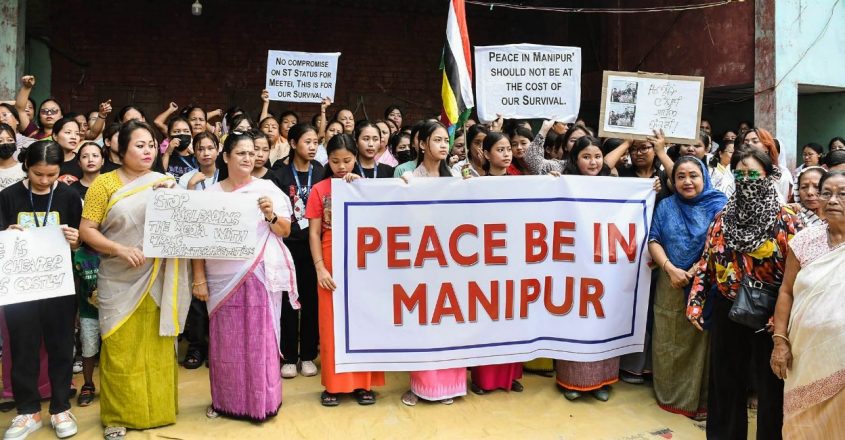
Part 2: The Political Impasse - Irreconcilable Demands
The profound societal divide is mirrored by an intractable political deadlock. The core demands of the two communities have hardened into seemingly non-negotiable, mutually exclusive positions.
-
The Kuki-Zo Demand for a "Separate Administration": Before the conflict, the demand was for greater autonomy within Manipur, possibly through territorial councils. Now, after the targeted violence and perceived state complicity, the demand has escalated. Kuki-Zo leaders and civil society insist that peaceful coexistence within a Meitei-dominated state is impossible. They are demanding a "Separate Administration," likely a Union Territory administered directly by the central government.
-
The Meitei Opposition to Territorial Division: For a significant section of the Meitei community, Manipur's territorial integrity is sacrosanct, rooted in the history of the pre-colonial Meitei kingdom. Any move to carve out a separate administrative unit from the state is seen as a betrayal and an unacceptable dismantling of their historical homeland.
This creates a perfect political impasse. In the following interview, Professor Kham Khan Suan Hausing, a leading academic voice from the Kuki-Zo community, explains why he believes a united Manipur is no longer a viable option.
Manipur Peace Needs Separate Administration for Kukis, Truth & Reconciliation Process with Meiteis
This segment from an interview on The Wire with Karan Thapar features Professor Hausing making the case for a separate administration.
Watch the segment from this discussion on a separate administration. Pay close attention to his reasoning: he argues that the complete demographic and geographical separation, coupled with the existential threat perceived by the Kukis, makes it impossible to imagine living together under the same political roof. Notice how he also addresses the counter-argument about the Nagas' similar demand and the potential economic viability of a separate Kuki territory.
While the demand for a separate administration has become central for the Kuki-Zo, it remains a red line for the Meitei and a deeply complex constitutional challenge for the central government. A comprehensive report by the International Crisis Group outlines this deadlock and explores the faint possibility of a middle path.
Finding a Way Out of Festering Conflict in India's Manipur
This report from the International Crisis Group provides a detailed analysis of the conflict's endgame. We will focus on the sections that lay out the opposing political demands and potential resolutions.
Please read the following parts of the report: At the end of Section III, "The Conflict Erupts", read the final three paragraphs. Focus on how the physical separation has led the Kuki-Zo to view the conflict as a "war for survival," making a separate administration a non-negotiable demand, while the Meitei remain "dead set against any change." Now, jump to Section V, "Finding a Way Out", and read the subsection "B. Peace Talks". This part discusses potential, albeit extremely difficult, political solutions. Pay attention to the proposals for addressing the core grievances: For the Meitei, finding ways to regulate land sales in the valley to allay demographic fears, without granting the contentious ST status. For the Kuki-Zo, exploring a compromise short of a Union Territory, such as extending the Sixth Schedule provisions that exist in neighboring states. This would create autonomous district councils with significant powers but still within the state of Manipur.
This highlights the monumental challenge: any viable solution requires both communities to step back from their maximalist positions, something that seems nearly impossible in the current climate of extreme mistrust and fear.
Part 3: The Security Quagmire
A lasting political resolution is unattainable without first establishing a secure and neutral environment. However, the security landscape in Manipur is another long-term challenge, characterized by a proliferation of armed groups and a near-total collapse of faith in state institutions.
Key security challenges include:
- Resurgence of Militant Groups: The conflict has given a new lease of life to dormant Meitei and Kuki-Zo insurgent outfits, which have re-emerged as key players, providing training and firepower to their respective communities.
- Rise of New Militias: The emergence of powerful and popular Meitei militias like Arambai Tenggol and Meitei Leepun has created a new, uncontrolled layer of armed actors. Their perceived impunity and alleged links to the state government have shattered any notion of state neutrality.
- The Disarmament Dilemma: Thousands of sophisticated weapons were looted from state armories at the start of the conflict, primarily by Meitei mobs. These weapons remain in circulation. Disarmament is essential for peace, but it is fraught with difficulty. Neither side will disarm voluntarily as long as they believe the other remains armed and the state cannot be trusted to protect them.
- Erosion of Trust in Security Forces: The Manipur Police is widely seen as having fractured along ethnic lines. The Kuki-Zo community views the police as partisan, while many Meitei view the central forces, like the Assam Rifles, with suspicion, accusing them of siding with the Kukis.
The International Crisis Group report details this dangerous security environment and the perils of inaction by the central government.
Finding a Way Out of Festering Conflict in India's Manipur
This section of the report explains how the failure to control violence has empowered a range of armed actors, creating a self-perpetuating cycle of conflict.
Please read Section IV, "The Perils of Inaction". Focus on these subsections: "A. Militant Groups": Note the analysis of how both Meitei and Kuki-Zo militant groups have become re-embedded in the conflict, complicating peace processes like the Suspension of Operations (SoO) agreement. "B. New Organisations in the Conflict": This part explains the dangerous rise of militias like Arambai Tenggol and the role of women's groups like the Meira Paibi in obstructing security operations. "C. Perceived State Bias": This crucial part discusses how the central government's inaction has been interpreted by both sides as partisanship, leading to a situation where people feel they have no alternative but to arm themselves for self-defense.
Part 4: The Elusive Path to Reconciliation
Even if a political and security solution could be brokered, the deepest wounds are psychological and emotional. Reconciliation requires confronting the horrific truths of the conflict—the killings, the lynchings, the sexual violence—without letting the process devolve into mutual recrimination.
Two main pathways for reconciliation are often discussed:
1. Truth and Reconciliation Commission:
Inspired by post-apartheid South Africa, this would involve creating a formal body for victims to share their stories and perpetrators to confess their culpability, potentially in exchange for amnesty. The goal is to establish a shared truth as a basis for healing and forgiveness.
In the interview with The Wire, Professor Hausing and Karan Thapar debate the viability of this model in Manipur.
Manipur Peace Needs Separate Administration for Kukis, Truth & Reconciliation Process with Meiteis
This part of the interview explores the pros and cons of a Truth and Reconciliation Commission for Manipur.
Please watch the segment from the discussion on a Truth and Reconciliation process. Note the key points of the debate: Professor Hausing argues it is essential for communities to learn to live as peaceful neighbors, even if they are administratively separated. He cites the Naga reconciliation process as a successful regional precedent. Karan Thapar raises a critical concern: in the Indian context, could it become "truth and recrimination"? They also touch upon the crucial lack of a towering, neutral figure who could lead such a process.
2. Indigenous, Bottom-Up Peacebuilding:
An alternative or complementary approach focuses on grassroots initiatives, often led by women, that draw on traditional methods of conflict resolution and community dialogue. This model bypasses the high-stakes politics and aims to rebuild trust from the ground up.
In a FRANCE 24 debate, activist Binalakshmi Nepram passionately advocates for this approach.
Inside India's ignored conflict: Where is Manipur's path to reconciliation? • FRANCE 24 English
This video presents a different perspective on peace, emphasizing historical coexistence and the power of women-led, indigenous initiatives.
Please watch these segments: Bin Lakshmi Nepram's opening statement: She argues the conflict was "engineered" and that Manipur has a long history of peaceful coexistence that can be revived. She criticizes the "divide and rule" policy. Explaining indigenous peacebuilding: Here, she elaborates on the concept, which involves women's networks working across ethnic lines to foster dialogue and confidence-building. How the initiative works: Towards the end of the debate, she provides more detail on how her organization facilitates peace congregations and works through village-to-village networks built over decades.
Both approaches face enormous hurdles. The top-down, political approach is stymied by the lack of trust in institutions, while the bottom-up, grassroots approach, while vital, may struggle to influence the hard political and security structures that perpetuate the conflict.
Conclusion
This lesson concludes our in-depth study of the Manipur crisis. As we have assessed, the path to reconciliation and political resolution is obstructed by a formidable array of challenges that have become deeply interwoven.
Here are the key takeaways:
- A Divided Society: The conflict has created a near-total physical and psychological separation between the Meitei and Kuki-Zo communities, eliminating shared spaces and hardening mutual suspicion.
- Political Deadlock: The core political demands—a "Separate Administration" for the Kukis and the preservation of Manipur's "territorial integrity" for the Meiteis—appear irreconcilable, creating a zero-sum impasse.
- A Proliferation of Arms: The security situation is dangerously unstable, with a mix of resurgent militant groups, new militias, and armed civilian volunteers, all operating in an environment of profound distrust towards state security forces.
- The Intangible Wounds: Overcoming the trauma of extreme violence requires a process of truth, justice, and reconciliation. However, both formal (Truth Commission) and informal (grassroots) approaches face immense obstacles due to the lack of trusted leaders and institutions.
The Manipur crisis is not just an event; it is an ongoing condition. It serves as a sobering case study of how historical grievances, when inflamed by political opportunism and state failure, can lead to a societal breakdown that may take generations to heal.
Having explored this complex issue of identity and conflict in Manipur, our next module will shift to another part of the Northeast to examine a different, yet related, challenge. We will investigate the history and consequences of the National Register of Citizens (NRC) in Assam, exploring the profound human and political fallout of the state's attempt to define citizenship and identify "foreigners."