In our last lesson, we explored the deep-seated historical and ethno-geographical fault lines that divide Manipur, establishing the competing grievances of the valley-based Meiteis and the hill-based tribal communities. We saw how a legacy of colonial policy and post-independence law created a volatile environment of mutual suspicion.
Now, we shift our focus from this long-term context to the proximate causes of the conflict. This lesson will analyze the immediate triggers of the devastating violence that erupted in May 2023. Our primary focus will be on the controversial Manipur High Court order regarding the Meitei community's demand for Scheduled Tribe (ST) status, and how a protest against this order became the spark that ignited the state. This analysis will allow us to bridge the gap between historical grievances and the outbreak of modern conflict.
The Demand for ST Status: A Contentious Request
As we discussed, one of the central grievances of the Meitei community is the feeling of being a "besieged majority," confined to the Imphal Valley without the ability to purchase land in the hill areas, a right protected for tribal communities. For decades, a key demand from certain Meitei groups has been their own inclusion in the Scheduled Tribe (ST) list.
To understand the arguments surrounding this demand, let's turn to a video that lays out the competing perspectives.
Manipur Violence & Meiteis Demand For ST Status | Shoot-At-Sight Order Issued in Manipur | UPSC 2023
This segment from BYJU'S IAS clearly articulates the long-standing demand by Meiteis for ST status and the reasons for the strong opposition from Naga and Kuki groups.
Please watch the portion from "even they have demanded ST status". As you watch, focus on the rationale presented by both sides: Meitei Argument: They seek ST status primarily to protect their ancestral land, culture, and language, which they feel are under threat. Tribal Opposition: They argue that the Meiteis, as the state's demographic and political majority with a constitutionally recognized language, do not require these special protections and that granting them ST status would dilute the benefits reserved for genuinely marginalized tribal communities.
This long-simmering debate was thrust into the center of state politics in the spring of 2023. On March 27, 2023, the acting Chief Justice of the Manipur High Court issued a directive to the state government. The court asked the government to "consider the case of the petitioners for inclusion of the Meetei/Meitei community in the Scheduled Tribe list, expeditiously, preferably within a period of four weeks".
This judicial intervention was the critical event that set the stage for the conflict.
The Trigger: The Solidarity March and the Outbreak of Violence
The High Court's directive sent shockwaves through the hill communities. They viewed it not as a procedural matter, but as an existential threat. The fear was that if the Meiteis were granted ST status, it would nullify the land protections enshrined in the Manipur Land Revenue and Land Reform (MLR&LR) Act, opening the door for the politically dominant Meiteis to acquire ancestral tribal lands in the hills.
In response, the All-Tribal Students' Union Manipur (ATSUM) and other tribal bodies called for a "Tribal Solidarity March" across all hill districts on May 3, 2023, to protest the court's order.
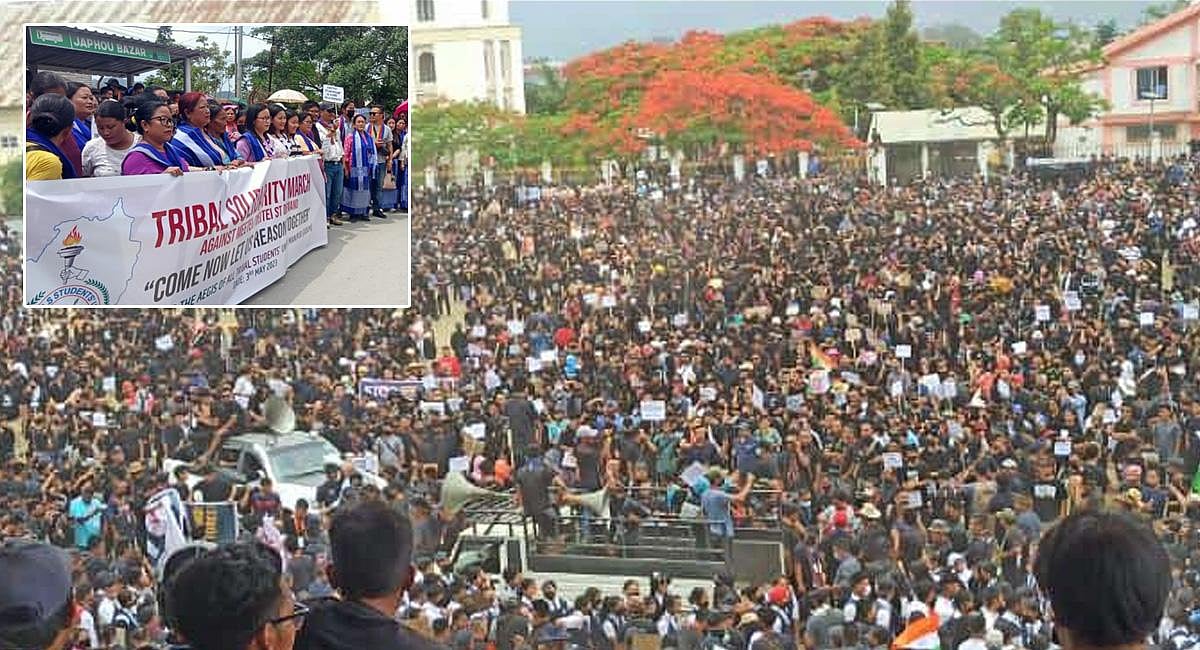
This march was the immediate flashpoint. To understand exactly how the situation spiraled out of control, we will consult a detailed academic paper and a report from the International Crisis Group.
[PDF] Manipur's Ethnic Divide: Inside the Meitei-Kuki Conflict
This research paper provides a clear account of the outbreak of violence, connecting it directly to the solidarity march.
Please read the section titled "The Outbreak of Violence". Pay close attention to the sequence of events: the march organized by ATSUM, the counter-blockades, and the initial reports of arson in Churachandpur district.
The violence began in Churachandpur district, a Kuki-Zo majority area bordering the valley. While accounts of the initial incident vary, a key report from the International Crisis Group provides a specific and widely cited narrative.
Finding a Way Out of Festering Conflict in India's Manipur
This report details the initial clash that triggered the widespread violence.
Read the section titled "The Conflict Erupts". Note the specific event that triggered the first clash: the attempted arson of the Anglo-Kuki War centenary memorial gate in Churachandpur by suspected Meitei miscreants, which led to immediate clashes with the Kuki-Zo community.
As both resources describe, what began as a protest quickly descended into chaos. Clashes at the border of the hills and valley escalated into retaliatory attacks. Homes and places of worship were set ablaze, and within hours, the violence had spread, leading to a complete breakdown of law and order and the forced displacement of tens of thousands of people along ethnic lines.
Analyzing the Trigger: A Spark in a Tinderbox
Was the High Court order the sole cause of the conflict? While it was undeniably the immediate spark, many analysts argue that it was merely the final provocation in an already explosive environment. Your preference for layered analysis is key here, as the situation is far more complex than a single cause and effect.
In the months leading up to May 2023, the state government, led by Chief Minister N. Biren Singh, had undertaken a series of actions that were perceived by the Kuki-Zo community as deeply discriminatory and hostile.
Let's examine these contributing factors, which created the "tinderbox" environment.
Manipur Violence & Meiteis Demand For ST Status | Shoot-At-Sight Order Issued in Manipur | UPSC 2023
The same BYJU'S IAS video we watched earlier also provides an excellent summary of the other factors that raised tensions immediately before the May 3rd violence.
Please watch the segment from "believe that there is another link". This section explains two crucial background events: Evictions and the "War on Drugs": The state government's drive to evict alleged illegal settlements and clear poppy fields in the hill areas, which the Kuki community felt unfairly targeted them. Withdrawal from SoO Agreement: In March 2023, the state government unilaterally withdrew from the Suspension of Operations (SoO) agreement—a ceasefire pact—with two major Kuki armed groups, accusing them of fomenting unrest.
These actions, particularly the withdrawal from the SoO agreement, were seen by the Kuki community as a declaration of hostility by the Meitei-dominated state government. It dismantled a key institutional framework for peace and signaled a more confrontational approach.
This brings us to a central debate: was the High Court order the true cause, or was it a convenient catalyst for a conflict that was already brewing? The following discussion between legal experts and analysts offers compelling, competing perspectives.
In Manipur, 10 Months On, Can This High Court Order Bring Peace For Meitei & Kukis I Barkha Dutt
This panel discussion from Mojo Story, recorded months after the conflict began, reflects on the role of the High Court order.
Watch the following clips to appreciate the nuances of the debate: Introduction: Barkha Dutt frames the High Court order as the "trigger point" or "catalyst." Legal Invalidity: A lawyer explains that the order was never legally sustainable, as only the executive (through the President) has the power to alter ST lists, a point later affirmed by the Supreme Court. A "Facade"?: Panelists debate whether the ST demand was the real reason or a "facade" for pent-up anger over other issues like the eviction drives and the "War on Drugs." This directly addresses the complexity of causation. "Multi-Layered Problem": The discussion concludes that the order's subsequent modification changes little on the ground because the conflict is a "multi-layered problem" rooted in a deep "trust deficit."
This debate highlights a critical point: while the High Court order and the subsequent solidarity march were the direct, observable triggers, they landed on fertile ground prepared by decades of historical grievances and, more immediately, by a series of provocative state actions that had already pushed inter-communal tensions to a breaking point.
Conclusion
In this lesson, we have moved from the deep historical context to the immediate events that triggered the Manipur violence in May 2023. Let's summarize the key takeaways:
- Primary Trigger: The Manipur High Court's directive to the state government to consider ST status for the Meitei community acted as the primary, immediate trigger for the conflict.
- The Flashpoint: The "Tribal Solidarity March" on May 3, 2023, organized in protest against this order, became the flashpoint, with violence erupting in Churachandpur district and quickly spreading.
- A Multi-Layered Crisis: The trigger cannot be seen in isolation. It was the spark in a tinderbox of pre-existing tensions, inflamed by recent state government actions including eviction drives, a controversial "War on Drugs," and the withdrawal from ceasefire agreements with Kuki armed groups.
- Competing Analyses: The role of the court order is itself a subject of debate, with some seeing it as the direct cause and others as a "facade" for deeper, more immediate political grievances against the state government.
With an understanding of both the long-term context and the immediate triggers, we are now equipped to analyze the response to the crisis. In our next lesson, we will examine the actions—and inactions—of the state and central governments once the violence began, and the intense political controversy that has surrounded their handling of the conflict.