Welcome to the next stage of our analysis of the Manipur crisis. In our previous lessons, we unpacked the deep-seated historical context and then zoomed in on the immediate triggers of the May 2023 violence. We now have a solid understanding of why the conflict erupted. This lesson shifts our focus to the crucial question of what happened next, by analyzing the responses of the state and central governments to the crisis and the intense political controversies that have surrounded their actions and inactions.
Your preference for dissecting issues into distinct analytical layers is particularly useful here. We will treat the government response as the third critical layer, examining how the machinery of the state—at both the regional and national level—functioned, or failed to function, once law and order collapsed. We will explore the competing narratives that seek to explain and critique these responses, allowing you to form your own assessment of a deeply contested issue.
The State Government: Accusations of Partisanship
When the violence erupted on May 3, 2023, the state's law-and-order machinery collapsed with shocking speed. One of the most critical failures was the breakdown of the state police force, which reportedly fractured along ethnic lines. Meitei police personnel were seen as unable or unwilling to protect Kuki-Zo citizens in the valley, and Kuki-Zo police were similarly ineffective in Meitei areas, with many fleeing to their respective ethnic strongholds.
This collapse of the state's primary security institution put the role of the state government, led by Chief Minister N. Biren Singh of the BJP, under intense scrutiny. The Kuki-Zo community, and many independent observers, accused the government of partisanship, arguing that as a Meitei-led administration, it either failed to protect the Kuki-Zo or was actively complicit in the violence against them. This sentiment is vividly captured in the protests that took place.
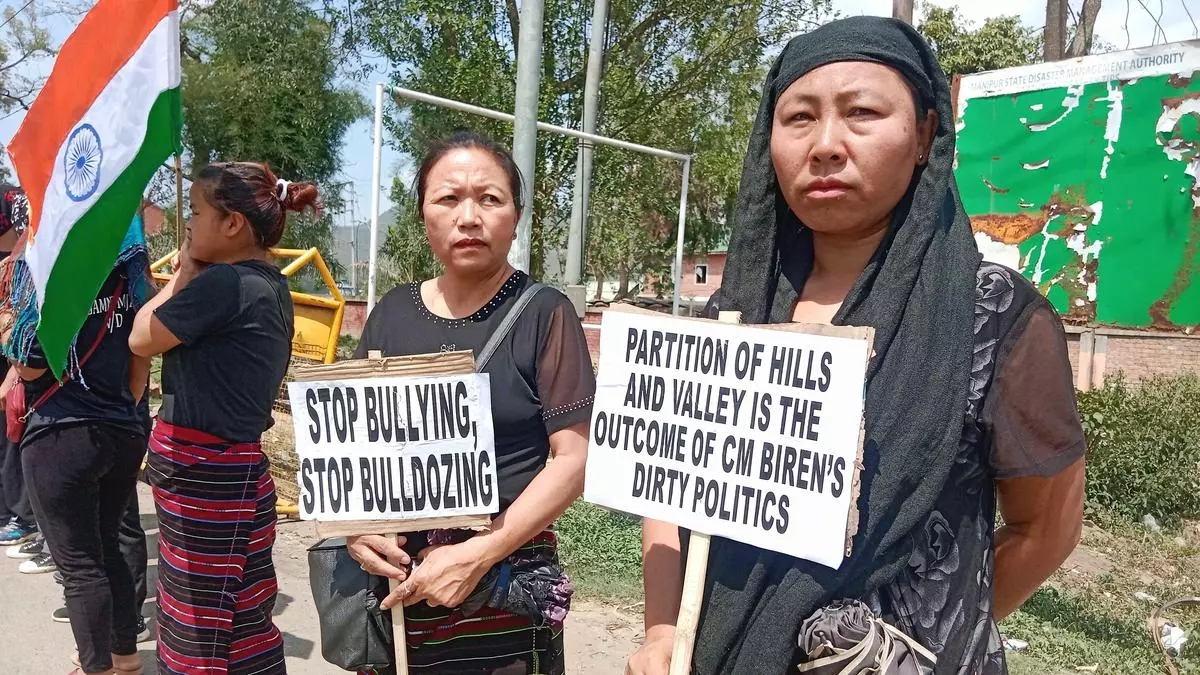
The state government, however, has vehemently rejected these accusations. It has consistently articulated a counter-narrative, positioning its actions not as biased but as necessary measures to address long-standing issues of illegal immigration and demographic change.
In response to The Hindu Editorial, Manipur government says it's not ...
This article from The Hindu details the Manipur government's official rebuttal to its critics. It provides a direct look into the narrative promoted by the state administration.
Please read the article in its entirety. As you read, focus on the key pillars of the state government's argument: Its assertion that the drive to identify illegal immigrants was a primary reason for the violence. The claim that it is providing humanitarian aid to immigrants, countering allegations of stigmatization. The justification for its actions by citing historical immigration and the formation of a cross-community Cabinet sub-committee to address the issue. Its use of data on poppy cultivation and drug seizures to link the conflict to a "narco-terrorist" angle, primarily targeting the Kuki-Zo hills.
The state government's position frames the conflict as a response to its legitimate crackdown on illegal activities. However, this narrative is sharply contested. The International Crisis Group, in a detailed report, outlines how the actions of the Biren Singh government in the months and years leading up to the violence were perceived by the Kuki-Zo as a direct assault on their community.
Finding a Way Out of Festering Conflict in India's Manipur
This report from the International Crisis Group provides a critical analysis of the state government's role.
In the report, please read the section titled "B. Escalating Tensions: Land, Drugs and State Power". This section directly addresses the actions that fueled Kuki-Zo resentment. Focus on how the report describes the Chief Minister's policies, such as questioning land ownership, the "war on drugs" campaign that was directed at the Kuki-Zo, and the unilateral decision to pull out of the ceasefire agreement with Kuki militant groups.
These two resources present the core of the political controversy surrounding the state government: a government defending its actions as necessary statecraft versus a community that views those same actions as a targeted, ethnically-motivated campaign that set the stage for violence and left them unprotected when it began.
The Central Government: A Crisis of Intervention
With the state machinery in disarray, the responsibility to control the situation fell to the central government in New Delhi. The Centre's response can be characterized by a few key actions and several significant controversies.
Immediate Actions:
- Deployment of Troops: The central government deployed tens of thousands of troops from the Indian Army and various Central Armed Police Forces (CAPFs), such as the Assam Rifles and the CRPF.
- Creation of a Buffer Zone: To halt the immediate violence, central forces established a "buffer zone" separating the Meitei-dominated valley from the Kuki-Zo-inhabited hills. This de facto partition of the state reduced large-scale clashes but created a tense, segregated geography.
- Unified Command: A central government official was appointed to head the "unified command" of all security forces, technically superseding the Chief Minister's authority in security matters, though the practical effectiveness of this move remains debated.
Despite these steps, the central government's response has been heavily criticized, primarily for what is perceived as delayed engagement, political indifference, and a failure to take decisive political action.

One of the most significant political controversies has been the Prime Minister's public silence on the issue for over two months and his decision not to visit the state, a point heavily criticized by the opposition.
Manipur | CM Biren Singh says PM Modi's visit to Manipur is a non-issue | #manipur
This NEWS9 Live debate encapsulates the political battle over the Prime Minister's role. It presents the opposing viewpoints of the Congress and the ruling BJP.
Please watch the following segments to understand the competing perspectives: CM's Defense: CM Biren Singh defends the PM, stating that a physical visit is a "non-issue" as the Centre is guiding all efforts remotely. Rahul Gandhi's Critique: Rahul Gandhi argues that it is crucial for the PM to visit, listen to the people, and offer a "healing touch." Political Impact: Panelists discuss how the 2024 election results, where the BJP lost both seats in Manipur, have amplified the opposition's criticism of the government's handling of the crisis. Symbolic Importance: An analyst explains the symbolic significance of a Prime Ministerial visit in conveying national solidarity and catalyzing peace efforts. A Voice from Manipur: Listen to the powerful statement in Parliament by Angomcha Bimol Akoijam, the newly elected MP from Inner Manipur, who questions how such a tragedy could unfold in one of India's most heavily militarized zones.
Beyond the optics of the Prime Minister's absence, critics argue that the central government's response has been "ad-hoc" and "knee-jerk," lacking a coherent strategy to resolve the underlying political issues.
Manipur is “like a Civil War” but Government Response is “Ad Hoc and Knee-Jerk”- Congress Manipur MP
In this interview with The Wire, Professor Bimol Akoijam, the MP from Inner Manipur, offers a sharp, academic critique of the government's response.
Watch these key portions of his analysis: "Knee-Jerk Reaction": Dr. Akoijam dismisses the deployment of troops and suspension of the internet as ad-hoc measures, and provocatively suggests the government's mishandling might be deliberate. The Call for President's Rule: He discusses the Congress party's call for the President to intervene, clarifying that this is not a simple demand for President's Rule but a call to hold the central government itself accountable for its complicity in the crisis. A Four-Point Plan: Dr. Akoijam outlines a clear four-point plan he would suggest to the Prime Minister, focusing on unified government messaging, restoring trust in security forces, rejecting sectarian political demands, and initiating a civil society dialogue.
The Politics of Inaction and Bias
The central government's perceived reluctance to act decisively has led to accusations of bias from both communities, a point thoroughly examined in the Crisis Group report.
Finding a Way Out of Festering Conflict in India's Manipur
This report analyzes the failures of government intervention and the resulting perceptions of bias.
Please read the following sections: Start at the end of Part III, focusing on the failure of the central government's first major political initiative: the peace committee, which collapsed because the Kuki-Zo refused to participate alongside CM Biren Singh. Read the section "C. Perceived State Bias". It details how both the Meitei and Kuki-Zo interpret the Centre's inaction through the lens of bias. The Kuki-Zo cite the failure to remove the CM and the selective application of laws, while the Meitei advance a theory that the Centre allowed the conflict to fester for its own strategic ends. Finally, read "A. Strengthening New Delhi’s Response". This section highlights the Centre's reluctance to acknowledge the state government's failure due to the "double engine government" slogan and notes that Prime Minister Modi only spoke about the crisis after a viral video caused national outrage. It argues that the eventual imposition of President's Rule (a hypothetical scenario in this forward-looking report) presents an opportunity for a more decisive response.
The analyses from these resources paint a picture of a state government seen as a party to the conflict and a central government criticized for a response that was too little, too late, and colored by political calculations. The failure to establish a credible peace process, coupled with the deep-seated mistrust in state institutions, has allowed the conflict to fester.
Conclusion
In this lesson, we have dissected the complex and controversial responses of the state and central governments to the Manipur crisis. Let's consolidate the key takeaways:
- State Government's Role: The N. Biren Singh-led state government has been widely accused of partisanship and failing to protect the Kuki-Zo community. It has defended its actions by framing the conflict as a response to illegal immigration and the drug trade.
- Central Government's Response: The Centre's primary interventions were the deployment of security forces and the creation of a buffer zone. However, it has been heavily criticized for a delayed political response, the Prime Minister's prolonged silence, and a failure to initiate a credible peace process.
- Competing Narratives of Bias: Both the Meitei and Kuki-Zo communities interpret the central government's actions (and inaction) as being biased against them, highlighting the complete erosion of trust.
- Political Controversy: The government's handling of the crisis has become a major political flashpoint, with the opposition accusing the BJP's "double engine government" of a catastrophic failure and demanding accountability from the highest levels.
The inability of either the state or central government to effectively disarm the population and restore order is inextricably linked to the resurgence of old militant outfits and the emergence of new armed militias. In our next lesson, we will analyze the role these armed groups have played in escalating the conflict and examine the breakdown of the critical Suspension of Operations (SoO) agreements.