Introduction
In our previous lesson, we established the foundational allegations of the Pegasus controversy. We identified the spyware as a powerful "zero-click" cyber-weapon sold exclusively to governments and examined the politically significant pattern of its alleged targets in India, which included journalists, opposition leaders, activists, and even a dissenting election commissioner. This led to the central accusation that a tool meant for national security was potentially used for political surveillance.
Having understood the "what" and the "who" of the case, we now turn to the "so what." This lesson will analyze the profound constitutional questions raised by these allegations. Our focus will be squarely on the clash between the state's claimed security imperatives and the fundamental rights of citizens. We will explore the constitutional implications for three pillars of Indian democracy: the right to privacy, the freedom of dissent, and the freedom of the press.
The Right to Privacy Under Threat
At the heart of the Pegasus controversy lies the fundamental right to privacy. While not explicitly written into the Constitution in one place, the Supreme Court has affirmed that it is an intrinsic part of the "right to life and personal liberty" guaranteed under Article 21.
The landmark 2017 judgment in K.S. Puttaswamy v. Union of India declared privacy to be a fundamental right. The court ruled that any state infringement upon this right must pass a strict four-part test:
- Legality: The action must be sanctioned by law.
- Legitimate Aim: The state must be pursuing a legitimate goal (e.g., national security).
- Proportionality: The infringement must be necessary for and proportionate to the aim. It should be the least intrusive measure possible.
- Procedural Safeguards: There must be procedures to prevent misuse.
The petitioners in the Pegasus case argued that the use of such invasive spyware, which grants total access to a person's digital life, is a grossly disproportionate violation of privacy. The Supreme Court took these arguments seriously in its order to establish an investigative committee.
The following reading from the Supreme Court's judgment in Manohar Lal Sharma vs. Union of India beautifully articulates the court's perspective on privacy in the digital age and its constitutional importance.
Manohar Lal Sharma vs Union Of India on 27 October, 2021
This section of the Supreme Court's order explains how the right to privacy is rooted in Article 21 and the Puttaswamy judgment. It sets the stage for why surveillance is not just a technical issue but a matter of fundamental rights.
Please read the part of the judgment under the heading "C. Nuances of the Right to Privacy". Focus on the paragraphs starting from this discussion. Pay attention to how the Court contrasts the "property centric" origins of privacy in the West with the "people centric" 'right to life' basis in India.
As the judgment highlights, privacy is not a concern for just journalists or activists; it is an expectation for every citizen in a democratic society. A tool like Pegasus, with its 'zero-click' infection and total data access, presents an unprecedented challenge to this fundamental right, raising serious questions about whether its use could ever be considered "proportionate."
Dissent, Speech, and the 'Chilling Effect'
The constitutional implications of surveillance extend beyond privacy to the freedom of speech and expression, guaranteed by Article 19. The threat is not just that the government might hear what you say, but that the fear of being heard will stop you from speaking at all. This phenomenon is known as a "chilling effect."
When individuals—be they opposition politicians, social activists, or ordinary citizens—believe they might be under surveillance for criticizing the government, they are likely to self-censor. This erodes the culture of open debate and questioning that is essential for a functioning democracy. The Supreme Court, in its Pegasus order, explicitly recognized this danger, particularly for the press.
Manohar Lal Sharma vs Union Of India on 27 October, 2021
Here, the Supreme Court directly connects surveillance to the 'chilling effect' and its assault on the public-watchdog role of the press.
Please continue reading the judgment, focusing on the section titled "D. Freedom of the Press and the Chilling Effect". Read the passage starting from this analysis of the chilling effect on free speech and the press.
The targeting of politically engaged individuals, as was alleged in the Pegasus case, sends a powerful message that dissent carries a high price. The petitioners argued that this was not an accidental byproduct of surveillance but its very purpose: to create an atmosphere of fear and silence opposition. This argument, as you've read, resonated strongly with the court.
The following news debate features veteran journalist N. Ram discussing the Supreme Court's recognition of this chilling effect.
Pegasus Probe Order: Is The Privacy Of Citizens Paramount? | Left, Right & Centre
This clip from an NDTV discussion highlights the real-world impact of the court's observations on the chilling effect, especially from a media perspective.
Please watch two short segments from this discussion: First, watch the anchor's summary of the potential chilling effect on the citizenry. Then, watch N. Ram's analysis of the court's statements on the impact on the press and the importance of protecting sources.
The Fourth Estate Under Siege: Freedom of the Press
While the chilling effect impacts all citizens, its effect on the press has unique constitutional significance. The press is often called the "fourth estate" for its role as a watchdog holding power accountable. This role is impossible to fulfill without two key things: freedom from fear and the ability to protect sources.
Investigative journalism often relies on whistleblowers and insiders who speak to reporters on the condition of anonymity. If a journalist's phone is compromised by spyware, that anonymity evaporates. The spyware can reveal not just the source's identity but the entire communication history, putting the source at grave risk. This effectively cripples the ability of the press to uncover inconvenient truths.
Furthermore, it undermines the public's "right to know," which the Supreme Court has held is an integral part of the freedom of speech. A muzzled press leads to an uninformed citizenry, which in turn weakens democratic accountability.
The petition filed by senior journalists N. Ram and Sashi Kumar explicitly lays out this argument.
[PDF] IN THE SUPREME COURT OF INDIA CIVIL ORIGINAL ...
This petition details the specific arguments on how surveillance compromises the right to free speech, the freedom of the press, and the public's right to know.
Please read the section titled "Right to freedom of speech and expression". Start from the paragraph that begins, "That the conscious targeting..." and continue through to the discussion on the "right to know."
The State's Defense: The 'Bugbear' of National Security
In response to the allegations, the government's consistent position in Parliament and the courts was to neither confirm nor deny the use of Pegasus. Instead, it invoked national security, arguing that disclosing such information would compromise intelligence operations and aid terrorists.
This created the central conflict of the case: a direct clash between the government's claim of a national security prerogative and the judiciary's mandate to protect fundamental rights.
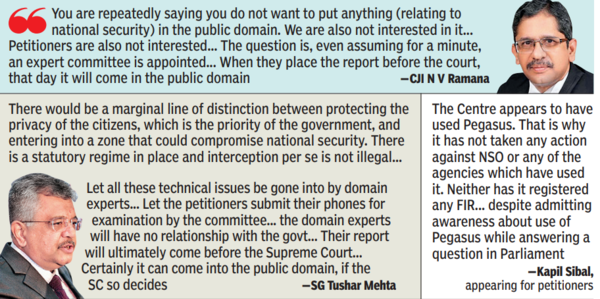
The Supreme Court's response to this defense was perhaps the most forceful part of its order. The Court stated that while it is mindful of national security, it cannot be used as a "free pass" to bypass accountability. The mere invocation of the phrase does not render the judiciary a "mute spectator."
Manohar Lal Sharma vs Union Of India on 27 October, 2021
This is a pivotal section of the judgment where the court establishes the limits of the national security argument and asserts its power of judicial review.
Please read the section titled "F. Scope of Judicial Review". Focus on the paragraphs that begin "It is a settled position of law...".
The court essentially told the executive that it cannot simply say "national security" and expect all questions to cease. It must, at a minimum, provide some justification to the court, even if not made public, to show that its actions are constitutionally valid. The government's refusal to do so is what ultimately prompted the court to appoint its own independent committee.
Conclusion
In this lesson, we have moved beyond the factual allegations of the Pegasus case to analyze its deep constitutional implications. We've seen how alleged state-sponsored surveillance strikes at the very heart of the rights that underpin Indian democracy.
Here are the key takeaways:
- Right to Privacy (Article 21): The use of invasive spyware like Pegasus represents a potentially disproportionate violation of the fundamental right to privacy, as established in the K.S. Puttaswamy judgment.
- Freedom of Speech and Dissent (Article 19): Widespread surveillance creates a "chilling effect," discouraging citizens, activists, and the opposition from speaking freely and holding the government accountable.
- Freedom of the Press (Article 19): It specifically undermines the media's role as a public watchdog by threatening journalists and their ability to protect their sources, thereby impairing the public's right to know.
- National Security vs. Fundamental Rights: The Supreme Court forcefully rejected the idea that "national security" can be used as a blanket excuse to avoid judicial scrutiny when fundamental rights are at stake.
We have now explored the allegations and the constitutional principles at stake. In our next lesson, we will examine the executive's response to the controversy more closely—its specific statements in Parliament and its legal strategy in the Supreme Court—before moving on to assess the findings of the court-appointed Technical Committee.