Introduction
In our previous lesson, we examined the executive's strategic refusal to confirm or deny its use of Pegasus, a stance that ultimately led the Supreme Court to appoint an independent Technical Committee to investigate the matter. The court's intervention, as you'll recall, was a direct response to the government's argument that "national security" could serve as a blanket shield against accountability.
This lesson picks up exactly where we left off, focusing on the work and outcomes of that very committee. Our goal is to critically assess the committee's findings—and, just as importantly, its limitations. We will dissect what the committee was able to uncover, what remained unanswered, and why the investigation concluded in an atmosphere of anticlimax and secrecy. This analysis will complete our factual exploration of the Pegasus controversy, setting the stage for our final debate on surveillance and democracy.
The Committee's Mandate and Composition
When the Supreme Court established the committee in its October 2021 judgment, it was not merely outsourcing the problem. It was creating a specialized agent of the court to conduct the complex fact-finding necessary to adjudicate a case involving fundamental rights and sophisticated technology.
The committee was structured in two tiers:
- A three-member Technical Committee of cybersecurity and digital forensics experts to handle the hands-on examination of devices.
- An overseeing authority led by a retired and highly respected Supreme Court judge, Justice R.V. Raveendran, to supervise the probe and produce a final report. Justice Raveendran was assisted by two other experts, including a former head of India's external intelligence agency, R&AW.

The court gave the committee a clear and extensive mandate, essentially a list of questions it needed answered. You can read a summary of this mandate in the following article from The Indian Express.
Explained: The findings of the Pegasus committee, and what we ...
This article provides a concise overview of the committee's purpose and its terms of reference.
First, in the section "But why was a committee needed in the first place?", read the explanation of its role as a fact-finding agent of the court. Then, under "What was this committee supposed to do?", review the terms of reference, which outline the committee's core tasks, from determining who procured the spyware to recommending future policy frameworks.
As you can see, the committee's job was twofold: to determine the facts of the specific allegations and to recommend broader reforms for a legal framework on surveillance.
The Findings: A Tale of Malware and Non-Cooperation
After several months, the committee submitted its report to the Supreme Court in a sealed cover in August 2022. The full report was not made public. Instead, the-then Chief Justice of India, N.V. Ramana, made a few key observations in open court. These oral remarks are our primary source for understanding the committee's findings.
The NDTV news report below provides a succinct summary of what the Chief Justice revealed on that day.
Pegasus Case: "Government Not Cooperating" - Supreme Court Cites Report
This news clip from NDTV captures the immediate announcement from the Supreme Court regarding the committee's report.
Watch the first minute of the video. Pay close attention to the two central findings revealed: first, the results from the forensic analysis of the submitted phones (malware found), and second, the committee's experience with the executive branch (government non-cooperation).
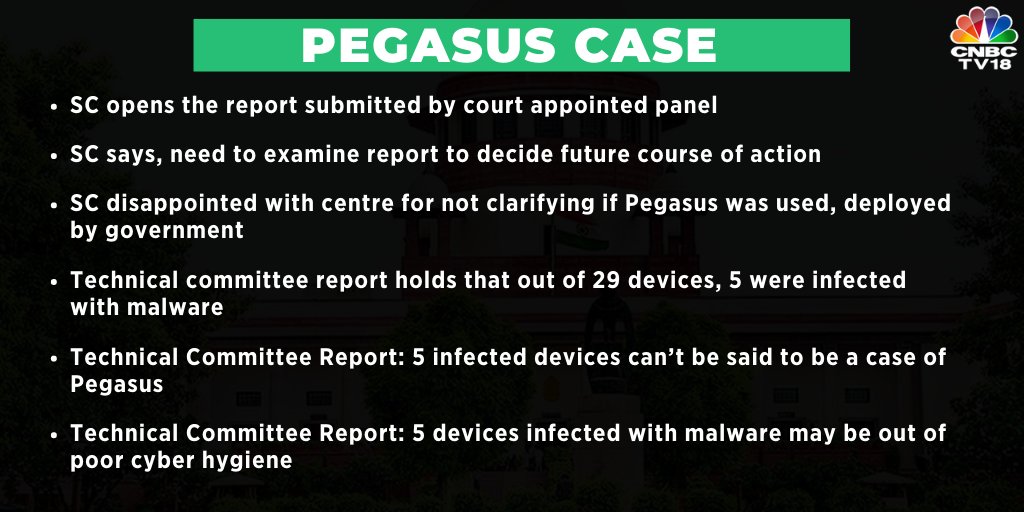
To summarize and consolidate these points, the committee's report concluded:
- Forensic Analysis: Of the 29 phones submitted to the committee by the alleged victims, five were found to be infected with some form of malware.
- Inconclusive Attribution: However, the committee could not conclusively determine if the malware found in those five devices was, in fact, Pegasus. The report noted that some findings could be attributed to "poor cyber hygiene."
- Government Non-Cooperation: The most critical finding was that the Union Government "did not cooperate" with the investigation, adopting the same non-committal stance it had taken before the Court.
Assessing the Limitations: Why the Anticlimax?
The committee's findings were widely seen as an anticlimax. Despite the Supreme Court's strong initial intervention, the inquiry failed to provide a definitive answer to the central question: Did the Indian government use Pegasus to spy on its citizens? To assess the committee's work, we must analyze its significant limitations, which stem directly from the findings.
Limitation 1: Technical Inconclusiveness
The failure to definitively identify Pegasus spyware on the infected devices was a major setback. While the full technical report is not public, several factors could explain this:
- Sophistication of the Spyware: Pegasus is designed to be stealthy and can even be programmed to self-destruct or remove traces, making forensic detection exceptionally difficult, especially long after an infection.
- Government Non-Cooperation: Without the government's cooperation, the committee had no reference points. It could not, for instance, compare the malware on the phones to a known signature of Pegasus that might have been provided by a government agency, nor could it examine government servers or procurement records.
Limitation 2: The "Stone Wall" of Non-Cooperation
The government's refusal to cooperate was the single biggest obstacle. It continued the strategy of evasion we discussed in the previous lesson. By stonewalling the committee, the executive effectively blocked the investigation into the most crucial terms of reference:
- Was Pegasus procured by any state or central agency?
- Which agency and individuals were responsible?
- Under what law or policy was this done?
The committee could analyze phones, but it could not force the state to incriminate itself. This limitation transformed the inquiry from a potentially explosive fact-finding mission into a technical exercise with no conclusive outcome.
Limitation 3: The Sealed Cover and Judicial Inaction
Perhaps the most profound limitation is the one that followed the submission of the report. Despite the Chief Justice's initial oral commitment to make the report public (with redactions for privacy), it was quickly re-sealed and has remained in the "safe custody" of the court ever since. The case, which was supposed to be heard again in four weeks, has not been listed for a hearing in over two years.
This judicial inaction represents a significant institutional limitation. The initial momentum for transparency and accountability has dissipated, leaving the entire matter in a state of suspended animation. The following article provides a critical perspective on this phase.
Indian Supreme Court's Silence on Pegasus Legitimizes Spying on ...
This analysis from the Center for the Study of Organized Hate critiques the aftermath of the committee's report, focusing on the lack of transparency and judicial follow-through.
Please read the section that details the events in court on August 25, 2022. Start from the paragraph beginning with "A day before...", which recounts CJI Ramana's oral observations about the government's non-cooperation and the committee's findings. Then, pay close attention to the final part of the section, which describes how the report was ultimately kept under wraps, despite the initial promise of transparency.
The decision to keep the report sealed has effectively ended the public and legal chapter of the Pegasus inquiry in India, leaving the core allegations neither proven nor disproven.
Conclusion
In this lesson, we have assessed the findings and limitations of the Supreme Court-appointed committee on the Pegasus allegations. We moved from the high hopes accompanying its formation to the anticlimactic and opaque reality of its conclusion.
Here are the key takeaways:
- Committee's Findings: The committee confirmed the presence of malware on five of the 29 examined devices but could not conclusively identify it as Pegasus. Its most significant finding was that the Union Government did not cooperate with the probe.
- Key Limitations: The investigation was fundamentally limited by the technical difficulty of detecting Pegasus, the government's refusal to provide any information, and finally, the Supreme Court's own decision to keep the report sealed and not pursue further hearings.
- Unresolved Questions: As a result, the central questions of who procured and deployed the spyware against Indian citizens remain officially unanswered, leaving a critical gap in accountability.
We have now examined the Pegasus controversy from multiple angles: the nature of the allegations, the constitutional principles at stake, the executive's response, and the judiciary's ultimately inconclusive investigation. In our final lesson for this module, we will synthesize these elements to debate the enduring tension between the state's invocation of "national security" and the democratic imperatives of privacy, dissent, and accountability.