Introduction
Over the past few lessons, we have systematically dissected the Pegasus controversy in India. We began with the core allegations and the types of individuals targeted, moved on to the constitutional crisis it precipitated regarding the right to privacy, analyzed the executive's stonewalling tactics under the cloak of "national security," and finally, assessed the anticlimactic and inconclusive findings of the Supreme Court-appointed committee.
In this concluding lesson for the module, we will synthesize these threads to address the fundamental conflict at the heart of this entire affair. Our goal is to move beyond the specific facts of the Pegasus case and debate the enduring philosophical and political tension between a state's arguments for surveillance in the name of national security and the foundational imperatives of democratic accountability. This is not a question with an easy answer, but rather a central dilemma for any modern democracy.

The Argument for Security: The State's Prerogative
Any robust debate must begin by acknowledging the validity of each position. The argument for state surveillance is grounded in one of the most fundamental duties of any government: protecting the nation and its citizens from threats, both foreign and domestic. Proponents of strong state surveillance capabilities argue that in an age of sophisticated terrorism, cyber warfare, and organized crime, the state requires equally sophisticated tools to maintain security.
The Indian legal framework has long recognized this necessity. Fundamental rights, including the right to privacy, are not absolute. Let's explore the legal basis for this argument.
[PDF] NATIONAL SECURITY AND PRIVACY - WHICH SIDE WILL THE ...
This academic paper provides an excellent overview of the legal foundations for both state security claims and privacy rights. It directly addresses the tension we are debating.
First, read the section "Absolutism of a Fundamental Right" (pp. 2-3). This section establishes the crucial legal principle that the right to privacy, while fundamental, can be subject to "reasonable restrictions" in the service of a "compelling public interest." Next, read the section "National Security Concerns" (pp. 3-5). Pay close attention to the specific laws cited, namely Section 5(2) of the Telegraph Act and the IT Act, which provide the legal pathways for government interception of communications. Finally, review the brief section "Government Privilege in Evidence Act" (p. 6). This explains the legal basis, under the Indian Evidence Act, for the government's ability to withhold sensitive documents in court, a tactic central to its response in the Pegasus case.
As you've read, the state's position is not arbitrary; it rests on established constitutional principles and statutory law. The argument can be summarized as follows:
- Existential Threats: India faces significant security challenges that require intelligence gathering.
- Reasonable Restrictions: The Constitution itself permits limitations on fundamental rights for reasons of national security and public order.
- Legal Framework: Laws like the Telegraph Act and IT Act provide a (theoretically) regulated mechanism for such surveillance.
- State Secrecy: The state has a legal privilege to withhold information related to the "affairs of the State" to protect its operational security.
In essence, from this perspective, tools like Pegasus, if used within this legal paradigm against genuine security threats, are a necessary, if potent, component of the state's security apparatus. The refusal to publicly confirm or deny their use is seen as a tactical necessity to avoid revealing intelligence methods to adversaries.
The Argument for Accountability: The Democratic Imperative
The counter-argument is not that national security is unimportant, but that allowing the state to operate powerful surveillance tools without transparency or oversight poses an existential threat to democracy itself. The very nature of Pegasus—its total, undetectable intrusion—and the identity of its alleged targets in India (journalists, opposition leaders, judges, activists) shift the debate from one of security to one of political control.
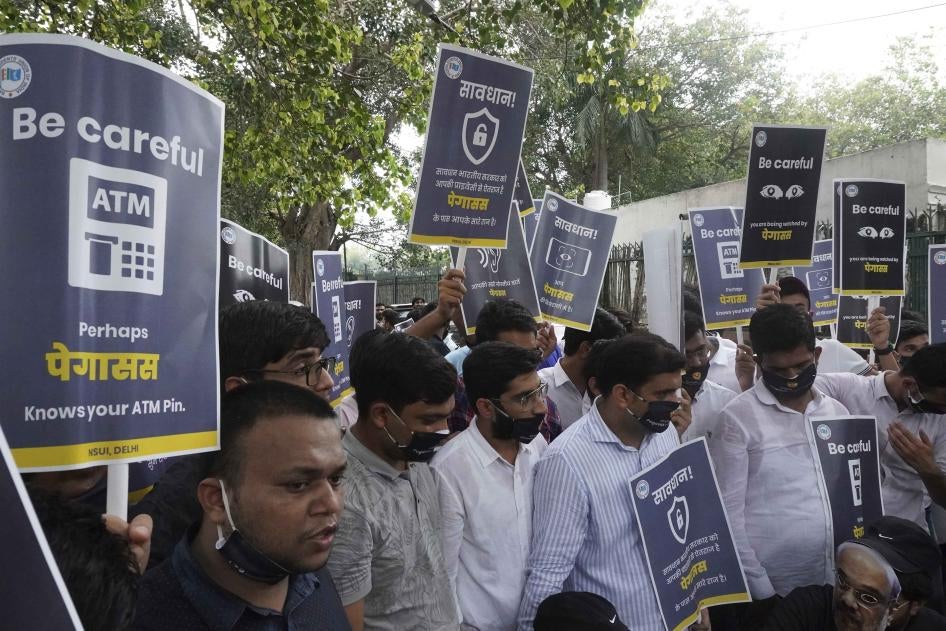
The core of the democratic argument rests on several pillars:
1. The Chilling Effect on Fundamental Rights:
Widespread or targeted surveillance creates a "chilling effect" that deters free expression. Journalists may self-censor, lawyers may fear speaking to clients, and activists may hesitate to organize. This erosion of free speech and association hollows out democratic discourse. The Supreme Court itself acknowledged this danger in its initial order on the Pegasus case.
Pegasus Probe Order: Is The Privacy Of Citizens Paramount? | Left, Right & Centre
This NDTV debate on the Supreme Court's order explains the court's reasoning for intervening.
First, listen to the anchor summarize the court's key pronouncements, especially the line that national security cannot be a "free pass" and that judicial review is always possible. Then, watch the segment where the court's concern about a potential "chilling effect" on the citizenry is discussed.
2. The Bypassing of Due Process:
The existing legal framework for surveillance, while granting power to the state, includes procedural safeguards (e.g., written orders, high-level authorization). A tool like Pegasus, as experts testified to the SC committee, bypasses these safeguards entirely. It is a form of extra-legal surveillance that is not governed by any regulatory mechanism, rendering the existing laws moot.
The Pegasus Probe: Depositions Before the Technical Committee
The depositions made before the Supreme Court committee offer powerful arguments for democratic accountability.
Skim the summaries of these three depositions: Dr. Sashi Menon: Focus on his point that Pegasus bypasses legal requirements and has no governing framework. Hon'ble MP John Brittas: Note his argument about the lack of accountability and the need for oversight of intelligence agencies. Mr. Siddharth Varadarajan: Read his argument that intelligence agencies cannot evade responsibility simply because a law doesn't exist for a specific new technology.
3. The Subversion of Democratic Institutions:
When surveillance is turned inward against the pillars of democracy—the press, the opposition, the judiciary—it ceases to be a tool of national security and becomes a tool of political power. It undermines the separation of powers and the checks and balances necessary for a functioning democracy. The final word in this debate perhaps belongs to the whistleblower who started the global conversation on mass surveillance, Edward Snowden.
Pegasus Explained | Will the Supreme Court committee’s report protect Indians from spyware?
This video from The Wire concludes with a powerful reflection on the ultimate stakes of the Pegasus affair.
Watch the final segment of the video, starting from Edward Snowden's commentary on the universal threat of such spyware. Then, listen carefully to the narrator's conclusion about why the truth is "politically explosive" and what it means for democracy itself.
The Unresolved Tension
We are left with two compelling but conflicting positions. The state asserts its sovereign right and duty to protect the nation, using secrecy as its shield. Civil society and constitutional watchdogs assert the citizen's right to privacy and the democratic imperative of accountability, demanding transparency as their sword.
The Pegasus case in India did not resolve this tension; it merely exposed its depth. The government successfully used the "national security" argument to evade accountability in both Parliament and the Supreme Court. The court, while initially championing transparency, ultimately acquiesced by sealing the committee's report and indefinitely postponing hearings.
This leaves us with critical, unanswered questions that define the current state of Indian democracy:
- Who gets to decide when the "specter of national security" is a genuine threat versus a "free pass" for political surveillance?
- In the absence of a strong data protection law and robust parliamentary oversight of intelligence agencies, what prevents the abuse of surveillance technology?
- Can a democracy survive if its citizens believe, rightly or wrongly, that they can be placed under total surveillance at any moment, without cause, and with no legal recourse?
The paper on "National Security and Privacy" captures this dilemma perfectly in its conclusion.
[PDF] NATIONAL SECURITY AND PRIVACY - WHICH SIDE WILL THE ...
Let's return to this paper for a final, synthesizing thought.
Read the short paragraph that begins with "A critical aspect..." (p. 6). This paragraph neatly summarizes the "trade-off" and offers a crucial warning.
The warning that "national security must not become a justification for a surveillance state" is the key takeaway. The debate is not about choosing between security and liberty, but about establishing the robust legal and institutional frameworks that ensure the pursuit of security does not lead to the death of liberty.
Conclusion
In this final lesson on the Pegasus controversy, we have moved from the specific details of the case to the profound principles it implicates. We have debated the tension between the state's claimed need for surveillance and the democratic demand for accountability.
Here are the key takeaways from our debate:
- The National Security Argument: The state has a legitimate duty to protect the nation and possesses legal grounds (e.g., "reasonable restrictions," "government privilege") to conduct surveillance and maintain secrecy.
- The Democratic Accountability Argument: Unchecked surveillance has a "chilling effect" on fundamental rights, bypasses due process, and can be used to subvert democratic institutions like the press and the opposition.
- An Unresolved Dilemma: The Pegasus affair in India concluded without resolving this tension. The government successfully stonewalled all attempts at accountability, and the judiciary's intervention ultimately faded, leaving the core questions unanswered and the balance between security and liberty more precarious than ever.
This module has explored a critical stress point in India's democratic fabric related to state power and individual rights. In our next module, "Restructuring Representation," we will pivot to a different, but equally consequential, structural challenge: the brewing conflict over political representation, federalism, and demographic shifts, beginning with the complex and intertwined issues of delimitation and women's reservation.