Introduction
In our last module, we delved into the complex interplay between state power, surveillance, and civil liberties through the lens of the Pegasus controversy. We concluded by debating the unresolved tension between the state's invocation of national security and the democratic imperative of accountability.
We now pivot from a crisis centered on individual rights to a looming structural crisis concerning collective representation. This module, "Restructuring Representation," tackles the politically charged issues that will define India's federal balance in the coming decade. Our first topic is delimitation—a seemingly technical process with profound political consequences. In this lesson, we will explain the process of delimitation and uncover the precise reasons why the number of seats in the Lok Sabha has been frozen since the 1970s, a decision that has essentially kicked a political can down the road for half a century.
The Principle and Process of Delimitation
At its core, delimitation is the act of redrawing the boundaries of electoral constituencies for the Lok Sabha and State Assemblies. It is the foundational mechanism for translating population into political representation.
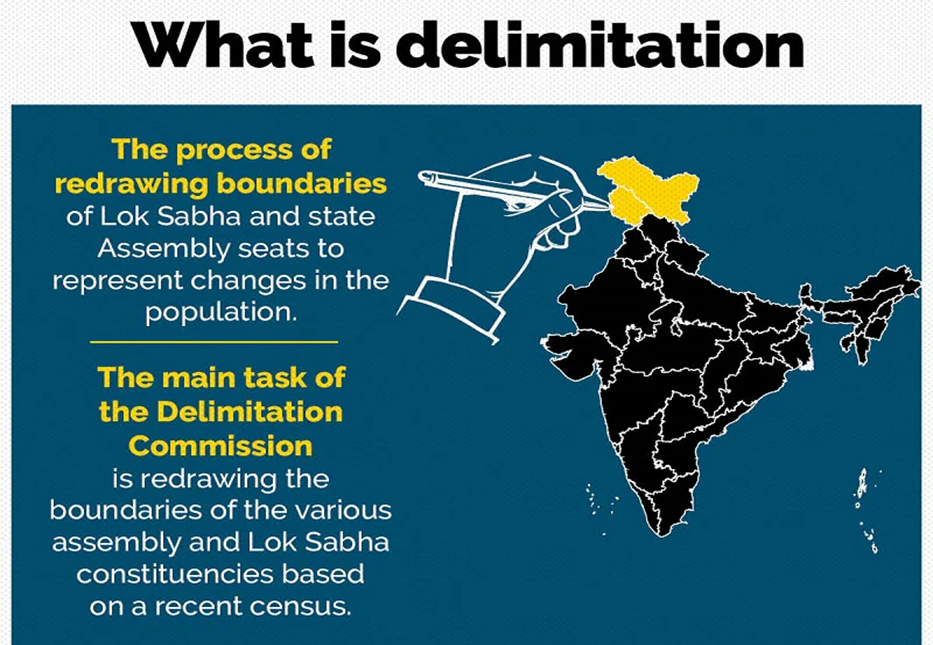
The guiding principle behind this process is the democratic ideal of "one person, one vote, one value." For this ideal to be meaningful, each elected representative should, as far as practicable, represent a roughly equal number of people. Because populations are not static—they grow at different rates and migrate—constituency boundaries must be periodically revised. Without this revision, vast disparities can emerge, where a Member of Parliament (MP) from one constituency might represent five times as many people as an MP from another, fundamentally violating the principle of equal representation.
The following video explains this core concept and the constitutional necessity for delimitation.
Delimitation Commission of India: Key Constitutional Provisions | UPSC Polity | Sleepy Classes
This video from Sleepy Classes IAS provides an excellent introduction to the purpose of delimitation.
Watch the segment from the beginning up to the explanation of vote value. Pay close attention to the example given of two constituencies with vastly different populations. It clearly illustrates how unequal populations can devalue an individual's vote.
As the video explains, the process is not arbitrary. It is rooted in the Constitution itself. To formalize this understanding, let's look at the specific constitutional framework.
India's Delimitation Dilemma: Challenges and Consequences
This article from The India Forum clearly lays out the constitutional basis and democratic purpose of delimitation.
Please read the first several paragraphs of the article, from the beginning down to the section titled "Need for periodic revision". Focus on the discussion of Article 81 and Article 170 (2), which provide the ground rules for carving out Lok Sabha and Assembly constituencies, respectively, with the goal of maintaining population parity.
To carry out this constitutionally mandated task, Parliament, through an Act, establishes a Delimitation Commission. This is a high-powered, independent body whose orders have the force of law and cannot be challenged in any court. This institutional design is meant to insulate the highly political process of drawing electoral boundaries from partisan influence.
The History of Delimitation and the Great Freeze
Following independence, India followed the constitutional script. Delimitation Commissions were set up after the censuses of 1951, 1961, and 1971, and they dutifully readjusted constituency boundaries and reallocated the number of seats for each state in the Lok Sabha.

This regular, decennial process ensured that the principle of "one person, one vote, one value" was broadly maintained. However, this rhythm was abruptly halted in 1976 during the Emergency. The 42nd Constitutional Amendment Act introduced a freeze, decreeing that both the allocation of seats to states in the Lok Sabha and the total number of seats in State Assemblies would be frozen based on the 1971 census figures. This freeze was initially intended to last until the year 2000.
Why was this drastic step taken? The rationale was directly linked to a major national policy priority of the time: family planning and population control. By the 1970s, it was clear that different states were having vastly different levels of success in this area. The southern states, in particular, were implementing population control measures more effectively than many northern states.
This created a political paradox. Under a strict population-based representation system, the states that succeeded in controlling their population would be "penalized" by losing their share of seats in the Lok Sabha to states where the population was growing faster. This would create a powerful disincentive for state governments to pursue the national goal of population stabilization.
The following video provides a very clear explanation of this political logic.
Delimitation 2026 Explained: India’s Biggest Political Dilemma | UPSC Polity
This clip from a Vision IAS lecture explains the core rationale behind the 1976 freeze.
Watch the segment from "dilemma stem from the phrase". The lecturer clearly explains that the freeze was imposed by the Union Government as an incentive measure to ensure states pursuing family planning were not politically disadvantaged.
The government's logic was to decouple political representation from population growth, thereby rewarding, or at least not punishing, the states that were aligned with the national population policy.
The Extension of the Freeze
When the initial 25-year freeze was set to expire in 2001, the demographic divergence between northern and southern India had only grown wider. The same political logic that motivated the 1976 freeze still applied. Consequently, the government, then led by the NDA coalition, passed the 84th Constitutional Amendment Act in 2002, extending the freeze on the number of Lok Sabha seats per state until after the first census post-2026.
While the official justification remained the same, your preference for analysing competing narratives is relevant here. Political analysts point out that the NDA government at the time was a coalition that relied on the support of several powerful southern regional parties. These parties had a vested interest in extending the freeze to protect their political influence, giving the government a strong political incentive beyond the stated policy goal.
Freezing India's democratic consciousness: A murky story of India's ...
This article from The Leaflet details the history of the freezes and introduces the political compulsions behind the 2001 extension.
First, quickly read the section under the heading "What is the historical context?" to review the 1976 freeze. Then, read the following paragraph that begins "Fast forward to 2001". This section explains the extension of the freeze until 2026 and highlights the political calculation involving the NDA's southern coalition partners.
It is crucial to understand one nuance of the post-2001 situation. While the 84th Amendment froze the number of seats allocated to each state, it did allow for a "partial" delimitation. A fourth Delimitation Commission was established in 2002. Its task was not to reallocate seats between states but to redraw the boundaries of constituencies within each state based on the 2001 census data. This was done to correct population imbalances that had developed between different constituencies inside the same state over the previous 30 years, while keeping the total number of seats for that state constant. The Sleepy Classes video you watched earlier also touches upon this important distinction between freezing seat allocation and allowing internal boundary readjustment.
Conclusion
In this lesson, we have established the fundamental purpose and process of delimitation and investigated the historical reasons for its suspension. This has laid the groundwork for understanding one of the most significant structural challenges facing the Indian federation.
Here are the key takeaways:
- Delimitation's Purpose: It is the process of redrawing constituency boundaries after each census to uphold the democratic principle of "one person, one vote, one value." It is carried out by a powerful, independent Delimitation Commission.
- The 1976 Freeze: The 42nd Amendment Act froze the allocation of Lok Sabha seats to states based on the 1971 census. This was done to prevent states with successful family planning programs (mainly in the South) from being politically penalized with fewer seats.
- The 2002 Extension: The 84th Amendment Act extended this freeze until at least 2026, citing the same rationale but also influenced by the political compulsions of coalition governance.
- A Key Nuance: While the number of seats per state remains frozen, a delimitation exercise in 2002 did redraw constituency boundaries within states to correct internal population disparities.
We have essentially been living in a state of suspended animation regarding political representation for five decades. Now, with 2026 approaching, the political and demographic consequences of lifting this freeze are coming into sharp focus. In our next lesson, we will analyze these consequences, focusing on the projected shift of political power from southern to northern states and the intense federal conflict this is set to ignite.