Introduction
In our last lesson, we examined the two powerful and conflicting political narratives that have come to define the debate around the Waqf Amendment Bill: one framing it as a necessary reform to end 'minority appeasement', and the other viewing it as a deliberate 'attack on Muslim institutional autonomy'. The intensity of this clash, both inside and outside Parliament, led to a crucial procedural step. Rather than being pushed to an immediate vote, the bill was referred to a Joint Parliamentary Committee (JPC).
This lesson delves into that procedural decision, which is far more than a mere technicality. Our goal is to first explain the function of a JPC within the Indian parliamentary system and then analyze the specific political significance of sending this highly contentious bill to one. We will explore what these committees do, how they operate, and why they serve as a critical, though often overlooked, arena for political negotiation and legislative scrutiny.
The Parliamentary Committee: A 'Mini-Parliament' at Work
When a bill is too complex, technical, or politically sensitive for a straightforward debate on the floor of the house, Parliament has a powerful tool at its disposal: the committee system. To get a quick overview of how these committees function, particularly the JPC, let's start with a short explainer.
What Is A Joint Parliamentary Committee, Set To Examine Waqf Bill?
This video from The Indian Express provides a concise introduction to parliamentary committees, explaining what a JPC is, how it functions, and the status of its recommendations.
Watch the video from 00:36 to 03:22. As you watch, focus on three key points: How a JPC is defined as a type of ad hoc committee. Why committee meetings are described as forums for more genuine, detailed discussion compared to debates in the main chamber. The recommendatory nature of the committee's report.
The video gives us the broad strokes. Now, let's build a more detailed understanding of the mechanics and purpose of a JPC.
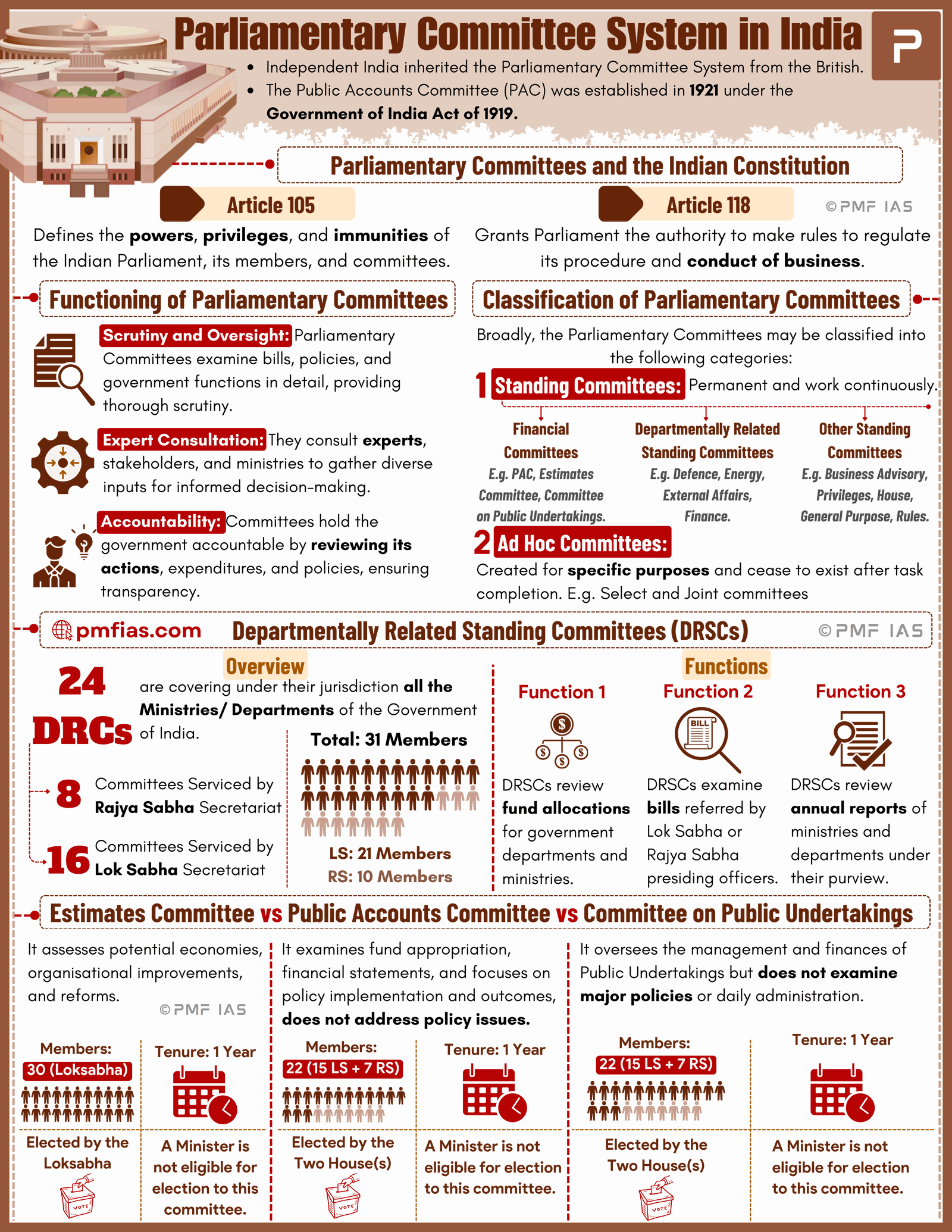
Deconstructing the JPC: Composition, Powers, and Procedure
A JPC is a unique instrument designed for deep, cross-party, and bicameral (involving both houses) scrutiny. The following resource from Levelup IAS offers a clear, structured breakdown of its key features.
Joint Parliamentary Committee 2026 - Levelup IAS
This article explains the essential characteristics of a JPC, from its creation to the final report.
Please read the following sections of the article: Start with the Introduction to understand the JPC's role as a 'mini-Parliament'. Read the section on Constitution and Composition to learn how a JPC is formed and who its members are. Pay attention to the detail that the Lok Sabha typically has twice the members as the Rajya Sabha. Next, read the Nature and Functions section, which describes the committee's investigative powers to collect evidence and examine witnesses. Finally, read the section on Working and Procedure. Focus on the crucial point that recommendations are not binding, but the government must present an Action Taken Report (ATR) in response.
From this reading, we can crystallize the core functions of a JPC:
- Constitution: It is an ad hoc (temporary) body, created by a motion passed in one house and agreed to by the other for a specific purpose—in this case, to examine the Waqf Amendment Bill.
- Composition: It includes MPs from both the Lok Sabha and Rajya Sabha, with party representation proportional to their strength in Parliament. This ensures a cross-party character.
- Powers: It has significant investigative authority. It can summon ministers, government officials, experts, and ordinary citizens for questioning. It can demand documents and records.
- Process: After conducting its inquiry, it submits a report with findings and recommendations. Crucially, these are advisory. The government is not legally bound to accept them. However, the government cannot simply ignore the report; it must formally respond to Parliament with an Action Taken Report (ATR), explaining which recommendations it is accepting or rejecting, and why.
This process is visually captured in photographs from the JPC's actual proceedings.

The Political Significance: Why Refer This Bill to a JPC?
Knowing what a JPC is allows us to analyze why using one is politically significant. Referring the Waqf Bill to a JPC was not just a procedural formality; it was a strategic political decision with implications for both the government and the opposition.
The core of its significance lies in the committee's role as a space for genuine deliberation, away from the glare of cameras and the rigid party lines that dominate floor debates.
Parliamentary Rules, the JPC on Waqf Bill, and the Need for ...
This article from the blog "Law and Other Things" provides a sophisticated analysis of why parliamentary committees are considered vital spaces for non-partisan deliberation and consensus-building.
Please read the section titled "Parliamentary Rules and the Underlined Values of Non-Partisan Deliberation and Consensus-Building." Focus on the author's argument that committees offer a crucial forum for opposition voices in a system where the executive (government) controls the parliamentary agenda. Note the specific rules and norms that facilitate this, such as: The absence of cameras and broadcasting to discourage grandstanding. The ability to call for outside experts and conduct free and frank discussions. The fact that members are generally freer from the party whip in committee meetings.
The points raised in this article help us analyze the political calculus behind the decision to create a JPC for the Waqf Bill:
-
A Conflict De-escalation Mechanism: The opposition had branded the bill "draconian" and an "attack on the Constitution." Forcing it through via a simple majority vote would have amplified accusations of majoritarianism. By referring the bill to a JPC, the government could signal a willingness to listen and deliberate, thereby lowering the immediate political temperature and projecting an image of procedural fairness.
-
A Platform for Substantive Opposition: For the opposition, the JPC offers a far more potent platform than a noisy walkout. Within the committee, they could meticulously build their case against the bill, question officials on record, bring in constitutional experts to testify against its provisions, and, most importantly, submit formal dissent notes. A final report containing strong, reasoned dissent from opposition members becomes a permanent, official record of their objections, which can be used to mobilize public opinion and even support future legal challenges.
-
Buying Time and Building a Record: The JPC process takes time—weeks or months. This pause allows both sides to strategize. The government can use this period to refine its arguments and conduct back-channel negotiations. The opposition can use it to coordinate its strategy and consult with affected communities.
-
Enforcing Accountability through the ATR: While the JPC's report is not binding, the requirement for an Action Taken Report (ATR) is a powerful tool of accountability. The government must publicly and formally justify its decisions regarding the committee's recommendations. This creates a paper trail and forces the executive to engage with the legislative branch's scrutiny, preventing it from simply dismissing the committee's work without explanation. The following video explains this reporting loop clearly.
Joint Parliamentary Committee: Why are they formed and function? | Forum IAS | News Simplified |
This video from ForumIAS, while using the Adani case as an example, provides an excellent step-by-step explanation of the JPC's reporting process and its relationship with the government.
Watch the segment from 05:55 to 07:46. The presenter details the crucial sequence: The JPC submits its report to the government first, not directly to Parliament. The government is not bound by the recommendations but must provide a written reply on its stand. The JPC then presents a final Action Taken Report to Parliament, which includes the government's response.
In the context of the Waqf Bill, this process means the government cannot simply ignore the deep constitutional concerns raised by the opposition. It would be forced to articulate its legal and political reasoning for rejecting any recommendations, placing its arguments on the permanent parliamentary record.
Conclusion
This lesson has moved from the heat of political rhetoric to the cooler, more deliberative mechanics of parliamentary procedure. We've seen that the decision to refer the Waqf Amendment Bill to a Joint Parliamentary Committee was a significant political maneuver, not a simple procedural delay.
Key Takeaways:
- Function of a JPC: A JPC is an ad hoc, bicameral parliamentary body created to conduct in-depth scrutiny of a specific bill or issue. It has investigative powers to summon witnesses and documents.
- Advisory but Influential: While its recommendations are not legally binding, they hold significant political weight. The government is obligated to respond with an Action Taken Report (ATR), ensuring a degree of accountability.
- A Space for Deliberation: JPCs are designed to be forums for non-partisan, detailed discussion, operating away from the glare of media and the constraints of strict party whips that govern floor debates.
- Political Significance: For the Waqf Bill, the JPC serves as a conflict management tool. It allows the government to demonstrate due process on a contentious issue, while providing the opposition a formal, substantive platform to dissect the bill and record its dissent. It transforms a political shouting match into a structured, evidence-based inquiry.
Preview of the Next Module:
This lesson concludes our deep dive into the Waqf Amendment Bill. We have analyzed its legal basis, the competing political narratives it fuels, and the parliamentary process used to manage the conflict surrounding it.
In our next module, we will turn to another deeply contentious issue at the intersection of law, religion, and politics: the Uniform Civil Code (UCC). We will begin by exploring the constitutional context of the UCC debate, tracing its origins to Article 44 of the Constitution and the long-standing existence of separate personal laws for different religious communities in India.