Introduction
Welcome to our new module. In our previous discussions on the Waqf Amendment Bill, we explored the complex intersection of law, religion, and institutional autonomy, culminating in our analysis of the Joint Parliamentary Committee's role as a forum for deliberative scrutiny. We now turn our attention to one of the most enduring and politically charged subjects in Indian constitutional law: the Uniform Civil Code (UCC).
This lesson serves as the foundation for our study of the UCC. Our objective is to explain its constitutional context by tracing its origins to Article 44 of the Constitution and understanding the historical reasons for the existence of distinct personal laws in India. We will uncover why India has a patchwork of laws for marriage, divorce, and inheritance, and how the nation's founders addressed this complexity by framing a unique constitutional vision—one that continues to fuel debate to this day.
What is the Uniform Civil Code?
At its core, the Uniform Civil Code is the idea of having one common set of civil laws for all citizens of India, regardless of their religion. These laws would govern personal matters that are currently regulated by different religious legal systems.
The infographic below provides a concise overview of the UCC, outlining the areas of personal law it seeks to unify, its constitutional basis, and the main arguments surrounding it.
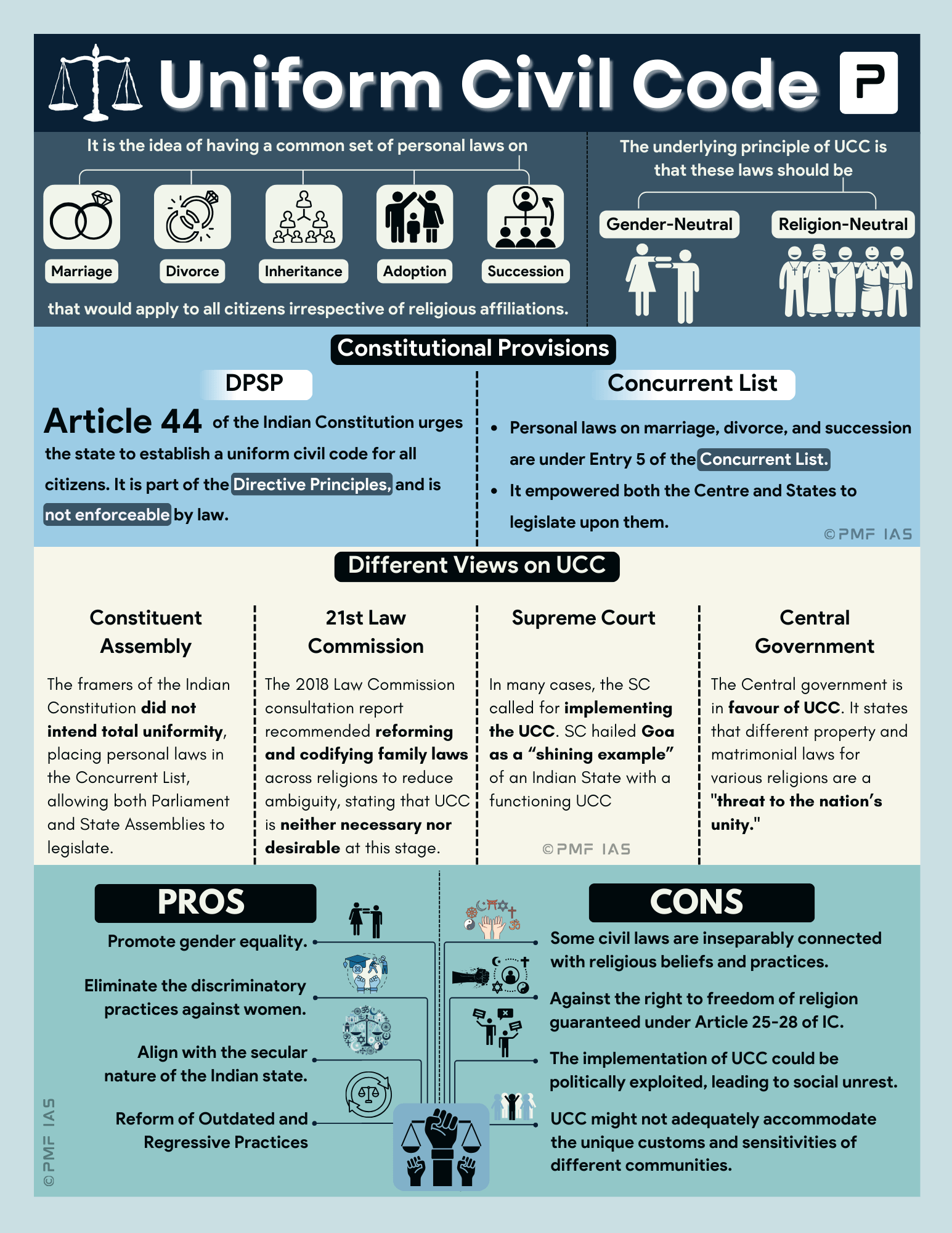
As the infographic shows, the UCC would apply to matters like marriage, divorce, inheritance, adoption, and succession. To understand why a "uniform" code is even a topic of discussion, we must first understand the "non-uniform" system currently in place: the system of personal laws.
The Landscape of Distinct Personal Laws
India does not have a single family law. Instead, different religious communities are governed by their own "personal laws." The following video from BYJU'S IAS provides a clear, structured list of the major personal law statutes that exist today.
Uniform Civil Code [Explained] | Article 44 of Indian Constitution | UPSC Prelims & Mains 2022-2023
This video outlines the current legal landscape, showing how different statutes apply to different religious communities.
Watch the segment from 05:04 to 06:27. As you watch, note the existence of the Hindu Code Bills (which also apply to Sikhs, Jains, and Buddhists), separate laws for Muslims and Christians, and the Special Marriage Act, 1954, which serves as a secular alternative for inter-faith or non-religious marriages.
These different legal frameworks lead to significant practical differences in the rights and obligations of citizens depending on their religion. For a few concrete examples of this legal diversity, the next video offers a brief comparison.
One Nation, One Law | Uniform Civil Code 2023
This video highlights some of the practical differences between various personal laws.
Watch the segment from 04:56 to 06:07. The presenter gives specific examples of how personal laws differ on crucial matters like polygamy (permitted under Muslim personal law but not others), inheritance rights for women, and grounds for divorce.
This patchwork system of laws is not an accidental feature of the Indian legal system; it has deep historical roots, shaped significantly during the British colonial era.
The Colonial Roots of Legal Pluralism
The existence of distinct personal laws is often mistaken for an ancient, unbroken tradition. In reality, the system as we know it today was largely a product of colonial administrative policy. Pre-colonial legal traditions were often more flexible and regionally diverse. The British, in their effort to govern a vast and diverse subcontinent, chose to codify and, in the process, rigidify these traditions into separate legal compartments for different religious communities.
The following academic text explores this historical process, introducing a key concept for understanding India's legal structure.
[PDF] Debating Uniform Civil Code: the making of Article 44 in the ...
This excerpt from a paper by Sambaiah Gundimeda explains how British colonial policies shaped the personal law system that India inherited at independence.
Please read the section just before "2. Demanding a uniform civil code...", starting on page 4 of the PDF. Focus on how British rule profoundly restructured existing legal traditions into rigid, textual codes. Pay close attention to the concept of "compartmentalized pluralism", which describes the framework of legally recognized, community-specific norms that the British established and post-colonial India inherited.
This colonial legacy of "compartmentalized pluralism" presented the framers of the Indian Constitution with a profound challenge: how to build a modern, secular nation-state while accommodating the deeply entrenched system of distinct personal laws.
The Constitutional Compromise: Article 44
The Constituent Assembly engaged in intense debates over this very question. Some members argued for a UCC to be a fundamental, enforceable right to forge national unity and ensure gender justice. Others warned that imposing a uniform code would violate the religious freedoms of minority communities and undermine their cultural identity.
The resolution to this deadlock was a uniquely Indian constitutional compromise: the creation of Article 44 and its placement in Part IV of the Constitution, the Directive Principles of State Policy (DPSP).
Article 44 states: "The State shall endeavour to secure for the citizens a uniform civil code throughout the territory of India."
The key word here is "endeavour." By placing the UCC in the DPSP, the framers designated it as an aspirational goal for the state to strive towards, rather than a legally enforceable right. The next video explains the significance of this classification.
Uniform Civil Code [Explained] | Article 44 of Indian Constitution | UPSC Prelims & Mains 2022-2023
This video clearly explains the constitutional status of Article 44 as a Directive Principle.
Watch the segment from 01:16 to 03:26. Focus on the explanation of how Article 44 is located in the non-justiciable part of the Constitution. This means you cannot go to court to demand its implementation, but the principles are considered "fundamental in the governance of the country." Note Dr. B.R. Ambedkar's crucial observation that the UCC was desirable but should, for the moment, remain "voluntary."
To appreciate the intellectual and political currents that led to this compromise, it is essential to look at the debates themselves.
[PDF] Debating Uniform Civil Code: the making of Article 44 in the ...
This reading from the same academic paper provides a window into the Constituent Assembly's deliberations. It reveals the competing visions that were ultimately reconciled in Article 44.
Please read section 2, "Demanding a uniform civil code in the name of national unity." Focus on how the idea of a UCC was debated first as a fundamental right but was then moved to the Directive Principles. This was a deliberate choice to frame it as an ideal to be pursued. Also, note the sharp dissent from members like Rajkumari Amrit Kaur and Hansa Mehta, who argued for a binding mandate, showing that the compromise was not unanimously celebrated.
This careful placement of the UCC in the DPSP created a foundational tension that remains at the heart of the debate today.
The Core Constitutional Tension: Uniformity vs. Freedom
The constitutional context of the UCC is defined by an inherent tension between two sets of principles:
- Article 44 (Directive Principle): Urges the state to work towards a uniform civil code for all citizens, promoting national integration and legal consistency.
- Articles 25 & 26 (Fundamental Rights): Guarantee the freedom of religion and the right of religious groups to manage their own affairs. Many communities view their personal laws as an integral part of this protected religious freedom.
The following text offers a succinct summary of this central conflict.
[PDF] From Tradition to Reform: A Comparative Study of Personal Laws in ...
This article clearly articulates the core constitutional dilemma at the heart of the UCC debate.
Please read the subsection "7.1. Constitutional Provisions." The text concisely explains how Article 25 is used to protect the right of communities to govern themselves according to their personal laws. It then contrasts this with Article 44, which calls for a uniform code, thereby creating the fundamental constitutional tension that defines this entire political issue.
This clash between the aspirational goal of uniformity and the fundamental right to religious freedom is the primary reason why the UCC remains one of the most complex and contentious issues in Indian politics.
Conclusion
In this lesson, we have established the essential constitutional and historical foundations of the Uniform Civil Code debate. We've moved beyond the political slogans to understand the nuanced legal framework that underpins this issue.
Key Takeaways:
- Distinct Personal Laws: India has a system of separate personal laws for different religious communities, governing matters like marriage and inheritance. This system is largely a legacy of British colonial administration's policy of "compartmentalized pluralism."
- Article 44 as a Directive Principle: The framers of the Constitution placed the UCC in Article 44, part of the non-enforceable Directive Principles. This made it an aspirational goal for the state, not an immediate, justiciable right.
- A Constitutional Compromise: This placement was a deliberate compromise to balance the ideal of national unity with the protection of religious and cultural diversity in a newly independent nation.
- The Core Tension: The UCC debate is fundamentally a constitutional one, balancing the directive of Article 44 (uniformity) against the fundamental rights of religious freedom enshrined in Articles 25 and 26.
Preview of the Next Lesson:
Having explored the historical origins and constitutional theory of the UCC, our next lesson will examine its modern-day application. We will analyze the Uttarakhand Uniform Civil Code (2024) as the first comprehensive legislative template for a state-level UCC. We will dissect its key provisions, the exemption of tribal communities, and the intense political and legal arguments it has ignited, bringing the decades-old constitutional debate into the realm of concrete law.