Introduction
Welcome to a new module. In our previous lessons, we concluded our analysis of the 'One Nation, One Election' proposal by assessing the competing narratives of efficiency versus centralization. That discussion was fundamentally about the structure of India's electoral democracy. We now shift our focus to an equally contentious issue that lies at the intersection of law, religion, and property rights: the Waqf system.
This module will dissect the ongoing debate surrounding the Waqf (Amendment) Bill. To do that properly, we must first establish a firm understanding of the existing legal framework. This initial lesson is dedicated to that foundation. Your learning outcome is to explain the legal basis of the Waqf system in India under the Waqf Act of 1995 as a form of Islamic charitable endowment. We will define what Waqf is, trace its legislative history, and then detail the key components of the 1995 Act that governs it today.
What is Waqf? The Core Concept
At its heart, Waqf is a concept rooted in Islamic law and tradition. The term itself implies detention or restriction. It refers to the permanent and irrevocable dedication of a property—movable or immovable—by a person for any purpose recognized by Muslim law as pious, religious, or charitable. Once a property is designated as Waqf, its ownership is metaphorically transferred to God, and it cannot be sold, gifted, or inherited.
ThePrint's editor-in-chief, Shekhar Gupta, provides a clear explanation of this foundational concept, tracing it back to the origins of Islamic tradition.
The waqf question: How Modi-led NDA is changing the law & why 2013 amendments are back in focus
This video, titled "The waqf question," begins by explaining the theological and traditional basis of Waqf.
Please watch the segment from 2:49 to 7:37. Focus on how the video defines Waqf as a form of "perpetual charity" (Sadaqa Jariya) and explains its characteristics: The property is given away forever. It is meant to yield benefits in perpetuity for a specific cause. Its origins are traced to the Hadith and the time of the second Caliph, Omar.
The person who creates the Waqf is known as the waqif, and the property is managed by a custodian or manager called a mutawalli. The purpose is to ensure the asset continues to serve the community or the specified charitable goal indefinitely.
For a formal, legalistic understanding, we can turn to an academic analysis of the Waqf Act.
[PDF] An Extensive Analysis of the Waqf Act, 1995
This research paper provides a deep dive into the legal and conceptual underpinnings of Waqf.
First, read the brief introductory section that begins "What does waqf mean?". This sets the stage by defining the term and its irreversible nature. Next, find the section titled "The Basis of Waqf is superfluous but necessary for identity politics" (you may need to search for this phrase). Here, focus on two key parts: The explanation of the three core characteristics: inalienability, irrevocability, and immortality. The description of the three types of Waqf, including the "Waqf by user" concept you're already familiar with.
The Legislative Evolution of Waqf in India
The practice of creating Waqfs has existed in India since the Delhi Sultanate. However, its modern legal framework is a product of British-era and post-independence legislation. The journey to the 1995 Act is a critical part of understanding its legal basis.
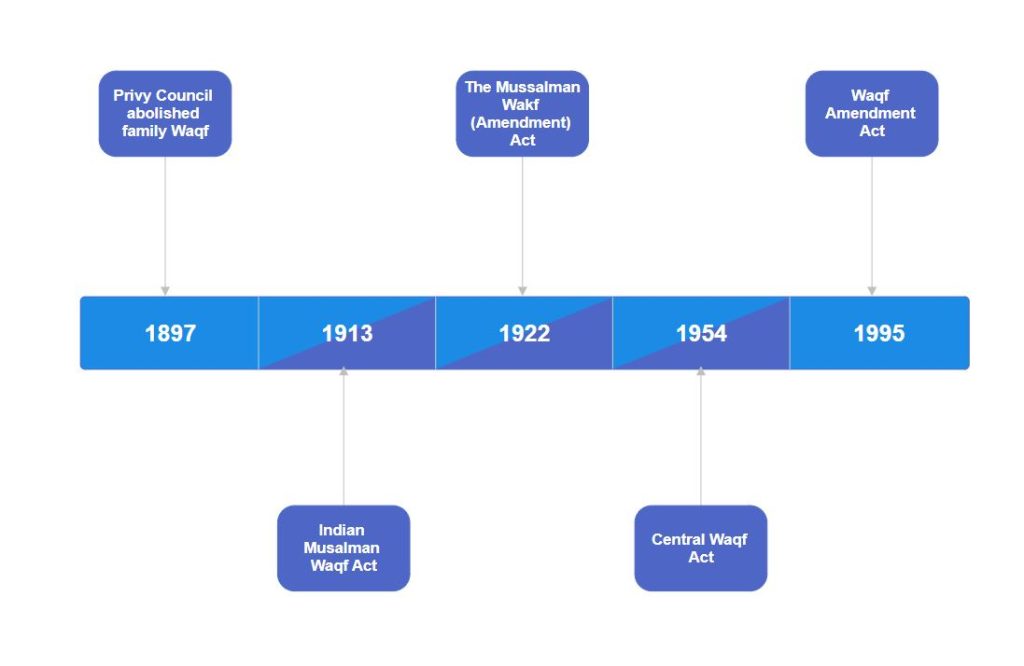
During British rule, after some initial judicial skepticism, the Mussalman Waqf Validating Act of 1913 was a landmark law that formally recognized and upheld the Waqf system in India. After independence, the Indian government sought to create a more uniform and centralized system for administering these properties.
This led to the Waqf Act of 1954. This act was the first major step towards centralizing Waqf administration. It established State Waqf Boards and, through a later amendment, a Central Waqf Council to advise the government. However, the 1954 Act faced criticism and required several amendments, leading to calls for more comprehensive legislation.
The video from Drishti IAS provides a concise summary of this transition from the 1954 Act to the 1995 Act.
Waqf (Amendment) Bill 2024 | Waqf Act 1995 | Lok Sabha | InNews | Drishti IAS English
This video on the Waqf Amendment Bill provides a helpful overview of the historical laws governing Waqf.
Watch the section from 5:48 to 8:40. This segment will walk you through: The origin of Waqf in India and its validation by the 1913 Act. The role of the Waqf Act of 1954 in centralizing the administration and creating the Central Waqf Council.
The Waqf Act, 1995: The Current Legal Bedrock
The difficulties and inconsistencies in the 1954 Act culminated in the enactment of the Waqf Act, 1995. Passed during the P.V. Narasimha Rao government, this act repealed earlier laws and established a new, comprehensive legal framework. It is the primary statute that governs the administration and supervision of Waqfs across India today.
The blog post from iPleaders clearly outlines the objectives and significance of this act.
Understanding the essential provisions of the Waqf Act, 1995
This article explains why the 1995 Act was enacted and what it aimed to achieve.
Please read the following sections: The introduction, which explains that the 1995 Act was created to overcome prior issues and provide comprehensive legislation. The section on the objectives of the Act. The section on the "Significance of the Act," which details how the 1995 law was an improvement over the 1954 version, applying to the whole of India and reorganizing the administrative structure.
The 1995 Act established a clear three-tiered structure for the administration of Waqf properties.
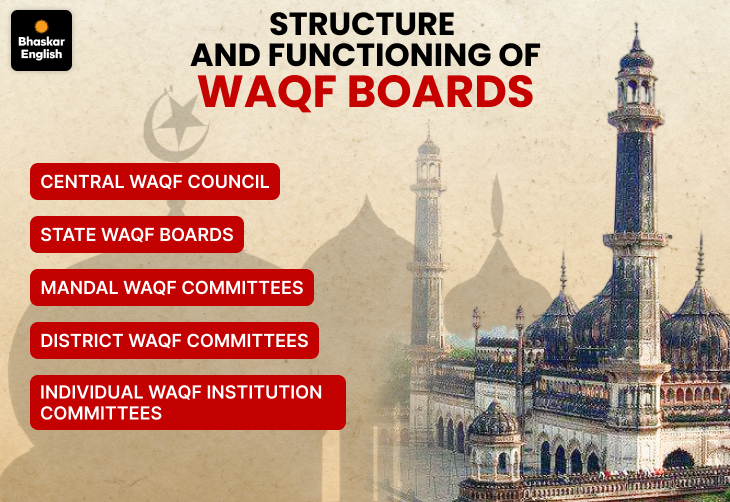
The key legal pillars of the 1995 Act are:
- The Central Waqf Council: A statutory body established by the Central Government to advise on matters concerning the working of State Waqf Boards and the administration of Waqfs. It is an advisory body, not an executive one.
- State Waqf Boards: These are the primary executive bodies with powers of superintendence over all Waqfs within a state. Their functions include surveying Waqf properties, ensuring their proper administration, and maintaining records.
- The Waqf Tribunal: This is one of the most significant innovations of the 1995 Act. It created special tribunals with the power to adjudicate disputes relating to Waqf properties. These tribunals have the powers of a civil court, and their decisions are final and binding, with their jurisdiction barring that of regular civil courts on such matters.
The academic paper "An Extensive Analysis of the Waqf Act, 1995" provides a more critical look at the introduction of the Waqf Tribunal.
[PDF] An Extensive Analysis of the Waqf Act, 1995
This paper delves into the specifics of the 1995 Act, particularly its more powerful provisions.
First, read the paragraph that begins "The Waqf Act of 1995 was implemented". It describes the creation of the Waqf Tribunal and its broad jurisdiction, noting its unique position in the legal system. Next, to sharpen your analytical understanding, read the section that draws a comparison between a Waqf and a trust. Focus on the paragraph that starts "Waqf is theoretically similar to a trust". This highlights key differences related to its religious basis, permanence, and the distinct legal system it operates within, contrasting it with the secular nature of a trust under the Indian Trusts Act, 1882.
Conclusion
In this lesson, we have established the legal foundations of the Waqf system in India. We started by defining Waqf as a permanent, irrevocable, and inalienable charitable endowment under Islamic law. We then traced its legislative history, culminating in the Waqf Act of 1995, which serves as the current cornerstone of its administration.
Key Takeaways:
- Waqf: A perpetual dedication of property for religious or charitable purposes, with ownership vesting in God. Its core characteristics are inalienability, irrevocability, and immortality.
- Legislative History: The system, while ancient, was legally codified in modern India through a series of laws, most notably the Mussalman Waqf Validating Act of 1913, the centralizing Waqf Act of 1954, and finally, the comprehensive Waqf Act of 1995.
- The Waqf Act, 1995: This is the primary law governing Waqfs today. It provides for a three-tiered administrative structure (Central Council, State Boards) and established powerful Waqf Tribunals to adjudicate disputes, giving the system a unique legal standing.
- Waqf vs. Trust: Unlike a secular trust, a Waqf is a faith-based institution tied to Sharia, is inherently perpetual, and is governed by a distinct legal framework.
Preview of the Next Lesson:
Now that we have built this legal foundation, we can proceed to the heart of the political controversy. In the next lesson, we will analyze the long-standing criticisms of Waqf board management, including allegations of corruption and encroachment, which form the basis for reform calls. This will set the stage for understanding the motivations behind the proposed Waqf (Amendment) Bill.