Introduction
In our previous lessons on the 'One Nation, One Election' (ONOE) proposal, we've systematically deconstructed this complex issue. We began with its core concept and history, moved on to the constitutional and federalist objections, and most recently, we delved into the political science evidence on how simultaneous elections might alter voter behavior.
This final lesson of the module serves as a synthesis. We will now bring all these threads together to directly address the central political debate surrounding ONOE. Your learning outcome is to assess the two dominant, competing narratives: one that frames ONOE as a necessary efficiency reform designed to improve governance, and another that views it as a structural power grab intended to centralize authority. In line with your preference for analytical debates, this lesson will structure the arguments for each narrative, allowing you to weigh the evidence and form a comprehensive judgment.
The Two Narratives: A Visual Overview
Before we dive deep, let's look at a high-level summary of the arguments that fuel these two opposing narratives. The following infographic neatly encapsulates the main points made by proponents and critics of ONOE.
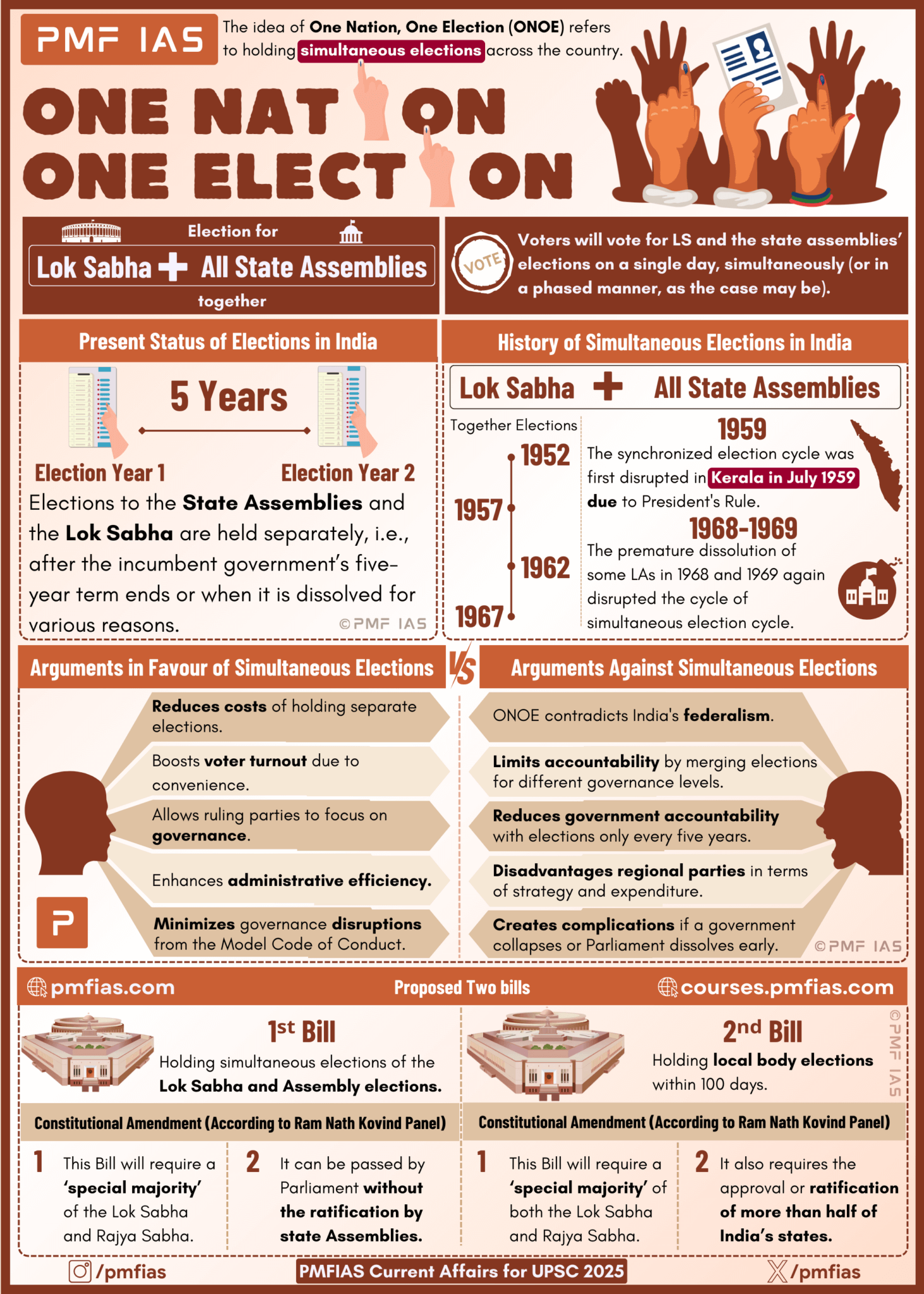
As you can see, the arguments are not just technical; they touch upon the very nature of governance, accountability, and the federal balance of power in India. Let's now explore each narrative in greater detail.
Narrative 1: The Case for a Necessary Efficiency Reform
The primary narrative put forward by the government and proponents of ONOE is one of pragmatic, good-governance reform. The central claim is that India's current system of staggered, frequent elections creates significant inefficiencies that hinder national progress. This argument has three main pillars.
The Think School video frames this perspective effectively, highlighting the disruptions caused by the current system.
Masterstroke or Death of Democracy: One Nation One Election EXPLAINED
This video, titled "Masterstroke or Death of Democracy," lays out the government's case for ONOE as a solution to several systemic problems.
Please watch the section from 5:04 to 9:27. Pay close attention to the three key problems identified: governance disruption due to the Model Code of Conduct (MCC), the high financial and administrative costs of frequent elections, and the perpetual campaign mode that distracts politicians from governance.
To build a more detailed understanding of these points, the Carnegie Endowment article, "Does 'One Nation, One Election' Make Sense for India?", provides a thorough and structured summary of the government's rationale.
Does “One Nation, One Election” Make Sense for India?
This section from the Carnegie Endowment for International Peace offers a comprehensive breakdown of the arguments in favor of ONOE.
Please read the entire section titled "Government’s Rationale." It organizes the arguments into three clear categories: Savings: This covers the savings of time, money, and resources. Note the specific claims about ending political "short-termism" and reducing costs for both the government and political parties. Public Engagement: This details the arguments about reducing voter fatigue and creating more opportunities for lower-level leaders. Government Efficiency: This focuses on the impact of the Model Code of Conduct, which proponents claim leads to "policy paralysis."
In essence, this narrative portrays ONOE as a logical step to streamline a chaotic electoral calendar, allowing for more stable, focused, and efficient governance. The costs associated with the current system are framed not just in financial terms, but in terms of lost development and administrative capacity.
Narrative 2: The Anatomy of a Structural Power Grab
The counter-narrative, articulated by opposition parties, federalist scholars, and civil society groups, dismisses the "efficiency" arguments as a smokescreen. It contends that ONOE is a political project of deliberate centralization, designed to fundamentally alter India's federal character and benefit the ruling national party. This argument also rests on several key pillars.
An article in The Wire provides a sharp, critical analysis that traces the development of this proposal, framing it as a systematic effort to manufacture consent for a centralizing agenda.
Does 'One Nation, One Election' Threaten the Federal Structure of ...
This article argues that ONOE is a project of political engineering. It systematically deconstructs the government's rationale and reframes the debate around power and federalism.
Please read the following sections: Start with the introduction, which immediately frames the debate as "administrative efficiency" versus "political engineering." Read "What is the genealogy of this proposal?" which traces the sequence of official reports from 2015 to 2024 to argue that a consensus was deliberately constructed. The section "How does the ‘appointed date’ impact federalism?" explains how synchronizing election cycles can truncate the mandates of state governments and structurally ensure that a "national narrative...drowns out regional narratives." Next, examine the "Unexpired Term’ controversy" to understand how this mechanism could disincentivize holding governments accountable. Read the section "Does model code cause ‘policy paralysis’?" which offers a powerful rebuttal to one of the main efficiency arguments. Finally, read "Where do political parties stand?" which outlines the clear political fault lines on this issue.
This perspective argues that the true "cost" of ONOE is not financial but constitutional. The primary concerns are:
- Weakening Federalism: By forcing state election cycles to align with the national one and by promoting national over regional issues (revisiting the 77% vote congruence figure we discussed), ONOE is seen as a direct assault on the autonomy of states.
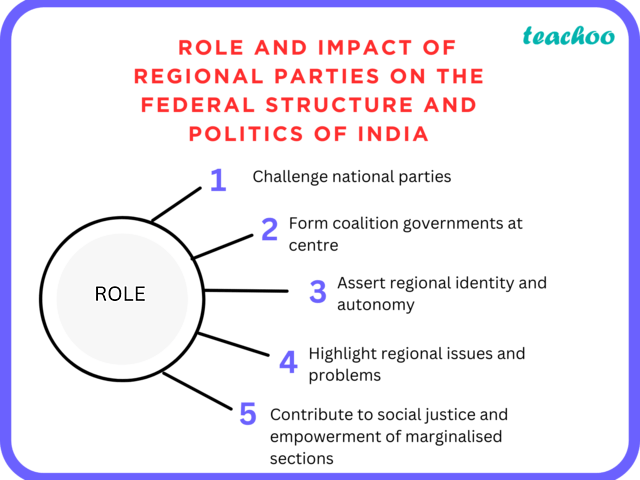
- Marginalizing Regional Parties: Regional parties are the political expression of India's diversity. By creating an electoral environment that favors national narratives and a "presidential" style of campaigning, ONOE threatens their very existence. This is why their role, as outlined in the image below, is so central to this debate.
- Reducing Accountability: Frequent state elections function as a vital, continuous feedback loop. They allow voters to express their satisfaction or dissatisfaction with both state and central governments. Critics argue that reducing elections to a single event every five years would insulate governments from public opinion and make them less accountable. The video from Vajiram and Ravi elaborates on this and other critiques, drawing on the expert opinion of former Lok Sabha Secretary-General P.D.T. Acharyya.
One Nation, One Election - Is INDIA Ready? Pros and Cons | Perspective by Vajiram And Ravi
This segment of the "Perspective" episode by Vajiram and Ravi presents a structured overview of the "cons" or arguments against ONOE.
Please watch from 15:52 to 22:13. This section covers several critical points: The federalism argument made by P.D.T. Acharyya (16:01-17:36). The positive role of frequent elections in enhancing accountability (17:51-18:35). The impact on voter behavior and the blurring of local and national issues (18:44-19:32). The argument that ONOE is fundamentally against the democratic nature of the country (21:03-22:11).
Synthesis: Efficiency vs. Power, Intent vs. Consequence
We are now faced with two irreconcilable narratives. Is ONOE a sensible, apolitical reform, or a partisan power grab disguised as one? The Carnegie article provides an excellent critical evaluation that weighs the "efficiency" claims against their potential negative consequences.
Does “One Nation, One Election” Make Sense for India?
This part of the article systematically critiques the government's rationale and explores the deeper implications for India's democracy.
First, read the section titled "Critiques." It goes through the arguments about savings, public engagement, and efficiency one by one, offering sharp counter-points and arguing that many of the proposed benefits are either overstated or could be achieved through other means. Pay attention to the argument that ONOE could ironically lead to more elections due to the "unexpired term" rule. Next, read the section "Democracy’s Future." This part synthesizes the critique by arguing that ONOE would further "presidentialize" India's politics, reduce opportunities for public participation, and undermine federalism as a check on executive power.
The core tension is this: the "efficiency" narrative focuses on stated intentions (to save money, improve governance), while the "power grab" narrative focuses on predictable consequences (centralization, reduced accountability). The final paragraph of The Wire article you read earlier captures this perfectly: "In the final analysis, the resistance to ONOE is not about time, but about power."
Is There a Middle Path?
The debate doesn't have to be a binary choice between the current system and the proposed ONOE model. Several experts have proposed alternative reforms that aim to achieve some of the efficiency goals without the drastic constitutional and political overhaul.
Does “One Nation, One Election” Make Sense for India?
This final section from the Carnegie paper explores several alternative reform possibilities that offer a middle ground.
Please read the section titled "Reform Possibilities." It discusses several creative solutions, including: Renegotiating the Model Code of Conduct instead of changing the entire election cycle. A "one nation, two elections" model, where all state polls are held together at the Lok Sabha's halfway mark. A model where state elections are clubbed into two distinct groups, one with the Lok Sabha and one at the midpoint.
These proposals suggest that it may be possible to address the problems of cost and disruption without sacrificing the core principles of federalism and accountability that staggered elections currently uphold.
Conclusion
In this lesson, we have assessed the two competing narratives that define the 'One Nation, One Election' debate. We have seen how what one side presents as a pragmatic efficiency reform, the other decries as a fundamental threat to India's federal democracy.
Key Takeaways:
- The "Efficiency Reform" Narrative: Proponents argue that ONOE is essential to curb excessive expenditure, reduce the administrative burden of constant elections, and free governments from the "policy paralysis" induced by the Model Code of Conduct, allowing for stable and focused governance.
- The "Structural Power Grab" Narrative: Critics contend that ONOE is a political project designed to centralize power. They argue it will undermine India's federal structure, marginalize regional parties by nationalizing electoral narratives, and erode democratic accountability by reducing the frequency with which citizens can pass judgment on their governments.
- The Core Tension: The debate ultimately weighs the tangible benefits of administrative and financial efficiency against the less tangible, but fundamental, constitutional principles of federalism, accountability, and political diversity.
- Alternative Paths: The discourse is not strictly binary; various middle-ground solutions have been proposed that seek to balance the goals of efficiency with the preservation of democratic checks and balances.
Preview of the Next Module:
Having concluded our deep dive into ONOE—a debate about the very structure of democratic power—we will next turn to a conflict over the substance and scope of law. Our next module, "The Uniform Civil Code: Between Gender Justice and Legal Pluralism," will explore one of the most contentious issues in Indian politics. We will begin by examining the constitutional context for the UCC, looking at Article 44 and the history of personal laws in India.