Introduction
In our previous lesson, we established how the on-the-ground reality of the Assam NRC—its chaotic implementation and politically inconvenient results—forced a strategic retreat from the BJP's ambition of a nationwide citizenship register. The exercise, intended as a proof of concept, became a cautionary tale that made a national rollout politically untenable.
This raises a crucial question: if a key policy is politically shelved, how is it done without a formal announcement? In this final lesson of the module, we will uncover the administrative mechanism that allowed the government to functionally freeze both the nationwide NRC and the implementation of the Citizenship Amendment Act (CAA). We will connect the indefinite postponement of the 2021 Decadal Census to this political objective, demonstrating how delaying one massive bureaucratic exercise became the solution to avoiding another, far more contentious one.
The Unbreakable Link: Census, NPR, and NRC
To understand why the Census is the key, we must first revisit the government's original plan. The process was not simply Census -> NRC. It involved a critical intermediary step: the National Population Register (NPR).
The government's plan, announced in 2019, was to conduct the first phase of the Census 2021 (the 'house-listing' phase) simultaneously with an update of the NPR. The NPR is a register of all "usual residents" of the country, collecting basic demographic and biometric data. The crucial point, as established in the Citizenship (Registration of Citizens and Issue of National Identity Cards) Rules, 2003, is that the NPR is the foundational database from which a nationwide National Register of Citizens (NRC) would be created through a process of verification.
The sequence was intended to be:
- Census Phase 1 + NPR Update: Go door-to-door for the census house-listing and collect/update NPR data at the same time.
- NPR Scrutiny: Local officials would scrutinize the NPR data to identify individuals whose citizenship was considered "doubtful".
- Nationwide NRC: Those flagged would then need to provide further documentation to prove their citizenship, leading to a final NRC list.
This direct, legal link between the Census-NPR drive and the creation of an NRC is what transformed a routine statistical exercise into a subject of intense political conflict.
The article "Disastrous Decade for Data," from the Impact and Policy Research Institute (IMPRI), explains this connection and the political fallout it caused.
This piece clearly outlines the technical and political links between the CAA, NPR, and NRC, and how these connections poisoned the well for the 2021 Census.
Please read the following sections: Start with the section that begins "In fact, the conduct...". This part explicitly states how the CAA and NRC issue became intertwined with the Census. Next, read the section under "Politics of Data and Trust Deficit." Focus on the passage that explains how the government's commitment to the NRC led to public opposition, citing the famous slogan "kaagaz nahin dikhaenge" (we will not show papers). Finally, read the part that discusses the apprehension about the NPR and the suggestion to "delink" it from the Census. This highlights the core of the controversy.
As the article makes clear, the massive protests against the CAA in late 2019 and early 2020 were fueled by this very connection. Protesters understood that the NPR update, piggybacking on the Census, was the gateway to a nationwide NRC. This created a profound "trust deficit," where citizens were being urged to resist the entire enumeration process, fearing it was a trap to question their citizenship.
Postponement: From Pandemic Pretext to Political Strategy
The first postponement of the Census and NPR update, scheduled for April 2020, was perfectly understandable. The COVID-19 pandemic and the national lockdown made such a vast field exercise impossible. However, as the months and years passed, other large-scale national activities, most notably multiple state elections, resumed. Yet, the Census remained on hold.
The official reason continued to be the pandemic, but as this video from The Wire explains, the delay became unprecedented in India's history, suggesting other factors were at play.
India’s First Ever ‘Delayed Census’ And Its Impact On The Country
This video report details the unprecedented nature of the census delay and explores its significant impact on governance and policymaking.
Watch the opening segment from the beginning, which establishes the timeline and confirms that this would be the "first ever delayed census." Then, you can skip to the segment where statistician Pronab Sen explains the consequences of the delay from "we spoke to statistician...". He makes a critical point: while you can project population growth, you cannot capture migration without a census. This detail is crucial for understanding why an old census is so problematic for planning.
The continued delay strongly indicates that the government's official reason was masking a political calculation. Launching the Census/NPR exercise would have meant re-igniting the very protests and political controversies that the government had managed to quell. After the fiasco in Assam, the BJP had little appetite for another nationwide battle over citizenship, especially in the run-up to the 2024 general election.
This infographic lays out the official timeline and processes, including the NPR link, that became politically frozen.
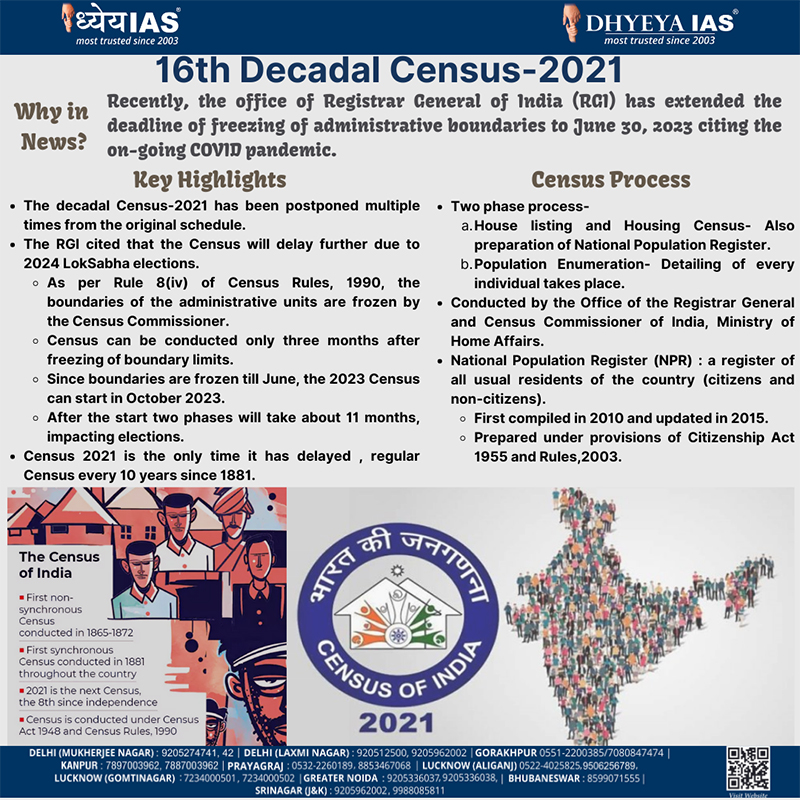
The article "From CAA-NRC to caste conundrum" further analyzes the political motivations behind the delay.
CAA-NRC and caste politics: Why has the government has ... - Scroll.in
This article from Scroll.in dissects the various political reasons for the Census delay, placing the CAA-NRC issue at the forefront.
First, read the section that questions the official reason for the delay, starting from "It is quite clear". Next, focus on the passage that directly links the delay to the political risk of the NRC. Read from "Shoaib Daniyal explains...". Finally, read the paragraph that summarizes the political calculation: "Could the government...". This directly addresses why postponing the census was a politically safe option before the 2024 elections.
By repeatedly extending the deadline for freezing administrative boundaries—a necessary precursor to the Census—the government effectively created a rolling postponement. This served as a quiet, bureaucratic method to shelve the NRC without having to publicly admit a policy reversal. If the NPR is never updated, the legal process for a nationwide NRC cannot begin.
The Ripple Effect: Shelving the CAA
The indefinite postponement of the Census/NPR/NRC chain reaction also has a profound impact on the Citizenship Amendment Act. While the government finally notified the rules for the CAA in March 2024, its original strategic purpose has been hollowed out.
The CAA was politically designed as a "safety net" or a "filter" to be used in conjunction with a nationwide NRC. The idea was that the NRC would identify all undocumented persons, and the CAA would then rescue the non-Muslims among them, leaving only Muslims to face potential disenfranchisement.
Without a nationwide NRC, the CAA's function changes dramatically. It is no longer a tool for large-scale demographic sorting. Instead, it becomes a more standard, albeit controversial, pathway to citizenship for a specific, limited group of migrants who can prove they meet its criteria. The "stick" of the NRC is gone, so the "carrot" of the CAA loses its central political utility in the grander scheme of the BJP's ideological project.
The postponement of the Census, therefore, acts as the lynchpin. It freezes the NRC, which in turn functionally shelves the CAA in its originally intended role.
Conclusion
In this lesson, we have connected the dots between a delayed statistical exercise and the freezing of a cornerstone political agenda. The indefinite postponement of the 2021 Census, while officially blamed on the pandemic, became the government's unstated political strategy to avoid the explosive fallout of implementing a nationwide NRC.
Here are the key takeaways:
- The Administrative Link: The Census (Phase 1) was legally and procedurally tied to the update of the National Population Register (NPR), which is the mandated first step for creating a nationwide NRC.
- Political Toxicity: Following the Assam NRC experience and the massive anti-CAA protests, this link made the Census politically toxic. Initiating it would have meant re-igniting a nationwide conflict over citizenship.
- Postponement as a Solution: Indefinitely delaying the Census provided a quiet, bureaucratic way to shelve the NRC project without a formal policy reversal. If the first step (NPR) never happens, the subsequent steps (NRC) cannot follow.
- Functional Shelving of CAA: By neutralizing the threat of a nationwide NRC, the postponement of the Census also stripped the CAA of its primary strategic role as a "safety net," effectively altering its political impact.
This concludes our module on the complex and contested nature of citizenship in India. We have seen how a legal and bureaucratic process in Assam spiraled into a national political crisis, ultimately forcing the government to shelve one of its most prominent promises through the subtle administrative maneuver of postponing the Census.
In our next module, we will shift our focus to another critical issue of identity and conflict: the crisis in Manipur. We will explore the deep-seated ethnic tensions, the triggers for the recent violence, and the complex challenges to peace and reconciliation in the state.