Introduction
In our last lesson, we unpacked the curious case of the Assam NRC's political fallout, where the final list managed to disappoint every major stakeholder, including its most ardent champion, the BJP. We saw how the exclusion of a large number of Bengali Hindus and a lower-than-expected total exclusion number turned the exercise into a political liability for the party in Assam.
Today, we will scale up our analysis from the state to the national level. We will evaluate how the chaotic and politically damaging outcome of the Assam NRC served as a crucial, unintended "pilot project" that effectively crippled the BJP's broader ambition for a nationwide National Register of Citizens. You will analyze the strategic retreat of the government on this key manifesto promise, examining the moment when Prime Minister Modi publicly contradicted his own Home Minister, and explore the reasons behind this significant political pivot.
The Grand Ambition: A Nationwide NRC
Before the Assam results came in, a nationwide NRC was not a fringe idea; it was a core promise of the BJP. The party's 2019 Lok Sabha election manifesto was explicit, and senior leaders, most notably Home Minister Amit Shah, repeatedly vowed to implement it to identify and remove "infiltrators" from every state.
This plan was designed to work in tandem with the Citizenship Amendment Act (CAA). The logic was that the NRC would identify undocumented residents, and the CAA would then act as a "safety net" to grant citizenship to non-Muslims from Pakistan, Afghanistan, and Bangladesh, effectively isolating Muslims as the primary group facing potential disenfranchisement.
The demographic anxieties that fueled the original NRC demand in Assam were seen by the BJP as a template that could be nationalized.
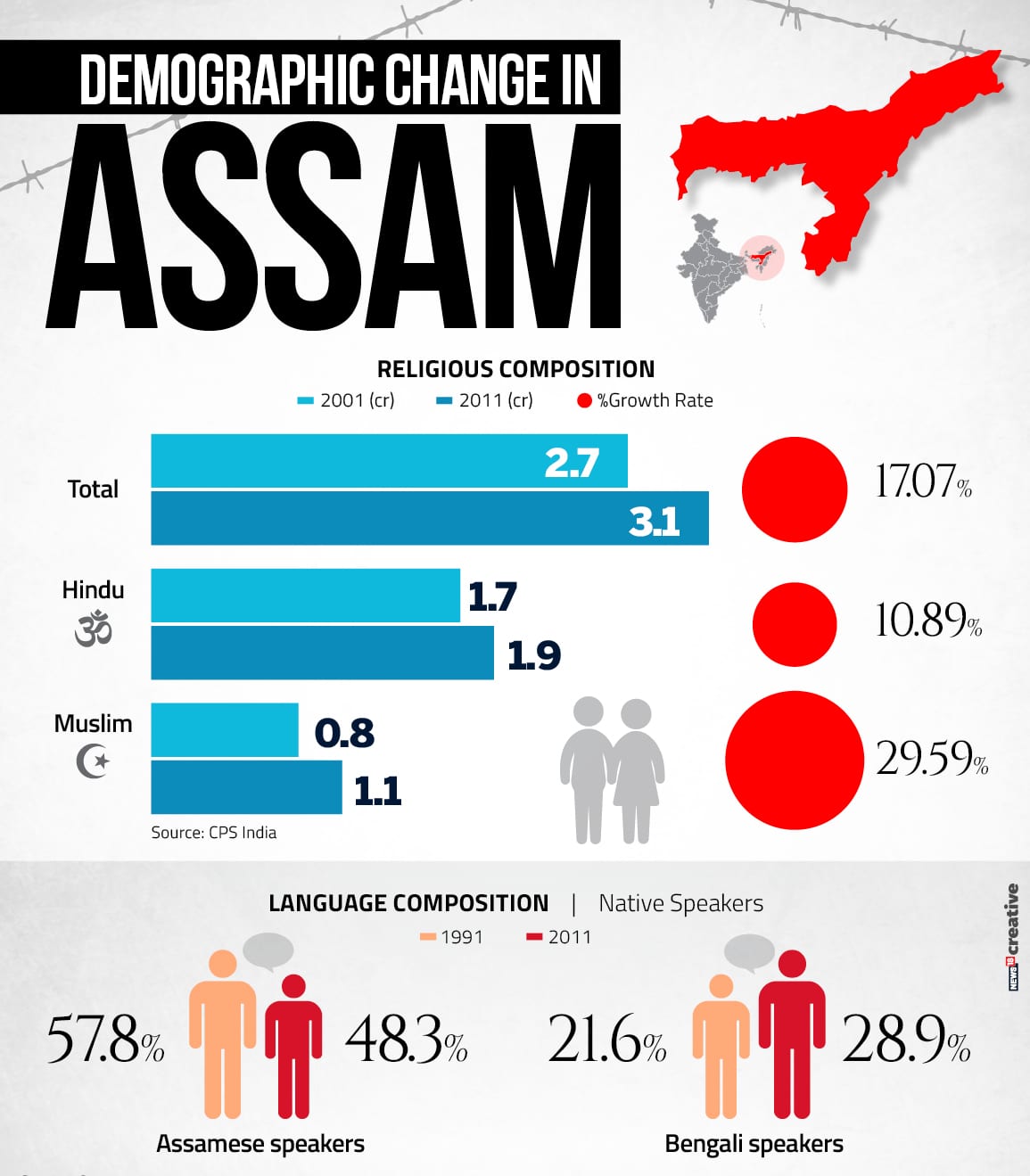
The political calculation seemed straightforward: consolidate the Hindu vote by framing the NRC as a tool for national security and cultural preservation, while using the CAA to protect the party's non-Muslim constituents. The Assam exercise was supposed to be the successful proof of this concept.
The Assam Reality Check: A Failed "Proof of Concept"
The Assam NRC, however, turned out to be a political and logistical disaster that provided a series of powerful arguments against a nationwide rollout. The experience exposed fatal flaws in the BJP's strategy.
A comprehensive analysis from the Migration Policy Institute lays bare how the Assam outcome undermined the very premises of a nationwide NRC.
Article: A Proxy War on Minorities? India Crafts C.. | migrationpolicy.org
This article provides an excellent overview of how the practical experience in Assam directly complicated the feasibility of a national NRC. It combines political analysis with demographic data.
Please read the following three sections: Under the heading "Implementation of a Registry of Citizens in Assam," read the three-sentence paragraph that details the demographic breakdown of the 1.9 million people excluded. This is the single most important fact that undermined the political logic of the NRC. Next, read the section titled "Bangladeshi Migrants: A Problem or Scapegoats?" Focus on the official census data presented, which shows a declining, not rising, number of Bangladeshi-born residents in India. Then, review the analysis of economic and social indicators in Bangladesh. This section challenges the core narrative used to justify the need for an NRC. Finally, read the "Conclusion" section. Pay close attention to the arguments about the practical difficulties of proving citizenship in India and the problem of state government opposition.
The reading highlights three critical ways the Assam NRC complicated a nationwide rollout:
-
The Demographic Boomerang: The most devastating blow was the discovery that of the 1.9 million people excluded, a majority—an estimated 1.1 million—were Hindus. This completely inverted the BJP's political narrative. An exercise meant to target "illegal Muslim immigrants" ended up threatening the citizenship of a huge number of Hindus, a core part of the party's vote bank. The prospect of replicating this on a national scale, creating chaos and anxiety among their own supporters, was politically terrifying.
-
The Narrative Collapse: As the article points out, the BJP's rhetoric was built on the idea of millions of "termites" or "infiltrators" overrunning the country. However, the Assam NRC's final number, while devastating for the 1.9 million people involved, was far lower than the hyperbolic figures of 5-10 million often cited by agitators. Furthermore, as you read, economic and census data suggest the entire premise of mass illegal immigration from Bangladesh is questionable, weakening the central justification for such a drastic and disruptive national exercise.
-
The Logistical Nightmare: Assam, a state with a long history of this specific political issue, struggled for years under Supreme Court supervision to produce a list that was ultimately rejected by all. The process exposed the immense difficulty of demanding documentary proof of ancestry in a country with high rates of illiteracy, poor record-keeping, and widespread poverty. The idea of scaling this bureaucratic quagmire to a nation of 1.3 billion people, with many state governments openly hostile to the idea, began to look not just difficult, but politically suicidal.
The Political Retreat
The combination of the Assam NRC's messy outcome and the massive, nationwide protests against the CAA in late 2019 and early 2020 forced the government into a strategic retreat. The public face of this pivot was a dramatic speech by Prime Minister Narendra Modi at Ramlila Maidan in Delhi.

Faced with mounting pressure, the Prime Minister chose to publicly distance his government from its own stated policy, directly contradicting his Home Minister.
Why PM Modi chose to contradict Amit Shah's NRC vow - India Today
This India Today article captures the immediate political shock of the Prime Minister's statement and connects it directly to the fallout from the Assam NRC.
Please read the introductory section, focusing on Modi's statement that there had been no discussion on a nationwide NRC. Then, read the section starting with "The exercise excluded", which explicitly links the BJP's rejection of the Assam list to the fact that it excluded more Hindus.
This public contradiction between the Prime Minister and the Home Minister was a clear signal that the political calculus had changed. The NDTV video below delves into the debate that ensued, analyzing whether this was a deliberate "rethink" forced by the Assam experience and public protest.
Did The BJP Government Not Discuss NRC At All? | NDTV Newsroom Live
This news analysis explores the ambiguity and political significance of Prime Minister Modi's apparent U-turn on the nationwide NRC.
First, watch the initial segment from the introduction to understand the core contradiction between the Prime Minister's claim and the Home Minister's repeated assertions. Then, skip to the analysis starting at "one other way of looking at this". This section is key. It argues that the protests and the practical lessons from Assam likely forced the government to "go soft" on the NRC. Note the contrast drawn between Amit Shah's early, aggressive "termites" rhetoric and the government's later, toned-down description of the NRC as a simple "clerical exercise."
As the video analysis suggests, the experience in Assam transformed the NRC from a perceived political masterstroke into a liability. The government, having witnessed the chaos firsthand, was forced to beat a hasty retreat. What was once trumpeted as a decisive nationalist policy was now being downplayed as a mere administrative task that hadn't even been formally discussed.
Conclusion
In this lesson, we have seen how the ambition for a nationwide NRC collided with the messy reality of its implementation in Assam. The Assam exercise, intended as a successful model, instead became a cautionary tale that effectively scuttled the BJP's national plans.
Here are the key takeaways:
- Political Backfire: The Assam NRC was politically devastating for the BJP because it excluded a large number of Hindus, undermining the exercise's intended communal logic and alienating the party's own voters.
- Narrative and Logistical Failure: The process failed to validate the high-pitched rhetoric about massive illegal immigration and exposed the immense practical difficulties of conducting such an exercise, making a national rollout seem untenable.
- Forced Strategic Retreat: Faced with the lessons from Assam and widespread public protests against the CAA-NRC combination, the government publicly pivoted. Prime Minister Modi's denial of any plans for a nationwide NRC was a clear signal that the political viability of the project had collapsed.
The Assam NRC demonstrated that a bureaucratic process of citizenship verification cannot be neatly controlled to produce a desired political outcome. Its failure was a critical factor in forcing the government to shelve one of its most prominent and controversial electoral promises. In our next and final lesson of this module, we will examine the final piece of this puzzle: how the indefinite postponement of the 2021 Census became the functional mechanism for putting both the nationwide NRC and the CAA's implementation on ice.