Welcome back. In our previous lesson, we traced the remarkable political arc of Rahul Gandhi, which culminated in the INDIA bloc's strong 2024 election performance and his acceptance of the role of Leader of the Opposition. We concluded that a renewed persona and a powerful narrative centered on the Constitution had successfully repositioned him as the anchor of a revitalized opposition.
Now, we shift our focus from the momentum of the campaign to the challenging realities of governance and opposition management. The very diversity that gave the INDIA alliance its collective strength—a tapestry of powerful regional parties—also contains the seeds of its potential fragility. This lesson will assess the immense challenge of maintaining opposition unity in the post-election landscape. We will move beyond the electoral success to examine the structural tensions, competing regional interests, and coordination failures that have already begun to test the bloc's cohesion.
The Paradox of an Alliance: National Unity vs. State-Level Rivalry
At its core, the INDIA alliance is a complex entity: a national coalition of parties that are often fierce rivals at the state level. This inherent contradiction is the central challenge to its long-term unity. The need to defeat the BJP nationally forces cooperation, but the desire to maintain or expand power within their respective states creates constant friction.
Political scientist Eswaran Sridharan provides a clear framework for understanding this dynamic. In an interview with the Center for the Advanced Study of India, he breaks down the structural fragility of the opposition bloc.
Eswaran Sridharan on the 2024 Elections and India's Unique ...
This interview offers a high-level analysis of coalition dynamics in India. Sridharan explains why the INDIA alliance is inherently more fragile than the NDA and identifies the key points of tension.
Please start reading from the question about the Congress and the India Alliance. Read through to the end of the section where Sridharan discusses the fragilities on the INDIA side. Pay close attention to his points about: The emergence of a "loose bipolarity" at the national level. Why he describes the INDIA coalition as "much more tentative, more fragile." The examples of state-level dynamics, such as in Kerala, where national allies are local opponents. The competing ambitions of regional parties like AAP, SP, and TMC to expand their own footprint.
Sridharan's analysis highlights the fundamental problem: the alliance is a patchwork. In states like Kerala, the Congress and the Left Front are the primary combatants, yet they are partners in Delhi. In Punjab and Delhi, the Aam Aadmi Party (AAP) and the Congress are direct competitors. In West Bengal, the Trinamool Congress (TMC) and the Congress have a long history of rivalry.
This map illustrates some of the key states where these tensions are most pronounced, showing the number of Lok Sabha seats at stake.

These regional competitions are not just theoretical. They manifest as real-world conflicts over seat-sharing, issue prioritization, and political leadership, creating fissures that the ruling NDA can exploit.
The First Test: State Elections and the Blame Game
The euphoria of the Lok Sabha results was short-lived. The first major stress test for the INDIA bloc's unity came with the subsequent Vidhan Sabha (State Assembly) elections, particularly in Haryana. The Congress, confident after its strong national performance, decided to contest largely on its own, spurning a potential alliance with AAP. The result was a victory for the BJP, which many analysts believe could have been averted with a united opposition.
The fallout was immediate and exposed the deep-seated friction within the bloc. This news segment from India Today captures the backlash the Congress faced from its own allies.
Congress Faces Backlash Post Haryana Defeat, Allies Urge Reflection | Haryana Election 2024 Results
This report details the criticism directed at the Congress by its allies following the party's defeat in the Haryana Assembly elections.
Please watch the following segments: The introduction, which summarises the criticism from allies like the National Conference and AAP. The analysis of how divisions, lack of mutual trust, and failed seat-sharing arrangements allowed the BJP to win. The discussion on the perception of Congress acting as a 'Big Boss' and refusing to ally with parties like AAP and Samajwadi Party, and the implications for future elections.
The video clearly illustrates several key points of friction:
- Congress's Perceived Arrogance: Allies accused the Congress of acting like a "Big Boss," assuming it could win alone and refusing to accommodate partners.
- Lack of Reciprocity: AAP, in particular, felt that its consistent support for the bloc was not being returned, leading to a breakdown in trust.
- Strategic Failure: The decision to go it alone split the anti-BJP vote, handing an advantage to the incumbent.
The Haryana episode was a textbook example of competing interests. The Congress, seeking to re-establish its own dominance in a state where it has deep roots, prioritized its own revival over the alliance's collective victory. This move, while understandable from the Congress's perspective, damaged the very trust and spirit of accommodation necessary for the bloc's survival.
Disunity on the Grand Stage: Coordination Failures in Parliament
If state elections revealed cracks in the alliance, the Winter Session of Parliament showed them widening. With its increased numbers, the opposition was expected to present a coordinated and powerful challenge to the government. Instead, the session was marked by confusion, a lack of communication, and public disagreements.
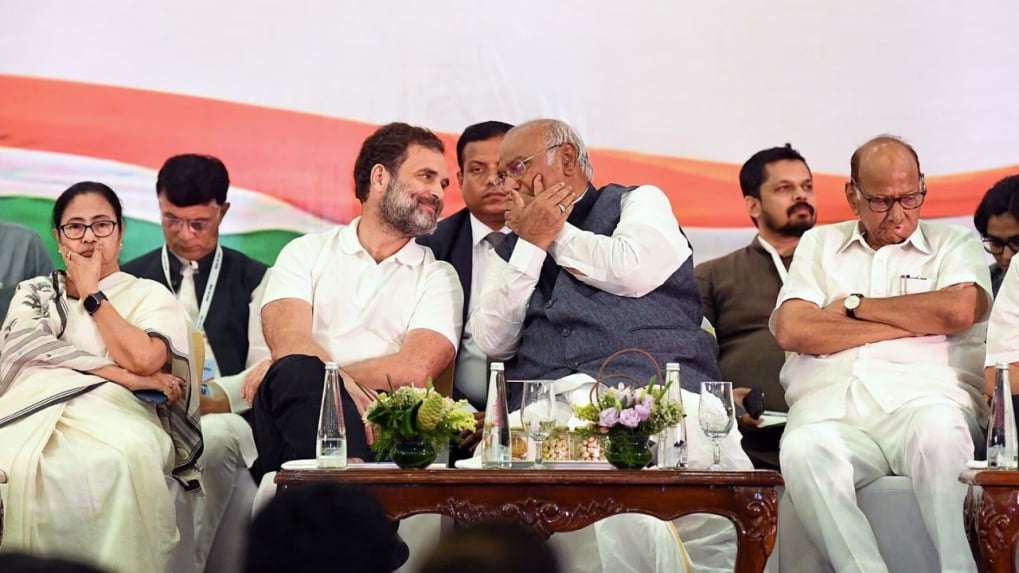
An article in Frontline magazine provides a detailed account of how the opposition's parliamentary strategy faltered due to internal disunity, primarily blaming the Congress for a lack of leadership and coordination.
Parliament's Winter Session shows the opposition can't work together
This article details the specific instances of friction and coordination failure that plagued the INDIA bloc during the 2024 Winter Session of Parliament.
As you read, focus on the concrete examples of disunity: Read the section beginning "The onset of the winter session" to understand how the Haryana and Maharashtra results created initial strain. Continue through the sections titled "The reign of confusion" and "Going solo". Note the specific complaints: no coordination meetings, Rahul Gandhi's perceived unavailability, friction with the Samajwadi Party (SP) over seating and issue priority (Sambhal vs. Adani), and the Congress undertaking solo initiatives. Finally, read the section "Walk-outs and protests", which highlights how different parties pursued their own agendas and how even joint protests saw key allies like TMC and SP abstain.
The article paints a picture of an alliance pulling in different directions. The failure to hold a single coordination meeting post-election is a telling sign of inertia. The public spat between the Congress and the SP over whether the Adani investigation or the Sambhal violence was the more pressing issue reveals a fundamental disconnect in priorities. The SP's dissatisfaction with its seating arrangement, while seemingly minor, points to a deeper feeling of not being given due importance by the Congress.
These are not just teething problems; they are symptoms of the structural fragility that Sridharan identified. Each party is attempting to balance its commitment to the national alliance with the political imperatives of its home state and the ambitions of its leadership.
Conclusion
The strong performance of the INDIA bloc in the 2024 elections was built on a pragmatic, if fragile, unity. However, the period since has demonstrated that maintaining this unity is a far greater challenge than forging it for a single election. The core challenge is threefold:
- Structural Contradictions: Key allies are direct competitors at the state level, creating unavoidable conflicts over power and political space.
- Strategic Divergence: The Congress, as the bloc's largest party, struggles to balance its own revival with the need to be an accommodative leader, leading to missteps like the one in Haryana.
- Coordination Deficits: A lack of consistent communication and joint strategy-making, as seen in the winter session, allows individual party interests to override collective action, weakening the opposition's overall impact.
The road ahead for the opposition is fraught with these internal challenges. The bloc's ability to function as a cohesive unit will depend less on the memory of the 2024 campaign and more on the Congress's ability to evolve into a genuinely consultative leader and the regional parties' willingness to prioritize long-term national goals over short-term state-level gains.
In our next lesson, we will pivot from the informal politics of alliance management to the formal role Rahul Gandhi now occupies. We will explore the constitutional powers, political significance, and historical context of the Leader of the Opposition, a position that is central to the functioning of India's parliamentary democracy.