Welcome back. In our last lesson, we delved into the mechanics and impact of the Bharat Jodo Yatras, establishing them as a powerful catalyst for change in both the Congress party's morale and Rahul Gandhi's public persona. We saw how these marches began to dismantle a decade-old caricature and create tangible electoral gains.
Today, we will build directly on that foundation to evaluate the full arc of Rahul Gandhi's political transformation. We'll move beyond the yatras to analyze other crucial factors—including strategic shifts in messaging and pivotal political events—that reshaped his image. Our focus will be on understanding how a leader often portrayed as reluctant and ineffective evolved into the formally recognized Leader of the Opposition, a constitutional post he had previously eschewed.
A Decade of Misfired Narratives
To appreciate the transformation, we must first understand the starting point. Following the Congress's historic defeat in 2014, Rahul Gandhi and his party struggled for a decade to find a narrative that could effectively counter the Modi-led BJP. Their attempts often failed to resonate or were skillfully neutralized.
The article "Rahul Gandhi dominates every debate. So why does his party keep losing?" from Frontline provides an excellent historical analysis of these narrative struggles.
Rahul Gandhi: Why Parliament Optics Don't Win Votes - Frontline
This article traces the evolution of Rahul Gandhi's political attacks on the Modi government from 2014 onwards. It offers a critical perspective on why his earlier strategies failed to translate into electoral success.
Please read the following sections to understand the pre-transformation context: The years 2014-2018, which covers early criticisms of economic policy and the "suit-boot ki sarkar" slogan. The 2019 campaign, focusing on the aggressive "chowkidar chor hai" slogan and how the narrative was lost after the Pulwama attack. The pandemic period, where despite a major national crisis, the government largely controlled the narrative. As you read, consider this question: What was the common weakness in these different narrative attempts?
The article illustrates a pattern. The "suit-boot ki sarkar" slogan, while catchy, failed to dent the Prime Minister's pro-poor image. The "chowkidar chor hai" attack in 2019 was a direct, personal accusation of corruption. It was deftly turned into an affirmation of nationalist pride ("main bhi chowkidar") following the Balakot airstrikes, making the Congress's campaign appear unpatriotic and out of touch with the national mood. Even during the immense suffering of the COVID-19 pandemic, the opposition's criticisms did not coalesce into a durable political narrative against the government.
These failures established the dominant image of Rahul Gandhi: a leader whose political instincts led him toward direct, often personal, confrontations that ultimately proved electorally ineffective. This was the perception that needed to be fundamentally altered.
The Engine of Transformation: From Physicality to Ideology
As we established in the previous lesson, the Bharat Jodo Yatras were the primary engine of this change. The sheer physical commitment began to chip away at the "non-serious" caricature. But beyond the physicality, the yatra provided a platform for a crucial ideological repositioning.
This video from India Today, produced during the yatra, captures this shift from a purely electoral focus to a broader battle of ideas.
Can Rahul's Bharat Jodo Yatra Save The Congress? | Nothing But The Truth
This news analysis explores how the yatra was not just about saving the Congress, but about recasting Rahul Gandhi's political identity and message.
Please watch the following segments: First, on the image makeover itself, where the host describes the visual and perceptual change from an "impatient" leader to a "sage-like" figure. Next, on the trinity of issues that formed his new message: economic inequality, social polarization, and political authoritarianism. Then, review the survey data presented, showing a "v-shaped recovery" in his approval ratings. Finally, note the analyst's conclusion that the yatra gave him the moral legitimacy to lead decisively.
The yatra did three things simultaneously:
- It changed his persona: The endurance test created an image of seriousness and perseverance.
- It shifted his message: He moved away from narrow, event-specific attacks towards a broader ideological critique of the BJP/RSS vision for India.
- It gave him authority: The public response and the sheer scale of the endeavor gave him renewed moral and political standing within his own party and the wider opposition.
An academic paper from the Journal of Emerging Technologies and Innovative Research reinforces this, concluding that the yatra was pivotal in changing his public image.
[PDF] Bharat Jodo Yatra and Its Impact on the 2024 Lok Sabha Elections
This paper analyzes the yatra as a political communication strategy.
Please read the two short sections under "6. Findings and Discussion" titled "Positive publicity" and "The impact on the Lok Sabha Elections 2024." These sections summarize how the yatra systematically rebuilt his image and established him as the opposition's face.
The paper highlights that the yatra "debunked his portrayal as a non-serious and naïve political leader" and "established Rahul Gandhi as the face of the Opposition." This wasn't just a PR success; it was a fundamental repositioning that set the stage for the 2024 election campaign.
The Master Narrative: A Fight for the Constitution
The new persona and broadened message needed a powerful, unifying symbol. That symbol became the Constitution of India. This narrative was powerfully amplified by a key political event: Rahul Gandhi's disqualification from Parliament in March 2023 following a criminal defamation conviction, a decision later stayed by the Supreme Court. This episode, widely seen by the opposition as political persecution, perfectly aligned with his message of institutional capture.
In a post-election interview, Rahul Gandhi himself explained how this narrative came to life and resonated with the public.
‘The Institutions Have Been Captured’: Rahul Gandhi Speaks On Indian Election Results In Washington
Speaking in Washington D.C. after the 2024 election results, Rahul Gandhi reflects on the campaign and the factors that led to the opposition's surprising performance.
Watch the segment from this point in the video, where he describes the moment he realized the power of the Constitution as a political symbol. He explains how the abstract idea of "captured institutions" became concrete for ordinary people when framed as a direct threat to the Constitution.
This was the masterstroke. Holding up the little blue book of the Constitution in rally after rally transformed the election from a referendum on the government's performance into a fight for India's soul. It was a narrative that was:
- Inclusive: It appealed to Dalits, Adivasis, minorities, and other marginalized groups who saw the Constitution as the ultimate guarantor of their rights.
- Ideological: It framed the contest as one of constitutional democracy versus authoritarianism, elevating the debate above personal attacks.
- Effective: It was simple, visual, and deeply resonant, finally giving the opposition a message that could not be easily co-opted or dismissed.
Culmination: The Leader of the Opposition
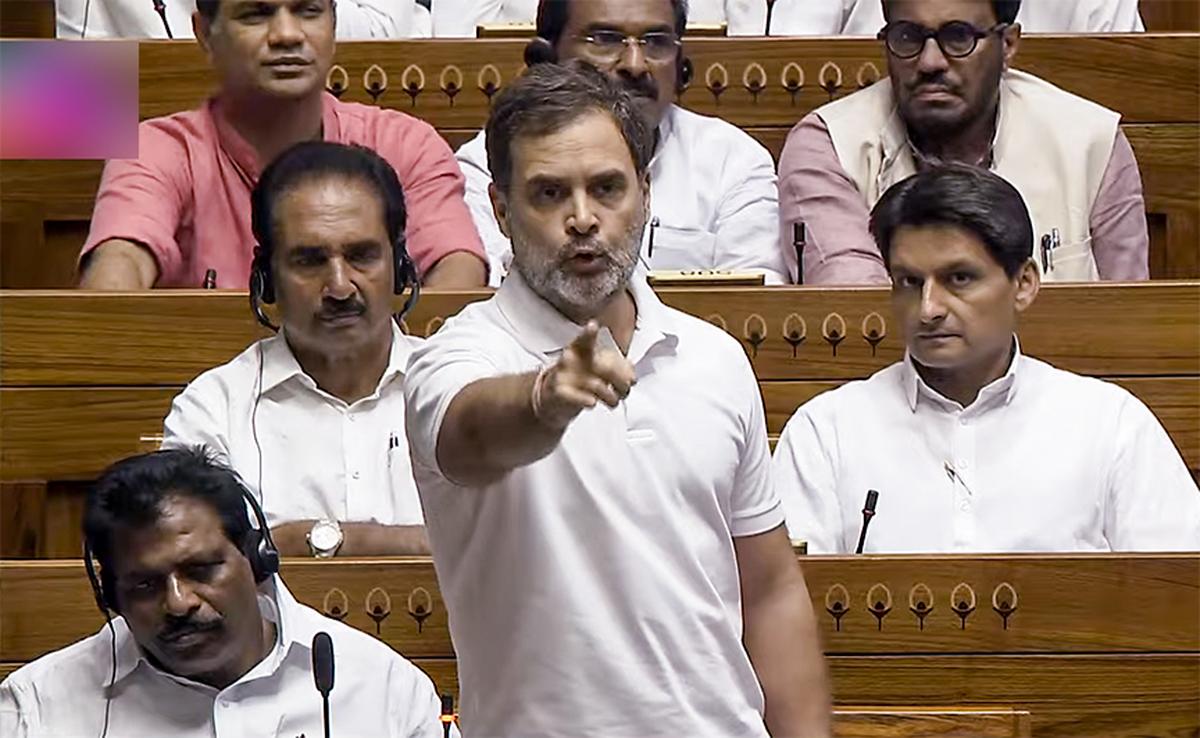
The 2024 election results—with the Congress nearly doubling its seat count to 99—were the political validation of this transformed image and strategy. The party's performance cemented its position as the anchor of the INDIA bloc and made Rahul Gandhi the inevitable choice for Leader of the Opposition (LoP).
The significance of his acceptance of this role cannot be overstated. After the 2019 defeat, he had resigned as Congress President, steadfastly refusing to take up a formal leadership post for five years. His decision to now become the LoP signaled a full embrace of institutional responsibility. It was the final step in his transformation: from a reluctant heir and street-fighter to the formal, constitutional head of the parliamentary opposition.
Conclusion
The transformation of Rahul Gandhi's image was not a single event but a multi-stage process. The failures of 2014-2022 created the necessity for a new approach. The Bharat Jodo Yatras provided the physical and moral foundation for an image makeover. This was then fused with a powerful, unifying ideological narrative centered on defending the Constitution. The 2024 election results provided the political mandate, and his acceptance of the LoP role marked the institutional culmination of this decade-long political arc.
Key Takeaways:
- Rahul Gandhi's pre-2022 political narratives were often personal and confrontational (e.g., "chowkidar chor hai") and proved electorally ineffective.
- The Bharat Jodo Yatras were the critical turning point, recasting his image as a serious, perseverant leader and giving him the moral authority to lead.
- The strategic shift to a broad, ideological narrative of "saving the Constitution" proved far more effective than previous attacks, resonating deeply with marginalized communities.
- His acceptance of the Leader of the Opposition role completed the transformation, signaling a new commitment to formal institutional politics after years of reluctance.
In our next lesson, we will examine the road ahead. Having consolidated his position as the undisputed leader of the opposition, we will assess the immense challenge Rahul Gandhi now faces in maintaining the unity of the diverse and often-conflicting interests within the INDIA bloc.