In our previous lesson, we analyzed the strategic evolution of the INDIA alliance, charting its journey from a tactical necessity to a surprisingly effective electoral force in the 2024 elections. We saw how a fragmented opposition managed to coalesce around a powerful "Save the Constitution" narrative. Today, we turn our focus to one of the central catalysts of this revival: Rahul Gandhi's extensive cross-country marches.
This lesson will analyze the political and public-perception impact of the Bharat Jodo Yatra and the Bharat Jodo Nyay Yatra. We will move beyond simple descriptions of the routes covered and examine these marathon campaigns as significant political events. Our goal is to dissect their effect on three distinct but interconnected fronts: reinvigorating the Congress party organization, transforming the public image of Rahul Gandhi, and, most critically, influencing electoral outcomes.
The Yatras: Concept and Execution
Between late 2022 and early 2024, Rahul Gandhi undertook two massive public outreach campaigns.
- The Bharat Jodo Yatra (BJY): A 150-day, 4,000+ km march on foot from Kanyakumari to Kashmir. Its stated themes were unity against social polarization, and raising awareness about economic distress and unemployment.
- The Bharat Jodo Nyay Yatra (BJNY): A 6,700 km journey, mostly by bus, from Manipur in the east to Mumbai in the west. This yatra added the theme of "Nyay" (Justice), focusing on social, economic, and political justice, and laying the groundwork for the Congress's election manifesto.
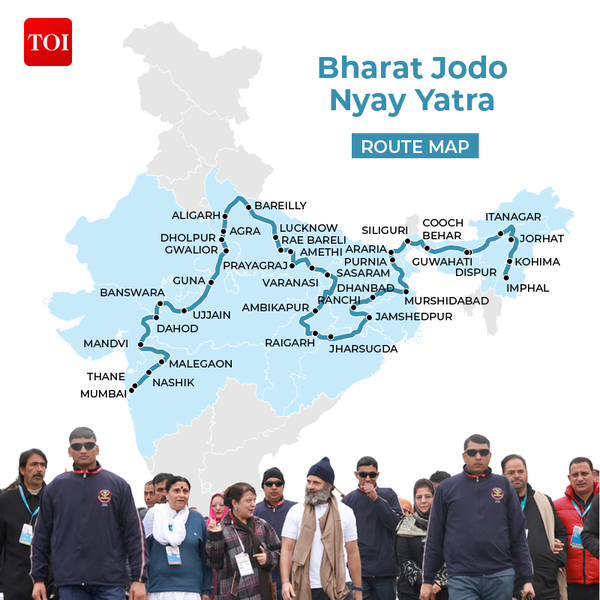
These yatras were an exercise in political communication designed to bypass traditional media, where the opposition often struggled for favorable coverage, and to establish a direct connection with the electorate.
Impact on Public Perception: Deconstructing a Caricature
For nearly a decade, a central element of the BJP's political strategy was the carefully constructed caricature of Rahul Gandhi as a reluctant, non-serious political heir, encapsulated by the dismissive moniker "Pappu." The Bharat Jodo Yatra was, first and foremost, a direct assault on this persona. The sheer physical endurance of the march, combined with constant public interaction, began to create a new narrative.
Political activist and intellectual Yogendra Yadav, who participated in the yatra, provided one of the most insightful contemporary analyses of this transformation.
[PDF] All the criticism against Bharat Jodo Yatra shows it has arrived in the ...
In this article for The Indian Express, written while the first yatra was underway, Yogendra Yadav assesses its ideological and political achievements. He argues that its most significant impact was on Rahul Gandhi's personal image.
Please read the sections titled "Sharpen the message, widen its reach" and "Modi’s biggest weapon blunted." Focus on how Yadav describes the yatra's challenge to the BJP's ideological hegemony and, specifically, his conclusion that "The pappu sticker has come off."
Yadav's analysis highlights a crucial shift. The yatra's imagery—Rahul Gandhi walking through rain, engaging with farmers, and embracing supporters—projected perseverance and empathy. This "re-enchantment" of concepts like love and unity, as Yadav puts it, served as a direct ideological counterpoint to the BJP's muscular nationalism. By discrediting the messenger's caricature, the yatra forced a more serious engagement with the message itself.
However, this rebranding also raised a fundamental question about Rahul Gandhi's ultimate political ambition, a dilemma that has long defined his career. Was this a genuine bid for electoral power, or an attempt to reposition himself as a moral or philosophical guide for the nation, detached from the grubby business of winning elections?
To ‘jodo’ Congress, Rahul Gandhi needs to pick his poison — power or philosophy
This video from ThePrint, produced as the Bharat Jodo Yatra entered Delhi, frames this central tension perfectly. Analyst Shekhar Gupta explores whether Rahul Gandhi seeks power, which he once famously described as "poison," or a more philosophical role.
Watch the following segments: First, the framing of the Congress's continued relevance and the BJP's paradoxical obsession with it, from the host's analysis. Next, the core of the argument about Rahul Gandhi's ambition, questioning whether he wants power or a moral role. Finally, observe how the yatra lifted the party's morale but didn't resolve this central ambiguity for its politicians, from the analysis of its internal impact.
This analysis introduces a critical layer of complexity. While the yatra undeniably succeeded in changing public perception, it left unresolved the core question for the Congress party: was their leader fully committed to the pursuit of electoral power, or was he charting a different, more ambiguous political path?
Political Impact: Galvanizing the Cadre
Beyond public perception, the yatras had a profound internal effect on the Indian National Congress. After the crushing defeats of 2014 and 2019, the party organization was demoralized and largely inactive. The yatras served as a massive mobilization exercise, forcing local units across the country to organize and participate, thereby breathing life back into a dormant party structure.
Watch Full Debate: Has Rahul Gandhi Undone Bharat Jodo Yatra Gains? Furore Over Rahul's UK Remarks
In this India Today debate, pollster Yashwan Deshmukh and Congress spokesperson Aishwarya Mahadev discuss the impact of the yatra. Their comments shed light on both the internal party dynamics and the broader electoral context.
Watch the initial exchange. First, listen to Yashwan Deshmukh's data-driven analysis of Rahul Gandhi's popularity, noting that his numbers were rising but primarily among the existing opposition base. Then, pay close attention to Aishwarya Mahadev's response, where she emphasizes the yatra's role in galvanizing the party cadre for the upcoming elections.
The Congress spokesperson's point is crucial. The yatras created a sense of purpose and activity. For hundreds of thousands of party workers, it was a tangible event to rally around, reconnecting them with the central leadership and providing a much-needed morale boost. This organizational revitalization was a necessary, though not sufficient, condition for the improved electoral performance that would follow.
Electoral Impact: Translating Footfalls into Votes
The ultimate measure of any political campaign is its electoral success. Did the yatras' massive public outreach and media attention translate into votes?
The first major test came in the May 2023 Karnataka Assembly elections. The Bharat Jodo Yatra had spent a significant amount of time in the state, and the results were striking.
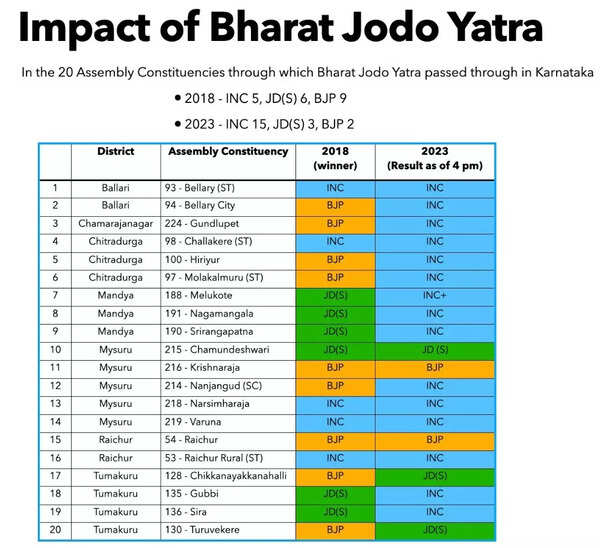
This dramatic swing in Karnataka provided the first concrete evidence that the yatra could have a tangible electoral payoff. The analysis of the 2024 Lok Sabha elections further corroborates this trend on a national scale.
[PDF] A Study of the Congress Party's Strategies in the 2024 General ...
This academic paper quantifies the electoral impact of both yatras in the 2024 general election by analyzing the results in the specific constituencies they traversed.
Please read the entire section titled "The Bharat Jodo Yatra." Pay close attention to the specific numbers presented for both the first and second yatras. The paper breaks down the seats contested and won by the Congress and its allies in these constituencies in 2019 versus 2024, concluding with a combined net gain.
The data from the paper is compelling:
- Bharat Jodo Yatra (Phase 1): In the constituencies it covered, the Congress's seat tally increased from 15 in 2019 to 23 in 2024. Its allies also saw an increase.
- Bharat Jodo Nyay Yatra (Phase 2): In these constituencies, the Congress tally rose from 6 to 17, while its allies went from 0 to 18 seats.
- Combined Impact: The paper cites a report noting a total increase of 41 seats for the INDIA bloc across the constituencies covered by both yatras.
This data suggests a strong correlation between the yatras and the opposition's improved electoral fortunes. While not the sole factor, the focused outreach, media coverage, and organizational energy generated by the marches appear to have delivered a significant electoral dividend, contributing directly to the INDIA bloc's resurgence and the BJP's loss of an outright majority.
Conclusion
The Bharat Jodo Yatras were a multifaceted political intervention with significant consequences. They successfully deconstructed a long-standing political caricature of Rahul Gandhi, recasting him as a determined and serious leader. They served as a vital tool for political mobilization, re-energizing a moribund Congress party organization from the grassroots up. Most importantly, this revival of man and machine translated into tangible electoral gains, as evidenced by the results in Karnataka and, more broadly, in the constituencies touched by the yatras during the 2024 Lok Sabha elections. The marches were a critical chapter in the story of the opposition's revival.
Key Takeaways:
- The yatras' primary public perception achievement was to dismantle the "Pappu" image of Rahul Gandhi, forcing a more serious engagement with him and his message.
- Internally, the campaigns served as a massive mobilization exercise that revitalized the demoralized Congress party cadre across the country.
- Quantitatively, there is a strong correlation between the yatras and improved electoral performance, demonstrated by significant seat gains for the INDIA bloc in constituencies along the march routes.
- The yatras successfully combined ideological messaging (unity, justice) with a physical demonstration of perseverance, creating a powerful political narrative that resonated with a segment of the electorate.
In our next lesson, we will broaden our lens to evaluate the complete transformation of Rahul Gandhi's image. We will examine how the momentum from the yatras, combined with his subsequent strategic decisions, led to his assumption of the role of Leader of the Opposition, a formal constitutional position that marks a new phase in his political career and for the Indian opposition.