Introduction
Welcome to our next lesson. In our previous session, we analysed the Ellsberg Paradox, which revealed our inherent aversion to ambiguity—the preference for making decisions with known probabilities (risk) over unknown ones. We saw how this could influence a choice between a familiar material with known performance data and a novel one with unknown potential.
Today, we address a different kind of decision-making challenge: what to do when faced with two options that are not ambiguous, but are in fact both known to be equally good? This is the essence of Buridan's Paradox. Our goal is to analyse Buridan's Paradox and devise tie-breaking criteria for decisions between equally attractive options.
This state of perfect balance can lead to a debilitating paralysis, whether in creative design, business strategy, or personal relationships. This lesson will equip you with the frameworks to understand this paralysis and, more importantly, to break through it.
1. The Parable of the Starving Ass
The paradox is famously illustrated by a thought experiment, though it was likely formulated by critics of the philosopher Jean Buridan rather than by Buridan himself.
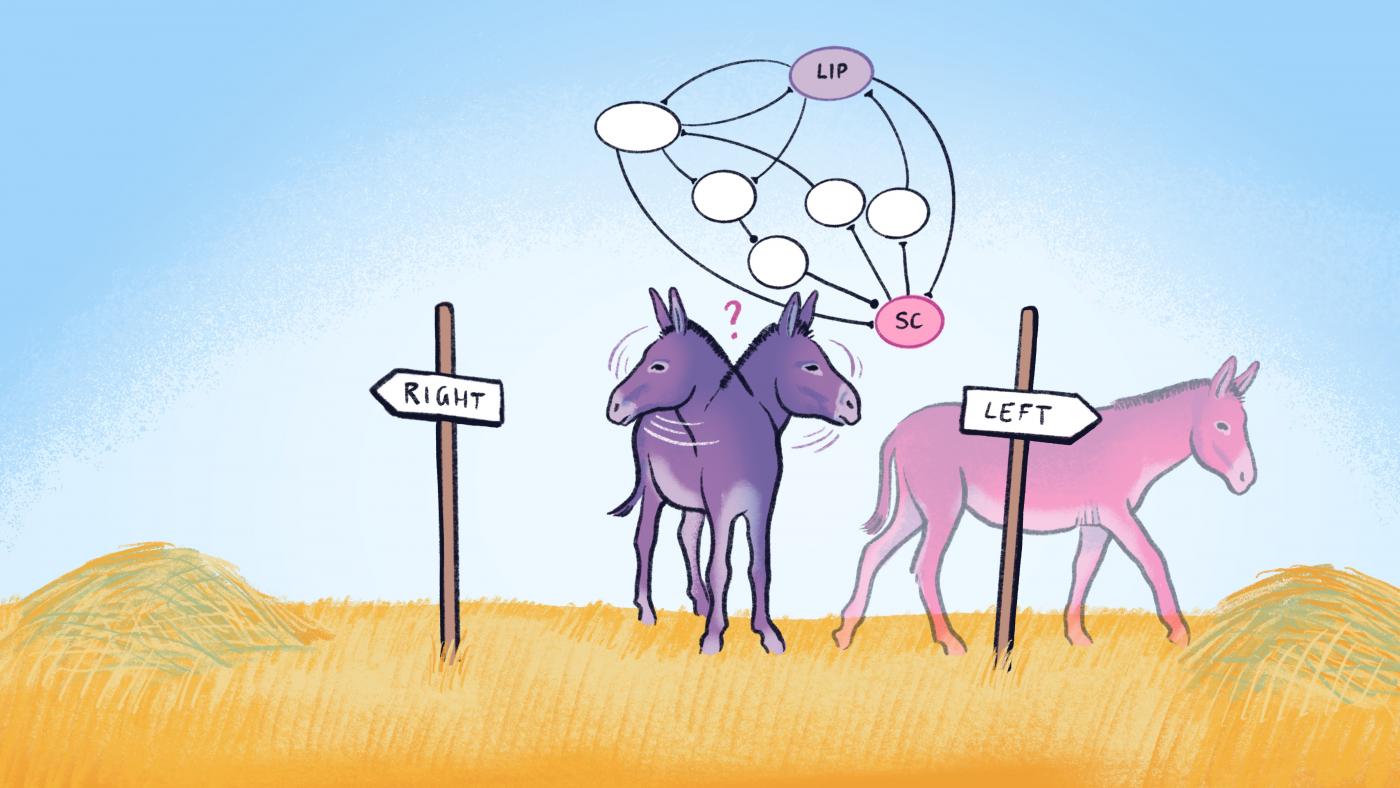
The core of the paradox is this: if a rational being is presented with two equally attractive options, and every reason for choosing one is perfectly balanced by a reason for choosing the other, how can a decision ever be made? Rational choice seems to require a reason to prefer one option, but here, no such reason exists.
To understand the philosophical underpinnings of this problem, let's explore its origins.
Some Logical Paradoxes from Jean Buridan
This document, 'Some Logical Paradoxes from Jean Buridan', introduces the classic paradox. It also presents a similar, earlier formulation by the philosopher Al-Ghazali, which helps clarify the core dilemma.
Please read section 7, 'Buridan's Ass (Or, Al-Ghazali’s Dates)'. Pay close attention to the three possible responses to Al-Ghazali's problem and how Buridan's and Ghazali's own conclusions differ. This will frame our analysis.
As the reading shows, the analysis of this problem leads to a few distinct philosophical positions:
- Paralysis (Buridan's View): A truly rational agent cannot break the deadlock. The will must suspend judgment until the situation changes, providing a new reason to favour one option. The donkey starves.
- Arbitrary Choice (Ghazali's View): To avoid paralysis, the will must possess a power to choose arbitrarily—to distinguish one thing from its identical twin without a rational basis. The man simply takes one of the dates.
- Denial of the Premise: The paradox is purely theoretical. In the real world, no two options are ever perfectly identical or equally attractive. There will always be some small, distinguishing factor.
While the philosophical debate is interesting, our goal is practical: to find strategies to break the tie when options feel perfectly balanced, even if they aren't in some objective, microscopic sense. The cost of indecision itself—the "starvation"—is often greater than the marginal difference between two excellent choices.
2. Devising Tie-Breaking Criteria: From Paralysis to Process
The key to overcoming Buridan's Paradox is to shift from a value-based mindset (which one is better?) to a reason-based one (what is a justifiable reason for choosing?). When the values are equal, we must generate a new reason. Here are three powerful criteria for doing so.
Criterion 1: The Lexicographic Rule
This strategy involves breaking down the options into their core attributes and then ranking those attributes by importance. Instead of comparing the options as a whole, you compare them on your single most important criterion. If there's a winner on that criterion, the choice is made. If they are still tied, you move to the second most important criterion, and so on, until the tie is broken.
This approach provides a clear, defensible reason for your choice, based on your own stated priorities.

This method forces you to articulate what truly matters most, turning a holistic stalemate into a sequential, solvable problem.
Criterion 2: The Arbitrary Rule (Systematic Symmetry Breaking)
This may sound unscientific, but it is a highly practical solution when the cost of delaying a decision is high. It accepts Ghazali's premise that a choice must be made and implements a pre-determined, arbitrary rule to break the tie.
Examples of arbitrary rules include:
- "When in doubt, flip a coin."
- "Always choose the option on the right / the first one presented."
- "Assign numbers to the options and use a random number generator."
The point of this rule is not to identify the "better" option, but to make a choice efficiently and commit to it, thereby avoiding the paralysis of indecision. It is most useful when the two options are genuinely close in value and the consequences of choosing either are positive.
Criterion 3: Context Manipulation (The Decoy Effect)
A more subtle approach, drawn from behavioural economics, is to change the choice context by introducing a third option.
The paper 'Reason-based choice' by Shafir, Simonson, and Tversky explores how decisions are made in situations of conflict. It provides empirical evidence for the tie-breaking strategies we're discussing.
Please skim the following sections to see the evidence behind these ideas: Section 1 ('Choice between equally attractive options'): Note Slovic's findings, which are the basis for the Lexicographic Rule. Section 4 ('Choice under conflict: adding options'): Focus on the 'asymmetric dominance effect' (illustrated in its Figure 1) and 'extremeness aversion'. Section 7 ('Concluding remarks'): Read the first paragraph to grasp the core idea that people search for a compelling rationale to justify their choice.
As the research shows, you can break a tie between Option A and Option B in two ways:
- Asymmetric Dominance: Introduce a "decoy" option C that is clearly inferior to A, but not necessarily to B. For example, if you're stuck between two bra designs (A and B), introducing a third design (C) that is similar to A but made with a cheaper fabric can suddenly make A look like the high-quality, justifiable choice. The presence of the decoy provides a new reason to prefer A.
- Extremeness Aversion: If A and B represent two extremes on a spectrum (e.g., a very minimalist design vs. a very ornate one), introducing a "compromise" option that sits between them can resolve the conflict. Alternatively, introducing a new even more extreme option can make one of the original options feel like a safe, middle-ground choice.
This criterion is about actively engineering a reason for choice by changing the landscape of options.
3. Application: A Relationship Deadlock
Let's apply these criteria to a scenario within your interest area of ethical non-monogamy.
Scenario: A husband, wife, and metamour are in a stable "Vee" relationship, with the husband as the hinge partner. The wife and metamour both deeply care for the husband and, without consulting each other, have each planned a surprise for his birthday. Both plans are equally wonderful, thoughtful, and require the husband to make a choice.
- Option A (from the Wife): A quiet, romantic weekend getaway for just the two of them at a secluded cabin, focusing on deep connection and relaxation.
- Option B (from the Metamour): A lively weekend party with all of the husband's closest friends, focusing on celebration and community connection.
The husband is touched by both gestures but finds himself paralyzed. Both options are highly desirable, and choosing one feels like a slight to the other partner. His indecision is causing stress and unhappiness for everyone. He is Buridan's Ass.
Applying the Tie-Breaking Criteria:
-
Lexicographic Rule: The husband must ask himself: "What is the single most important thing I need for my birthday this year?" He needs to define his primary attribute.
- If he's feeling burnt out and craving quiet intimacy, the most important attribute is "restoration." Option A wins.
- If he's feeling isolated and wants to reconnect with his social circle, the most important attribute is "community." Option B wins.
By prioritizing his needs, he creates a non-arbitrary reason to choose one over the other, which he can then communicate lovingly to both partners ("Thank you both for these incredible ideas. This year, I feel I really need to [rest/celebrate], so let's go with [A/B].")
-
Arbitrary Rule: If, after sincere reflection, both options still feel equally needed and valuable, the cost of continued paralysis is too high. He could use a fair, arbitrary process to break the tie. For example, he could propose: "Both of these are perfect. Let's do Option A for my birthday, and commit to doing Option B for the next major holiday." This isn't a random flip of a coin, but it uses a principle of fairness and turn-taking to break the symmetry without devaluing either partner's gift.
-
Context Manipulation: While harder for the husband to apply himself, imagine a friend, trying to help, suggests, "Or you could just do a simple dinner at a restaurant." This bland, low-effort option serves as a decoy. Its presence makes both the cabin trip and the party seem even more special and desirable, reinforcing that there is no bad choice here. This can lower the emotional stakes and make an arbitrary choice (Criterion 2) feel more acceptable.
The analysis shows that the solution to Buridan's Paradox in a real-world situation is not about finding a hidden flaw in one option. It's about consciously adopting a process that generates a justifiable reason to move forward.
Conclusion
Today we've analysed Buridan's Paradox, the classic problem of decision-making paralysis when faced with equally attractive alternatives. We've seen that while philosophically perplexing, it is a solvable problem in practice.
Key Takeaways:
- Buridan's Paradox describes the state of inaction that can result from a perfect balance of reasons between two or more options.
- The primary cost of the paradox is often the delay or inaction itself (starvation), which can be worse than the outcome of either choice.
- You can devise clear tie-breaking criteria to escape this paralysis, including:
- The Lexicographic Rule: Prioritise attributes and choose the option that wins on your most important one.
- Arbitrary Rules: Use a pre-agreed, random, or systematic process to break the symmetry when the cost of delay is high.
- Context Manipulation: Introduce decoys or new options to change the choice landscape and generate new reasons for preference.
Next Lesson Preview:
In our next lesson, we will put these principles into immediate practice. The learning outcome is to apply Buridan's Paradox to resolve a design choice deadlock between two equally promising bra concepts. We will take a concrete design scenario and use the criteria you've learned today to make a final, justifiable decision.