Introduction
Welcome back. In our last lesson, we explored the Inventor's Paradox, discovering that reframing a specific, difficult problem into a more general one can often be the most effective path to a solution. We applied this by transforming a specific relationship conflict into the more solvable problem of designing a fair governance system.
Today, we continue our journey through the decision paradoxes that can challenge rational choice. We'll be examining the Ellsberg Paradox, which takes us into the critical distinction between making decisions under risk versus under ambiguity. Your learning outcome for this lesson is to: Analyse the Ellsberg Paradox to differentiate between decisions under risk (known probabilities) and ambiguity (unknown probabilities).
Given your background in statistics and probability theory, this topic should be particularly interesting. It highlights a fundamental gap between the axioms of classical probability models and the realities of human decision-making when information is incomplete.
1. The Paradox of the Two Urns
The Ellsberg Paradox, named after analyst Daniel Ellsberg who popularised it in a 1961 paper, is best understood through a simple thought experiment involving two urns.
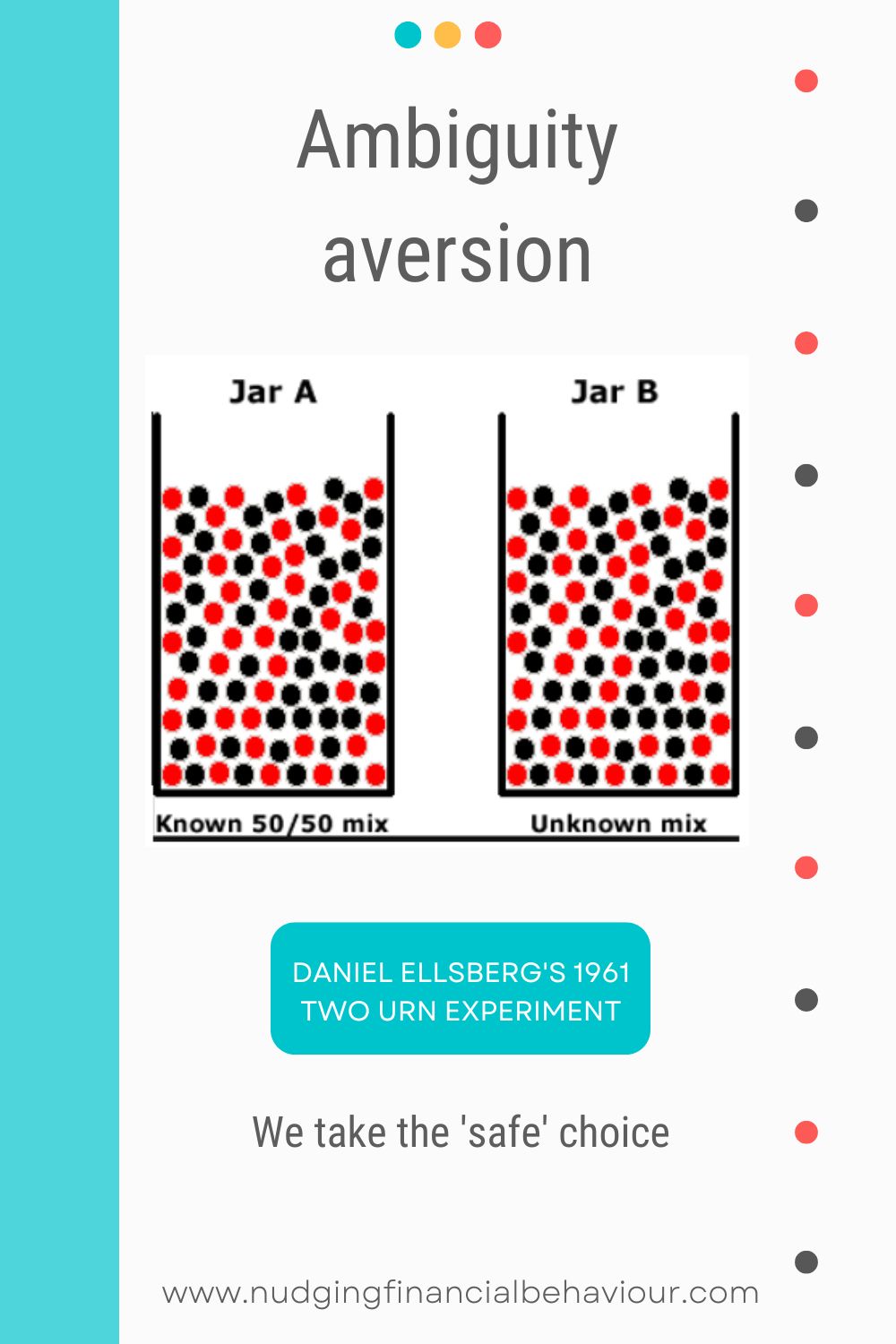
Imagine you are offered a chance to win $100 by drawing a ball of a specific colour.
- Urn A (Risk): Contains exactly 100 balls: 50 are red, and 50 are black.
- Urn B (Ambiguity): Contains exactly 100 balls, which are a mix of red and black, but the proportion is completely unknown. It could be 1 red and 99 black, 99 red and 1 black, or anything in between.
Now, consider two choices:
- Choice 1: Would you prefer to bet on drawing a red ball from Urn A or Urn B?
- Choice 2: Would you prefer to bet on drawing a black ball from Urn A or Urn B?
Most people make the following choices:
- For Choice 1, they prefer to bet on red from Urn A.
- For Choice 2, they also prefer to bet on black from Urn A.
This common pattern of preference is what creates the paradox. To understand why, let's examine the underlying probabilities.
Decision Making under Ambiguity
This document, 'Decision Making under Ambiguity', provides a detailed walkthrough of the Ellsberg Paradox and its implications. It will clarify the logical contradiction at the heart of the typical choices people make.
Please read the section titled 'The Nature of Uncertainty and Ambiguity'. Focus on the explanation starting with 'Ellsberg used the following example...' and ending just before the paragraph that begins 'Ellsberg's paradox demonstrates...'. This will guide you through the implied probabilities of the choices.
As the text explains, preferring Urn A for a red ball implies that you believe the subjective probability of drawing red from Urn A is greater than from Urn B: . Since we know , this means you are acting as if .
However, by also preferring Urn A for a black ball, you imply . Since , this means you are acting as if .
Here lies the contradiction. If you believe and , then the sum of the probabilities for the only two outcomes in Urn B is less than 1 (). This violates a fundamental axiom of probability theory. This systematic preference for known probabilities over unknown ones is known as ambiguity aversion.
2. Risk vs. Ambiguity: A Formal Distinction
The paradox forces us to make a clear distinction between two types of uncertainty, a distinction first articulated by economist Frank Knight in 1921.
To solidify these definitions, please read the following brief section.
Risk behind the veil of ambiguity: Decision‐making under social and ...
This article, 'Risk behind the veil of ambiguity', offers a concise and modern framing of the distinction between risk and ambiguity.
Please read the two paragraphs under the heading '2.1. General framework of risk and ambiguity in uncertainty'. Pay close attention to how it defines risk based on Knight's work and ambiguity based on Ellsberg's.
As the reading clarifies:
- Risk: Refers to a situation where you don't know the outcome, but you know the underlying probability distribution. Urn A is a perfect example of risk. You don't know if you'll draw red or black, but you know the exact probability is for each.
- Ambiguity: Refers to a situation where not only is the outcome unknown, but the underlying probability distribution is also unknown. This is sometimes called "Knightian uncertainty." Urn B is a situation of ambiguity.
The paper "Decision Making under Ambiguity" provides a useful spectrum:
- Ignorance: No probability distributions can be ruled out (Urn B before any draws).
- Ambiguity: Some, but not all, distributions can be ruled out (e.g., after drawing a few balls from Urn B, you have some information, but not certainty).
- Risk: All but one distribution is ruled out (Urn A).
This preference for risk over ambiguity is so pervasive it is often called the Ambiguity Effect.

3. Analysing the Ambiguity Effect
Why do people consistently violate the axioms of subjective expected utility theory in this way? The analysis goes deeper than simply stating that people dislike the unknown.
First, the aversion to ambiguity is not absolute. Ellsberg himself proposed a scenario where people might seek ambiguity. Imagine two urns, each with 1000 balls numbered 1 to 1000.
- Urn 1 (Risk): Contains one ball for each number. The probability of drawing any specific number (e.g., #687) is exactly 0.001.
- Urn 2 (Ambiguity): The proportion of balls with number #687 is unknown. It could be 0, or it could be all of them.
If offered a large prize for drawing ball #687, many people prefer to draw from Urn 2. Here, the ambiguity is attractive. This suggests that our attitude towards ambiguity might depend on the situation.
Models have been developed to account for this behavior. They propose that when faced with ambiguity, people use an "anchoring-and-adjustment" strategy. They might start with a best-guess probability (the anchor, e.g., 0.5 in the first urn problem) and then adjust it based on their attitude towards the ambiguity.
- For moderate-probability gains (like the 50/50 urn), people are often cautious, adjusting the subjective probability downwards. This leads to ambiguity aversion. .
- For low-probability gains (like the 1000-ball urn), people can be more optimistic, adjusting the subjective probability upwards. This leads to ambiguity seeking. .
Furthermore, this attitude can flip for losses. People tend to be ambiguity-averse for low-probability losses (e.g., buying insurance) but may become ambiguity-seeking for high-probability losses. The key takeaway for our analysis is that ambiguity isn't just "noise"; it's a distinct factor that people weigh in their decisions, often in complex, context-dependent ways that lead to non-additive subjective probabilities.
4. Application: Choosing Materials for a New Bra Design
Let's apply this to your domain of lingerie design. Imagine your company is developing a new cleavage-enhancing bra and must choose between two innovative materials for the cup structure.
-
Material A (Risk): This is a new generation of memory foam from a trusted supplier. Your company has used previous versions and has extensive lab data on this new one. The data shows it provides excellent lift and shape, with a known performance profile: for a given cost, there is a 95% probability of meeting all desired performance metrics for the product's expected lifespan and a 5% probability of premature material fatigue (losing shape). The supply chain is stable and costs are fixed.
-
Material B (Ambiguity): This is a revolutionary bio-adaptive fabric from a new startup. The technology is proprietary and claims to use body heat to mold into a perfect, supportive shape that is superior to any foam. The supplier has provided a few impressive samples and glowing testimonials, but there is no independent, long-term performance data. The potential upside is a market-disrupting product. The potential downside is completely unknown—the fabric could have a high failure rate, cause skin irritation, or face production issues.
Analysis using the Ellsberg Paradox:
- Differentiating the Decision: The choice here is not a simple risk calculation. Material A presents a situation of risk. The 5% failure rate is a known quantity. Your team can model it, budget for warranty claims, and make a standard cost-benefit analysis. Material B presents ambiguity. The probability of success or failure is unknown.
- Predicting the Choice: The Ellsberg Paradox predicts that most decision-makers, especially in a corporate setting, will exhibit strong ambiguity aversion. They will feel a powerful psychological pull towards Material A, even if the potential reward from Material B is enormous. The known 5% risk is uncomfortable but manageable; the unknown risk of Material B is psychologically daunting.
- The Core of the Paradox in Action: A purely "rational" actor might try to assign a subjective probability to Material B's success and proceed. However, the ambiguity itself becomes a heavily weighted negative factor in the decision. The product development team might even prefer a different known material with a higher risk (e.g., a 10% failure rate) over the ambiguous Material B, because the risk is quantifiable and can be managed. The decision is driven not just by the probability of outcomes, but by the certainty with which those probabilities are known. To choose Material B would require a culture that explicitly rewards taking leaps into the unknown—a culture of ambiguity seeking.
Conclusion
Today, we have delved into the Ellsberg Paradox, a cornerstone of behavioural economics that reveals a critical flaw in classical models of rational choice.
Key Takeaways:
- Risk vs. Ambiguity: You can now clearly differentiate between decisions under risk, where outcome probabilities are known, and decisions under ambiguity, where they are unknown.
- Ambiguity Aversion: We analysed how the paradox demonstrates a common human bias to prefer known risks over unknown ones, even when it leads to logical contradictions. This is the "Ambiguity Effect."
- Context is Key: This aversion is not universal. People may become ambiguity-seeking in certain contexts, such as when dealing with low-probability gains or high-probability losses.
- Application: The distinction is highly relevant in business strategy, such as when choosing between investing in a proven technology with known limitations (risk) versus a novel technology with unknown potential (ambiguity).
Next Lesson Preview:
In our next lesson, we will examine Buridan's Paradox. This paradox tackles a different decision-making challenge: the paralysis that can occur when faced with two equally attractive options. We will apply this to a scenario of resolving a design choice deadlock between two promising concepts, a perfect follow-up to today's application.