Introduction
Welcome to our next lesson. In the previous session, we tackled Buridan's Paradox, developing practical frameworks to resolve a design deadlock between two equally promising bra concepts. You learned how to break decision paralysis by using strategic criteria, thereby ensuring a project can move forward decisively.
Today, we continue our exploration of individual choice paradoxes by turning to an internal struggle many of us face: the limits of self-control. Our focus is the Willpower Paradox. The learning outcome for this lesson is to analyse the Willpower Paradox and identify how relying solely on self-control can be counterproductive in creative or personal goals.
We will unpack why the intuitive approach of "just trying harder" often fails, and sometimes even makes things worse. We'll explore the cognitive and biological reasons for this, and then apply this understanding to a scenario within your area of interest: managing challenging emotions in a non-monogamous relationship.
1. The Paradox of Willpower: A Finite and Fragile Resource
At first glance, willpower seems like a straightforward virtue. We believe that with enough self-control, we can overcome any temptation or undesirable impulse. The Willpower Paradox reveals this assumption to be flawed. At its core, the paradox states that the very act of exerting willpower can deplete it, making you more likely to fail in the long run. Furthermore, the conscious effort to suppress a thought or feeling can paradoxically make it more prominent.
Let's begin by understanding the biological foundation of this problem.
How to Trick Your Brain Into Liking Discipline
This video from Psyphoria, 'How to Trick Your Brain Into Liking Discipline', provides an excellent overview of why relying on willpower is like fighting against our own neurobiology. Please watch the first two minutes.
Watch the section from the beginning until 01:54. Focus on the explanation of how the brain evolved to seek immediate rewards and conserve energy, creating a fundamental conflict with the demands of modern life.
As the video explains, your brain is not designed for the kind of long-term, abstract goal pursuit that modern life demands. It is wired for immediate survival, which translates to a preference for quick rewards and energy conservation. When you rely on willpower, you are essentially trying to use conscious thought to override millions of years of evolutionary programming. This is an exhausting and often losing battle.
This leads to the central finding from neuroscience research on the topic: willpower is a fatigable, finite resource.
Psychiatrist Breaks Down Willpower
To understand this concept of a 'finite resource' more deeply, let's turn to this analysis by psychiatrist Dr. Alok Kanojia of HealthyGamerGG. He breaks down the neuroscience behind willpower.
Watch the segment from 00:16 to 01:02, which introduces willpower as a battle you will eventually lose if fought continuously. Then, watch from 02:47 to 06:28. This part explains the neuroscientific basis (frontal lobes vs. desire centers) and details a classic experiment that demonstrates willpower depletion.
Dr. Kanojia's explanation highlights two critical points:
- Willpower is a function of the frontal lobes, which act to restrain impulses from other parts of the brain (like the dopamine-driven nucleus accumbens).
- This function is fatigable. Just like a muscle, it gets tired with use. The cookie and beet experiment is a classic demonstration of this "ego depletion," where resisting one temptation (the cookies) leaves you with less mental energy to persist in a subsequent, unrelated task (the puzzle).
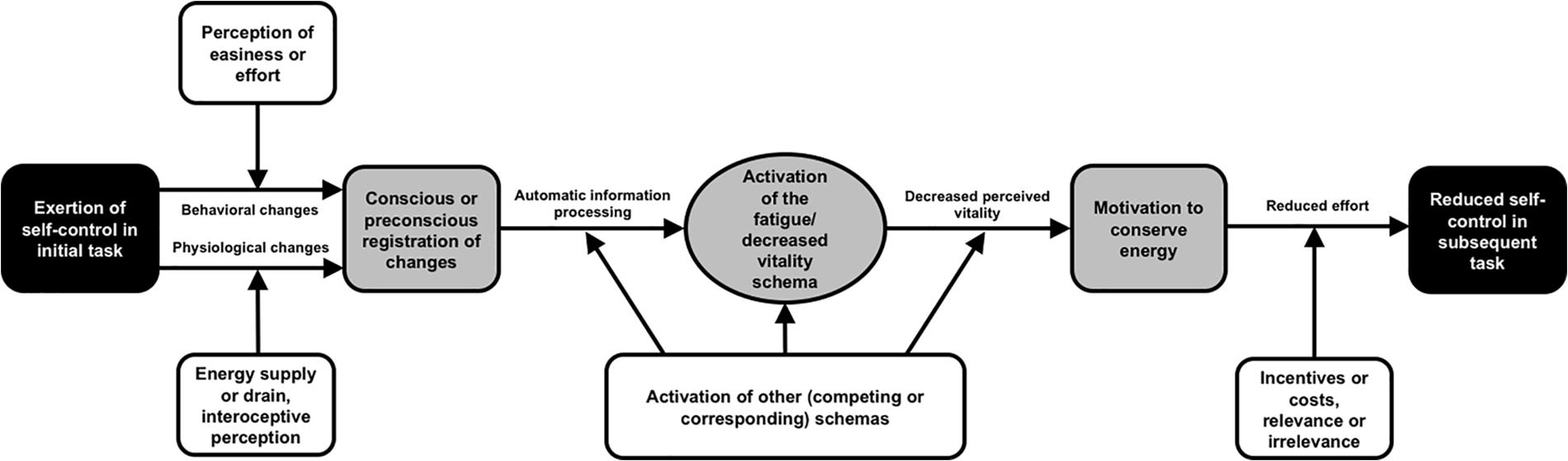
2. The Rebound Effect: Ironic Process Theory
Depletion is only one half of the paradox. The other, perhaps more counterintuitive part, is that the very act of trying to suppress a thought can make it stronger. This is explained by Ironic Process Theory.
What is The Ironic Process Theory Mental Model?
The article 'What is The Ironic Process Theory Mental Model?' provides a clear explanation of this phenomenon, famously known as the 'white bear problem'.
Please read the first three sections: 'Introduction to Ironic Process Theory', 'Exploring the White Bear Experiment', and 'Understanding the Ironic Process Theory Mental Model'. Focus on the dual-process explanation: a controlled 'operator' process tries to suppress the thought, while an automatic 'monitor' process checks for failure, ironically keeping the unwanted thought accessible.
When you tell yourself, "Don't think about X," your brain does two things:
- An effortful, controlled process actively searches for thoughts that are not X.
- An automatic, low-effort process scans your mind to make sure you are not, in fact, thinking about X.
This automatic monitoring process is the source of the irony. To check if you're thinking about the white bear, it has to hold the concept of "white bear" in mind, which makes you more likely to think about it, especially when your cognitive resources are low (i.e., when your willpower is depleted).
3. Application: Managing Insecurity in a Vee Relationship
Let's apply this to a personal goal. Consider a "Vee" relationship, where one person (the "hinge") is in a relationship with two separate partners who are not in a relationship with each other. Imagine you are one of the "spokes" of the Vee. Your partner (the hinge) is going on a date with their other partner (your "metamour"). You feel a pang of insecurity, a common human emotion in such situations.
The Counterproductive "Willpower" Approach:
You decide to handle it with pure self-control. Your internal monologue is: "I will not be insecure. I need to be strong and just suppress this feeling. I am not going to think about what they are doing. I will just force myself to be happy for them."
Let's analyse why this is likely to backfire, based on what we've learned.
- Willpower Depletion: Throughout the evening, you are actively pushing back against anxious thoughts. This requires constant mental effort. By the time your partner comes home, your frontal lobes are fatigued from the effort of suppression. You are mentally exhausted. A minor, unrelated annoyance—like them being 10 minutes late—might now trigger a disproportionately large emotional reaction because you have no self-control resources left to manage it.
- Ironic Process Rebound: Your instruction "Don't think about what they're doing" activates the mental monitor. This monitor periodically scans your thoughts, asking, "Am I thinking about the date?" This process keeps the very subject you're trying to avoid at the forefront of your mind. Instead of fading, the thoughts may become more intrusive and vivid, creating a feedback loop of anxiety.
- Misdirected Focus: The goal shifts from "having a secure and trusting relationship" to "winning the battle against my own feelings." This internal fight is stressful and alienating. It frames your own emotions as the enemy, rather than as signals to be understood.
This is the Willpower Paradox in action. Your attempt to control your feelings through sheer force has made you more emotionally volatile and preoccupied with the very thoughts you sought to avoid.
4. The Alternative: From Self-Control to Self-Regulation
If brute-force self-control is counterproductive, what is the alternative? The solution lies in shifting from fighting your brain to designing for it. This involves moving from effortful self-control to a more integrated, and often effortless, form of self-regulation.
[PDF] Effortless Willpower? The Integrative Self and Self-Determined Goal ...
This academic paper, 'Effortless Willpower?', provides the theoretical distinction between these two concepts. It explains how aligning goals with your core values can make willpower feel less effortful.
Please read the section under the heading 'Effortless Willpower,' starting with 'According to SDT...'. Then, read the subsequent section that begins 'Self-regulation may be contrasted with self-control...'. Focus on the distinction: self-control is suppressive and exclusive of the 'self', while self-regulation is about pursuing goals that are integrated with your values and identity.
As the paper discusses, self-regulation works best when a goal is internalized and feels congruent with your identity. Instead of suppressing an unwanted impulse, you are acting in line with a value you genuinely hold. This requires far less effortful suppression.
Let's look at some practical strategies for this shift.

Applying these more effective strategies to our Vee relationship scenario:
- Strategy 1: Design Your Environment. Instead of sitting home alone where it's easy to ruminate, you consciously create an environment that encourages a different state of mind. You could schedule that evening to be your dedicated time for your lingerie design hobby, watch a movie with a friend, or go to a yoga class. You make the desired behavior (not ruminating) the path of least resistance.
- Strategy 2: Build Automatic Habits (Systems). You and your partner could create a simple, automatic ritual. For example: before any date, you have a 10-minute "connection ritual" where you share a cup of tea and explicitly state your affection and commitment to each other. This becomes an automated habit that reinforces security, requiring no willpower in the moment. The Psyphoria video refers to this as making discipline "inevitable" (section 7).
- Strategy 3: Use "If-Then" Planning. You pre-decide your response to a trigger. You make a plan: "IF I start to feel insecure while my partner is out, THEN I will write down three things I value about our relationship and send my metamour a brief, positive text wishing them a good time." This offloads the decision from your depleted brain and provides a constructive, value-aligned action.
- Strategy 4: Reframe the Goal (Goal Integration). Instead of the suppressive goal "Don't be insecure," you adopt an integrative goal: "This is an opportunity to practice compersion (the feeling of joy for a loved one's joy in another relationship) and build trust." This connects the immediate situation to a higher-level value you've chosen for your life. Acting on this value feels authentic (self-regulation) rather than forced (self-control).
By using these strategies, you are no longer fighting a losing battle against your brain's wiring. You are creating a system that makes it easier to act in line with your long-term goals.
Conclusion
In this lesson, we have analysed the Willpower Paradox and its underlying mechanisms. We have seen that viewing willpower as an infinite resource to be applied through brute force is a flawed strategy that can lead to depletion and ironic rebound effects.
Key Takeaways:
- The Willpower Paradox: Relying on willpower is counterproductive because it's a finite resource that gets depleted with use, and trying to suppress thoughts can make them more prominent (Ironic Process Theory).
- Self-Control vs. Self-Regulation: Effortful self-control involves suppressing impulses. A more effective approach is self-regulation, which involves aligning your actions with deeply held values and goals, making them feel more effortless.
- Design Over Discipline: Lasting change comes not from "trying harder," but from intelligently designing your environment, building automatic systems, and reframing your goals to work with your brain's natural tendencies, not against them.
Next Lesson Preview:
In our next lesson, we will examine Newcomb's Paradox. This famous thought experiment will challenge us to evaluate decision strategies in situations involving a near-perfect predictor of our choices, pushing us into a fascinating exploration of causality, free will, and rational choice theory. This will connect directly with your background in statistics and probability.