Introduction
In our last lesson, we established a theoretical foundation for understanding the Hedgehog's Paradox, analyzing it as a fundamental tension between the need for relatedness (intimacy) and autonomy (independence). We concluded that the goal is not a compromise but differentiation—the ability to remain fully yourself while in close connection with others. We also equipped ourselves with practical tools: setting boundaries with "I" statements and managing anxiety using the "Three Buckets of Control."
Today, we move from theory to direct application. Your learning outcome is to apply the Hedgehog's Paradox to define personal space and emotional boundaries within a vee relationship. We will dissect the unique pressures this structure places on all individuals involved and use a systematic framework to design clear, actionable boundaries that foster both intimacy and autonomy.
1. The Hedgehog's Paradox in a "Vee" Relationship
A "vee" relationship involves three people: one person (the "hinge") who is in a relationship with two others, who are not in a relationship with each other. These two partners are known as "metamours."

The dynamic of seeking warmth while avoiding the "prickles" of the quills is amplified in this structure:
- The Hinge Partner: Is pulled between the needs of two distinct relationships. They must provide warmth and intimacy to both partners while avoiding the "prickles" of over-extension, burnout, or inadvertently causing jealousy. Their own need for autonomy—time and identity separate from either partner—can be significantly compressed.
- The Metamours: Each seeks warmth and security in their relationship with the hinge. However, the existence of the other relationship can be a source of "prickles"—insecurity, comparison, or jealousy. Their challenge is to maintain their own emotional autonomy and the integrity of their dyad without demanding the hinge withdraw from their other relationship.
To refresh our memory of the core analogy, let's watch the opening of this short video.
i fear you close by. i love you far away
The video 'i fear you close by. i love you far away' from Sisyphus 55 perfectly recaps Schopenhauer's original fable, which is the foundation of our analysis today.
Please watch the first 34 seconds (00:00 - 00:34). Focus on the cycle described: moving closer for warmth, being pricked, moving apart to shiver, and repeating. This is the core dynamic we will be managing.
In a vee, it's not just one group of hedgehogs, but an overlapping system. A skilled approach is needed to prevent a chain reaction where one person's reflexive withdrawal from a "prickle" causes another to "shiver."
2. The Hinge as Boundary Manager
Given your background as a statistician, you can appreciate that the hinge partner acts as a central node in this relationship network. The stability of the entire system often depends on the hinge's ability to act as a clear and competent facilitator of boundaries. A "people-pleasing" or avoidant hinge creates ambiguity, which is where unintended "prickles" thrive.
The following video provides excellent, direct advice on the role of the hinge partner, especially when metamours are interacting.
Dos and Don'ts When Meeting Your Metamour
In 'Dos and Don'ts When Meeting Your Metamour,' Dr. Liz Powell, a psychologist specializing in polyamory, explains the crucial responsibilities of the hinge.
Please watch two segments: From the beginning until 01:10. Focus on what makes a 'good hinge' and the problems caused by avoidance and people-pleasing. From 02:20 to 03:08. Pay close attention to the specific types of expectations that must be clarified beforehand (PDA, topics of conversation, etc.).
Dr. Powell's advice highlights a key application of our previous lesson. A "good hinge" proactively addresses the Hedgehog's Paradox by:
- Not avoiding conflict: They understand that discussing potential "prickles" (like PDA preferences) beforehand prevents actual pain later.
- Setting clear expectations: This is the act of establishing system-wide boundaries, creating a predictable environment where all partners can feel more secure.
- Taking responsibility: As discussed in the video's later sections, a good hinge owns their role in communication breakdowns, rather than blaming one partner or the other. This aligns with focusing on your own "Bucket 1" of control.
3. A Framework for Defining Boundaries in a Vee
To "very carefully" manage closeness, as the hedgehog joke goes, we need a structured way to think about boundaries. The abstract idea of "personal space" can be broken down into concrete categories.
Let's use a scenario: A husband (H) is the hinge partner to his wife (A) and his girlfriend (M). All three want to maintain their relationships, but are running into friction.
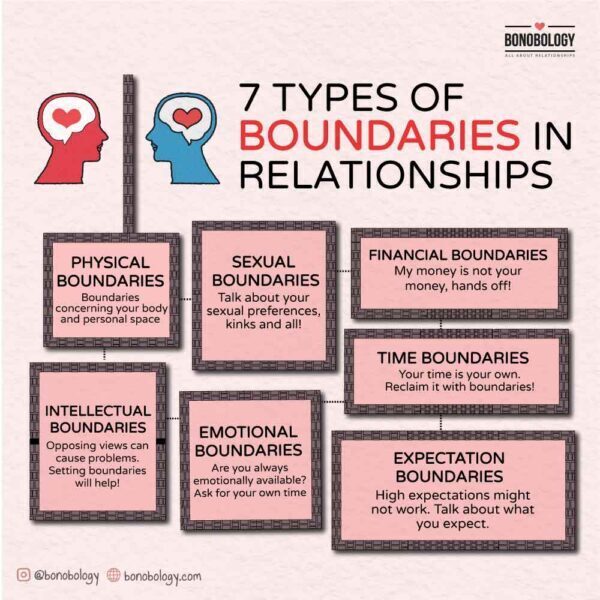
Using this infographic as our guide, we can systematically define boundaries for the H-A-M vee. This is how you apply the concept of differentiation in practice. For each category, we can formulate clarifying questions and sample "I" statements.
1. Emotional Boundaries
- The Challenge: Partner A feels insecure about Partner M. She looks to H to manage her feelings, making him feel responsible for her emotional state regarding M. This erodes his autonomy and her own.
- Clarifying Questions: Whose job is it to process A's jealousy? How can A get support from H without making H responsible for her feelings?
- Boundary Statement (from A to H): "I am feeling insecure about our connection tonight. I would love to spend some quality time together to feel reassured. I want you to know that I am working on my feelings about you dating M, and that is my responsibility, but I need to feel that we are strong."
2. Time Boundaries
- The Challenge: H feels constantly pulled between A and M, with no time for himself. A feels she doesn't get enough time; M feels her time is always secondary to the pre-existing marriage.
- Clarifying Questions: What is the baseline time allocation? Are date nights scheduled or spontaneous? How much solo time does each person need to feel autonomous?
- Boundary Statement (from H to A and M): "To be a good partner to both of you, I need to protect my own energy. I will be unavailable to everyone on Wednesday nights for my own hobbies. I want to schedule one dedicated date night with each of you per week, and we can be flexible with the other days."
3. Physical Boundaries (non-sexual)
- The Challenge: H and A share a home. A is uncomfortable with M being in their bedroom, which she considers a sanctuary for their marriage.
- Clarifying Questions: Where can metamours interact? Are any spaces in a shared home off-limits?
- Boundary Statement (from A to H): "I am happy for M to come over and spend time in the living room and kitchen. However, I need our bedroom to remain a private space for just you and me to feel secure."
4. Intellectual Boundaries
- The Challenge: H shares details of an argument he had with A with his partner M. M feels uncomfortable being put in the middle, and A feels her privacy was violated.
- Clarifying Questions: What information is private to each dyad (H-A and H-M)? What level of transparency is expected about the logistics of the other relationship versus the content?
- Boundary Statement (from M to H): "I want to support you when you're having a hard time. However, I need you not to share the details of your fights with A. It helps me maintain a respectful and separate connection with you."
5. Sexual Boundaries
- The Challenge: The three partners have not explicitly discussed sexual health agreements, leading to unstated assumptions and anxiety.
- Clarifying Questions: What are the safer sex practices for all interactions? What is the agreement on barrier use and STI testing frequency? How is this information communicated?
- Boundary Statement (from H to A and M): "My sexual health affects all of us. My boundary is that I will only have barrier-free sex within our polycule after we have all shared recent, clear STI test results and explicitly consented."
6. Expectation Boundaries
- The Challenge: H hopes his partners will become good friends ("kitchen table polyamory"). A feels pressured by this, preferring a more separate "parallel polyamory" style for now.
- Clarifying Questions: What is the desired or required level of interaction between metamours? Friendship? Civility? No interaction?
- Boundary Statement (from A to H): "I understand you have a vision of us all being close friends. I need the space to let my relationship with M, if any, develop at its own pace without pressure. For now, I am comfortable being friendly and polite when we see each other."
(Note: Financial boundaries are also critical, but are often highly specific to individual situations regarding shared assets and expenses.)
Conclusion
Applying the Hedgehog's Paradox to a vee relationship transforms it from a philosophical problem into a practical engineering one. The "prickles" of jealousy, insecurity, and frustration are not failures, but data points indicating where boundaries need to be clarified.
Key Takeaways:
- The Hedgehog's Paradox is amplified in a vee, affecting the hinge and metamours in distinct but interconnected ways.
- A well-differentiated hinge who communicates clearly and avoids people-pleasing is crucial for the stability of the entire system.
- Defining personal space and emotional boundaries is not an abstract goal. It is achieved by systematically addressing concrete areas like time, emotional labor, physical space, and expectations.
- Using "I" statements within these categories allows each person to express their need for autonomy (avoiding the prickles) without demanding that others give up their need for connection (warmth).
Next Lesson Preview:
Today, we focused on how to assert individual needs to maintain a healthy balance of intimacy and independence. In our next lesson, we will explore a fascinating and counterintuitive failure mode in group dynamics: the Abilene Paradox. We will analyze why groups sometimes unanimously agree to a course of action that no single member actually wants, and apply strategies to prevent this in both professional and personal settings.