Introduction
In our last lesson, we explored the Hedgehog's Paradox, focusing on the importance of setting boundaries to manage the tension between intimacy and independence. The central challenge was how an individual can assert their own needs (for autonomy, or to avoid being "prickled") while maintaining connection with others. This involved looking inward and communicating outward with clarity.
Today, we'll examine a fascinating and opposite dynamic: the Abilene Paradox. This paradox describes a situation where a group's inability to manage agreement, not conflict, leads to a collective decision that no single member of the group actually wants. It's a failure mode that arises not from asserting individual needs too forcefully, but from failing to voice them at all.
Your learning goal for this lesson is to analyse the Abilene Paradox and apply strategies to surface genuine preferences in a group decision-making process. We will dissect its causes, differentiate it from similar concepts, and equip you with a toolkit of practical strategies to prevent your teams—and personal groups—from taking an unwanted trip to Abilene.
1. Understanding the Abilene Paradox
The paradox gets its name from a real-life anecdote. To understand the core concept, let's start with a short video that tells the original story.
The Abilene Paradox: Why We Do Things That Go Against Our Better Judgment
This video, 'The Abilene Paradox: Why We Do Things That Go Against Our Better Judgment' by Ricardo Vargas, provides a clear and concise explanation of the anecdote that gave the paradox its name.
Please watch from the beginning to 03:03. Focus on how a simple suggestion snowballs into a collective action that nobody desired, and the surprise that follows when the truth is revealed.
As the video illustrates, the paradox isn't about conflict or a difficult trade-off. It's about a breakdown in communication where everyone mistakenly believes they are acceding to the will of the group, while the group's "will" is entirely imaginary.
For a more formal analysis, we can turn to the original paper by the man who coined the term, Jerry B. Harvey.
[PDF] The Abilene Paradox: The Management of Agreement - MIT
In his foundational article, 'The Abilene Paradox: The Management of Agreement,' Jerry B. Harvey lays out the precise symptoms of this organisational dysfunction. Reading this will give you a sharp diagnostic lens.
Please read the section titled 'SYMPTOMS OF THE PARADOX' (page 4 of the PDF). As you read the six symptoms, think about whether you have observed these dynamics in a professional or personal setting.
To summarise Harvey's points, the Abilene Paradox is characterised by:
- Private agreement on the problem.
- Private agreement on the solution.
- Failure to communicate these agreements; instead, individuals voice support for an opposite course of action.
- The group makes a collective decision that is counter to everyone's private preferences.
- This leads to frustration, anger, and the blaming of others.
- The cycle repeats if the underlying inability to manage agreement isn't addressed.
2. The Psychology Behind the Paradox
Why do reasonable people fall into this trap? It seems absurd, but the underlying causes are deeply rooted in social psychology. Your background in social research will find these dynamics familiar. The Harvey paper you just looked at provides a deep analysis.
[PDF] The Abilene Paradox: The Management of Agreement - MIT
Let's return to Harvey's article to explore the psychological drivers. He outlines several key anxieties that motivate people to take the 'trip to Abilene.'
Please read the section titled 'ANALYZING THE PARADOX' (pages 6-8 of the PDF). Pay close attention to the concepts of Action Anxiety, Negative Fantasies, Real Risk, and especially the Fear of Separation.
Harvey's core argument is that the paradox is driven by a profound fear of separation. We fear being ostracised, labelled as "not a team player," or seen as difficult. This fear creates "action anxiety"—anxiety about taking the action we believe is correct. To justify our inaction, we invent "negative fantasies" about the terrible consequences of speaking up, even if the "real risk" is small. Ultimately, we choose the certainty of a bad group outcome over the uncertain risk of social exclusion.
It's crucial to distinguish the Abilene Paradox from related concepts like Groupthink.
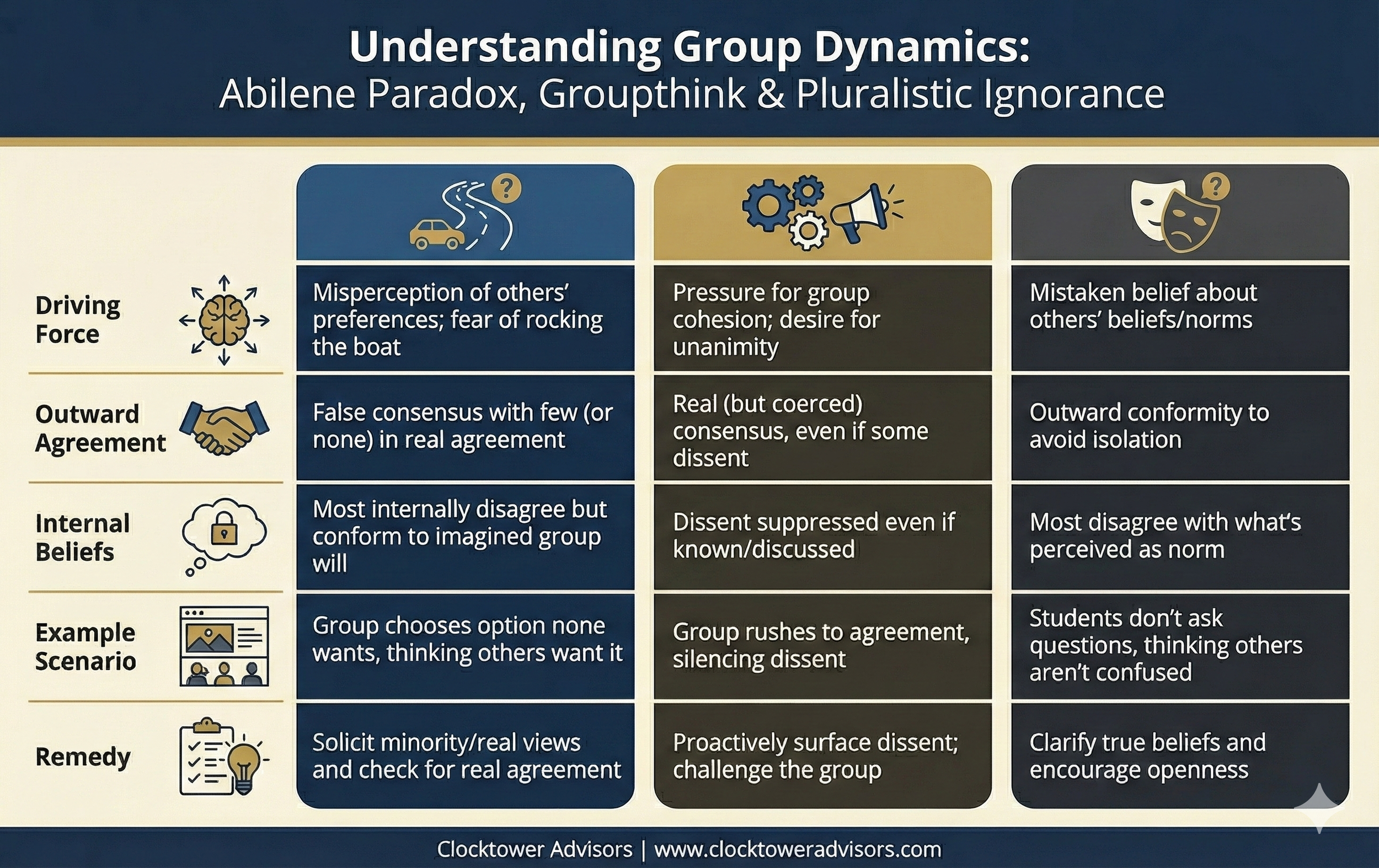
As the table shows:
- In the Abilene Paradox, individuals think they are the only ones with reservations. The problem is a misperception of agreement.
- In Groupthink, individuals are often aware of dissenting views (including their own) but actively suppress them to maintain harmony and please a leader. The problem is a coerced or manufactured agreement.
3. An Application in Lingerie Design
Let's apply this to your interest in lingerie design. Imagine a small team finalising a new cleavage-enhancing bra. The team consists of:
- The Lead Designer
- The Pattern Maker
- The Materials Specialist
- The Marketing Lead
During a final review, the Lead Designer, feeling pressure to innovate, half-heartedly suggests, "What if we use a radical new 'suspension bridge' wire system? It's something I've been sketching..."
- The Pattern Maker immediately sees the manufacturing complexity. But she thinks, "The Designer seems excited, and I don't want to be the one to shoot down a creative idea." She says, "Interesting. We can probably figure it out."
- The Materials Specialist knows the required wire will be custom-made and triple the cost. But he thinks, "The Designer is the visionary, and the Pattern Maker seems on board. I guess we have to make the budget work." He says, "It'll be premium, but it's a unique feature."
- The Marketing Lead is worried about the resulting high price point. But she sees the design team agreeing and thinks, "They are the product experts. If I object, they'll see me as the 'suit' who doesn't understand design." She says, "If you all believe in it, we can market it as a luxury innovation."
The team takes the trip to Abilene. They develop a bra that is a nightmare to produce, prohibitively expensive, and ultimately a commercial failure. During the post-mortem, the Lead Designer confesses, "I was never sold on that wire system; I just threw it out there for discussion. I thought you all loved it!" Everyone is frustrated and blames each other for not speaking up.
4. Strategies to Avoid the Trip
How could the design team have avoided this? The solution lies in creating processes that make it safe and normal to surface genuine preferences.
The following reading offers an excellent, practical toolkit for doing just that.
The Abilene Paradox in Online Communities: Why Your Members ...
The article 'The Abilene Paradox in Online Communities' provides six concrete tools to prevent this dysfunction. While it's written for online communities, the strategies are universally applicable to any team.
Please read the section 'Six Practical Tools to Prevent the Abilene Paradox.' As you read about each tool, think about how the lingerie design team could have used it.
Let's apply these tools to our lingerie design scenario:
- The Devil's Advocate Role: The Lead Designer could have said, "For this meeting, I want the Marketing Lead to be the official devil's advocate. Your job is to challenge every assumption we make about this design."
- Anonymous Feedback Channels: Before committing, the Lead Designer could hand out index cards and say, "On a scale of 1-10, how confident are you in this wire system? Write your number and one reason why. No names." This would have immediately surfaced the low confidence scores.
- Actively Solicit Dissent: Instead of just presenting the idea, the Lead Designer could have framed it as a hypothesis to be disproven: "I have a wild idea about a new wire system, but I'm not sure it's practical. Talk me out of it. What are all the reasons this would fail?"
- Pre-Decision Check-Ins: Before ending the meeting, the Lead Designer could pause and say, "I'm sensing we're all agreeing to move forward. But I want to do a final check. Is there anyone who feels hesitant but hasn't said so? This is your moment to save us from a potential mistake."
- Post-Decision Debriefs: Even if they made the decision, a check-in two weeks later ("How is the prototype sourcing for that new wire going?") could provide an opportunity to reverse course before too many resources are sunk.
- Build Psychological Safety: By actively using the strategies above, and by thanking people for raising difficult points ("Thank you for flagging the cost issue; that's exactly what I need to hear."), the Lead Designer builds a culture where people know it's safer to voice concerns than to stay silent.
Conclusion
The Abilene Paradox is a powerful reminder that the absence of conflict is not the same as genuine agreement. It exposes a vulnerability in group dynamics where the collective fear of short-term social discomfort leads to guaranteed long-term failure and frustration.
Key Takeaways:
- The Abilene Paradox occurs when a group collectively agrees to an action that no individual member wants, driven by a mutual misperception of each other's preferences.
- The root cause is not a desire for conformity (as in Groupthink), but a deep-seated fear of separation that creates anxiety around voicing a dissenting opinion.
- Preventing the paradox requires proactive strategies to make dissent safe and expected. This includes tools like appointing a devil's advocate, using anonymous feedback, and explicitly asking for counterarguments.
Next Lesson Preview:
In our next lesson, we will apply this understanding of the Abilene Paradox directly to your other area of interest. The learning outcome will be: "Apply the Abilene Paradox to prevent a group of partners from collectively agreeing to a decision that no individual truly wants." We'll explore how a vee relationship, for example, could accidentally decide on a holiday or living arrangement that leaves everyone unhappy, and how to use these strategies to ensure decisions reflect true desires.