Introduction
Welcome to your fifth lesson in Module 3. In our last session, we delved into the concept of Slow Hunches, analysing how most significant ideas don't arrive in a flash but rather incubate over long periods, gradually accumulating connections and strength. You analysed how this process works, using a scenario within a Vee relationship.
Today, we move to the second "S" in your LAPS SEE mnemonic: Serendipity. If a slow hunch is the patient cultivation of a garden, serendipity is the unexpected, favourable weather—or the surprise cross-pollination from a neighbour's yard—that makes something new and wonderful grow. It is the happy accident, the fortunate discovery that often provides the missing piece to a puzzle you've been working on for months or years.
Your learning outcome for this lesson is to analyse the role of serendipity in discovery and identify conditions that increase its likelihood. We will define what makes a discovery serendipitous, examine a classic case study of it in action, and, most importantly, explore concrete strategies you can use to make these "lucky" discoveries more likely to happen. Today's practical exercise will focus on your interest in lingerie design.
1. Defining Serendipity: More Than Just Luck
Serendipity is often confused with blind luck, but there's a crucial difference. A winning lottery ticket is luck. Discovering penicillin because you noticed mold killing bacteria in a forgotten petri dish is serendipity. It requires an element of chance, but also an active, prepared mind that can recognise the significance of the unexpected.
To formalise this, let's watch a segment from Dr. Christian Busch, who has studied this topic extensively.
The science of serendipity: How to make your own luck | Prof. Dr. Christian Busch | TEDxWarrenton
In this video, 'The science of serendipity', Dr. Busch defines serendipity and distinguishes it from blind luck. He introduces it as a process you can influence.
Please watch from 00:50 to 04:32. As you watch, focus on: The three key ingredients of serendipity: agency, surprise, and value. The classic Viagra example, which emerged from an unexpected side effect in a trial for heart medication. The concept of serendipity as a process: spotting an unexpected trigger, connecting the dots, and having the tenacity to act on it.
Dr. Busch's framework is powerful. Serendipity isn't just a single event; it's a three-step process:
- A Serendipity Trigger: An unexpected event, observation, or encounter.
- Connecting the Dots: The insight that links the trigger to a pre-existing problem, question, or slow hunch.
- Tenacity & Action: The effort to follow through and turn the connection into something valuable.
Given your background as a statistician, this visual representation might be helpful. It plots outcomes on three axes: Luck (the trigger), Preparedness (connecting the dots), and Aim (the underlying problem).
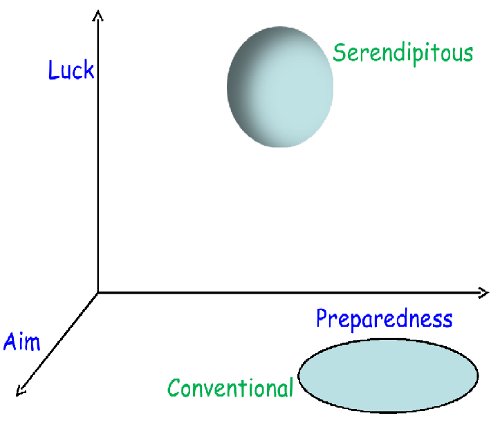
Serendipity, therefore, is where chance meets a prepared mind.
2. A Case Study in Serendipity: The Birth of GPS
One of the most compelling examples of serendipity is the invention of the Global Positioning System (GPS). It didn't start with a clear goal to create a navigation system. It began with simple curiosity and a chain of unexpected connections.
Let's watch Steven Johnson tell this fascinating story.
Where good ideas come from | Steven Johnson
In this segment of 'Where good ideas come from', Steven Johnson recounts the origin story of GPS, which perfectly illustrates the serendipity process.
Please watch the segment from 12:19 to 16:12. As you watch, try to map the story to the three-step process we just discussed.
Let's break down the GPS story using our framework:
- The Trigger: The Soviet Union launches Sputnik in 1957. This was a completely external, unexpected event.
- Connecting the Dots (Part 1): Two young researchers, Guier and Weiffenbach, get curious. As a side project, they start listening to the satellite's beeps. They realise they can use the Doppler effect to calculate its trajectory. This created an unexpected capability: they could pinpoint the location of an object in orbit from a known location on the ground. This was valuable, but its true potential was not yet realised.
- Connecting the Dots (Part 2 - The Key Serendipitous Moment): Their boss, Frank McClure, hears about their project. He has a completely different "slow hunch" or problem he's stewing over: how to locate nuclear submarines in the ocean to launch missiles accurately. He makes the pivotal connection: "You figured out an unknown location (satellite) from a known location (your lab). Could you do the reverse? Could you figure out an unknown location (a submarine) from a known location (a satellite)?"
- Tenacity & Action: This insight sparked the decades of work that led to the development of the GPS system we all use today.
This story highlights a crucial aspect of serendipity: the most powerful connections are often made by someone linking one person's capability to another person's problem.
3. How to Cultivate Serendipity
If serendipity depends on chance, how can we possibly increase its likelihood? You can't plan an accident, but you can create an environment where "happy accidents" are more likely to occur and, crucially, more likely to be noticed.
A paper by Makri et al. (2014) published in the Journal of the American Society for Information Science and Technology investigated this by interviewing creative professionals about their habits. They identified a set of "serendipity strategies." I'll summarise the most actionable ones for you, drawing from their research and our other resources.
Key Strategies to Increase Serendipity:
-
Vary Your Routine & Environment: Deliberately expose yourself to new people, places, and information. If you always work in the same office and read the same journals, you limit your chances of an unexpected trigger. This is about creating what Steven Johnson calls liquid networks, where diverse ideas can collide.
- Action: Go to a conference in an adjacent field. Take a different route to work. Read a magazine you'd never normally pick up.
-
Be Observant & Curious: This is about cultivating the "prepared mind." It’s not enough to be in a new environment; you must actively notice things and ask "Why?" or "What if?". Louis Pasteur's famous quote, "Chance favors only the prepared mind," is the cornerstone of this strategy.
- Action: When you see something unusual, don't just dismiss it. Pause and investigate. Look things up.
-
Use the "Hook Strategy": In his talk, Dr. Busch mentioned this powerful technique. When you talk to people, don't just state your job title. Seed the conversation with your current interests and problems. This allows other people to become part of your serendipity engine by making connections for you.
- Action: Instead of "I'm a lingerie designer," try "I'm a lingerie designer, and right now I'm fascinated by how architects create support in buildings without using bulky columns. I'm trying to figure out how to apply that to bras." This gives people multiple "hooks" to connect with.
-
Make Mental Space: As we discussed in the "Slow Hunches" lesson, our brains often make novel connections when we're not intensely focused on a task. Activities like walking, showering, or doing a mundane task allow your mind to enter a more associative state, connecting your recent observations with your long-term problems.
- Action: Build "fallow time" into your schedule. Go for a walk without your phone after being exposed to a lot of new information.
4. Application: Seeking Serendipity in Bra Design
Let's apply these strategies to your interest in lingerie.
Scenario:
You are a lingerie designer working on a new cleavage-enhancing bra. You have a slow hunch that the traditional underwire and push-up padding model is outdated and uncomfortable. You're looking for a breakthrough that offers excellent lift and shape but feels fundamentally different and more natural to wear.
Analysis & Strategy Exercise (Approx. 15 minutes):
Based on the strategies we've just discussed, outline a plan to increase the chances of a serendipitous discovery to solve this design problem. For each strategy below, provide 1-2 specific, creative examples.
- Vary Your Routine: Where would you go or what would you do to expose yourself to new structural or material ideas, completely outside the world of fashion?
- Be Observant & Curious: In one of those new environments, what specific things would you look for? What questions would you ask?
- The Hook Strategy: You meet two people at a dinner party: a civil engineer and a physical therapist. How would you describe your design problem to each of them using "hooks" to invite their unique expertise?
- Hypothesize a Serendipitous Discovery: Describe a plausible "aha!" moment. What unexpected thing could you see, and what pre-existing problem would it connect with to create a new idea for the bra? (e.g., "While watching a documentary on deep-sea creatures, I saw how a jellyfish uses hydrostatic pressure to maintain its shape. What if we used a sealed fluid or gel system in a specific pattern to create lift, instead of a rigid wire?")
Conclusion
Today we've analysed serendipity not as a passive form of luck, but as an active process that you can cultivate. By understanding its components and implementing strategies to encourage it, you can significantly increase the rate of innovative discovery.
Key Takeaways:
- Serendipity is the combination of an unexpected trigger, a prepared mind that connects it to a problem, and the tenacity to act on the resulting insight.
- It is a process that frequently completes or accelerates a slow hunch.
- We can increase the likelihood of serendipity by actively varying our routines, being observant and curious, using the "hook strategy" to enlist others, and making mental space for connections to form.
You have now covered the second "S" in your LAPS SEE mnemonic, adding another powerful source of ideas to your toolkit.
In our next lesson, we will explore Error. Much like serendipity, error involves the unexpected. However, instead of a happy accident, it stems from a mistake. We will analyse how these mistakes, when viewed with the right mindset, can be just as potent a source of innovation as serendipity.