Introduction
Welcome to your sixth lesson in Module 3. In our previous lesson, we analysed the role of Serendipity, the happy accident where chance encounters a prepared mind. We saw how you can cultivate the conditions for these fortunate discoveries in your lingerie design work.
Today, we explore the other side of the unexpected: Error. This is the first "E" in your LAPS SEE mnemonic. At first glance, error seems like the opposite of progress. We are conditioned to avoid it. However, when viewed through the lens of innovation, failure is not an endpoint but a powerful catalyst. It forces us to question our assumptions and explore paths we would have otherwise ignored.
Your learning outcome is to analyse how errors and failures can be systematically converted into sources of innovative ideas. We will dissect the psychology that makes us fear failure, introduce a structured process for learning from it, and examine the cultural conditions required to make this process work.
Following our pattern of alternating examples, today's application exercise will focus on your interest in ethical non-monogamy, specifically analysing a failure within a Vee relationship to strengthen it.
1. The Power of Being Wrong
Our natural inclination is to pursue correctness. In many fields, including statistics, minimising error is a primary goal. However, in the realm of creative problem-solving and innovation, error plays a different, paradoxical role.
To explore this, please read a short text based on the work of Steven Johnson.
Where Good Ideas Come From by Steven Johnson Summary & Notes
This reading from a summary of Steven Johnson's 'Where Good Ideas Come From' presents the core argument for why error is crucial for innovation.
Please read the section titled 'V. ERROR'. Focus on the central idea: 'Being right keeps you in place. Being wrong forces you to explore.' Note the distinction Johnson makes: error doesn't automatically unlock new possibilities, but it forces us to look for them.
The key insight here is that correctness confirms our existing models of the world. An error, however, is a signal that our model is incomplete or wrong. It creates a puzzle. This dissonance between expectation and reality forces a deeper level of engagement and exploration, which is often where new ideas are found.
Many groundbreaking inventions, from penicillin to the pacemaker, began with an error—an experiment that didn't go as planned, a contaminated sample, or a faulty device. The innovation didn't come from the mistake itself, but from the curiosity of the person who, instead of discarding the "failed" result, asked, "That's odd... what's happening here?"
2. From Failure to Innovation: A Systematic Process
Simply making mistakes is not enough. Without a process to learn from them, failures are just failures. The key is to convert them into intelligent failures—those that generate valuable knowledge.
A paper from the Rutgers Business Review ("How to Learn From Failure") explains that failure is effective at driving innovation because it forces a higher level of attention and a thorough investigation of our processes and assumptions. This investigation is what builds new organisational (or personal) knowledge.
We can visualize this as a structured loop.
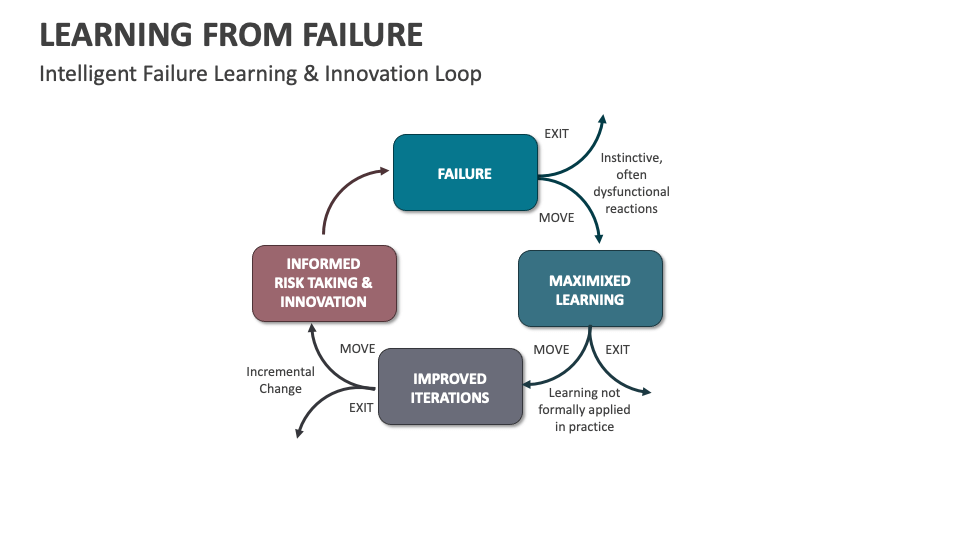
Let's break down this loop:
- Failure: An outcome that doesn't meet expectations occurs. The immediate, instinctive reaction is often dysfunctional (e.g., blame, denial, hiding the mistake).
- Move to Maximized Learning: The crucial step is to override this instinct and consciously decide to analyse the failure. This means asking questions like:
- What were we trying to do?
- What did we expect to happen?
- What actually happened?
- What can we learn from the gap between expectation and reality?
- Improved Iterations: The learning is then applied to change the process, design, or behaviour. This isn't about simply "trying again"; it's about trying again differently, based on what was learned.
- Informed Risk-Taking & Innovation: This process builds confidence and knowledge, allowing for more ambitious, yet better-informed, risks in the future. The accumulation of these learning loops is what drives significant innovation.
This cyclical process transforms failure from a dead end into a critical part of the engine of progress.

3. Creating a Culture that Embraces Error
A system for learning from failure can only work if the environment supports it. The single most important factor is psychological safety—a shared belief that it is safe to take interpersonal risks, such as admitting a mistake, without fear of being humiliated or punished.
Let's watch a short video by Simon Sinek that explains this concept and its importance for innovation.
Being Comfortable With Failing | Simon Sinek
In this video, Simon Sinek discusses why psychological safety is essential for teams and how reframing 'failure' can unlock innovation.
Please watch from the beginning to 02:41. Pay close attention to: His definition of a 'trusting team' where psychological safety exists (0:00 - 0:55). His argument that innovation requires experimentation, which inherently involves failure (1:03 - 1:20). His powerful suggestion to reframe 'failure' as 'falling'—something you can get back up from (1:20 - 1:57). The concrete example of the gaming company that celebrates failures as 'lessons' (1:57 - 2:41).
Sinek's points provide a practical toolkit for creating an environment where error becomes productive:
- Build Trusting Teams: Whether in a company or a relationship, psychological safety is the foundation.
- Reframe the Language: Shifting from the catastrophic term "failure" to the recoverable concept of "falling" can profoundly change how people view mistakes.
- Celebrate the Lessons: Actively celebrating the knowledge gained from a failure—as the gaming company does with its "lessons" champagne—is a powerful way to institutionalize a culture of intelligent failure. It turns a negative event into a positive, shared experience of growth.
4. Application: Analysing Failure in a Vee Relationship
Let's apply this framework to a scenario in your domain of interest: a Vee relationship, consisting of a husband, a wife, and the husband's partner (the metamour). The husband is the "hinge."
Scenario:
The husband mistakenly double-books himself. He promises his wife he will attend her work awards dinner on Friday night, a significant event for her. He later forgets and agrees to a casual dinner and movie with his metamour for the same night. He only realizes the conflict on Thursday. In a panic, he calls his metamour and cancels abruptly, vaguely saying "something came up." The metamour is hurt by the last-minute and non-transparent cancellation. The wife, upon hearing about the near-miss, feels her important event was treated as interchangeable with a casual date. Although the "problem" is solved (he attends the awards dinner), the emotional fallout—the failure—is significant.
Analysis & Strategy Exercise (Approx. 20 minutes):
Please analyse this scenario using the concepts we've discussed.
-
Identify the Failures: Go beyond the surface-level scheduling mix-up. What were the different "failures" that occurred here in terms of process and communication?
-
Analyse Barriers to Learning: Why might the three individuals involved avoid a deeper analysis of this failure? (Consider concepts like blame, fear of conflict, and lack of psychological safety).
-
Apply the "Intelligent Failure" Loop: Imagine the three of them agree to "debrief" the incident. Walk through the following steps:
- Maximizing Learning: What specific, non-blaming questions could they ask to understand the root causes of the failure? (e.g., "What was the breakdown in our scheduling system?", "What pressures led to the abrupt cancellation instead of a more open conversation?").
- Designing Improved Iterations: Based on what they might learn, propose two concrete changes to their "relationship operating system" to prevent this type of failure in the future. (e.g., a specific calendaring protocol, a pre-planned script for handling scheduling conflicts).
-
Fostering a Culture of "Falling": Drawing inspiration from Simon Sinek's example, propose one specific, actionable ritual the partners could adopt to reframe future conflicts or mistakes from disasters into "lessons." How would this ritual help build psychological safety over time?
Conclusion
Today, we've analysed error not as something to be avoided at all costs, but as a vital source of data for innovation and growth. By treating failures as puzzles to be solved rather than events to be punished, we can unlock new avenues for exploration.
Key Takeaways:
- Being wrong forces us to explore and revise our mental models, while being right often keeps us in place.
- A systematic process, the Intelligent Failure Loop, is required to convert errors into learning, improved iterations, and informed innovation.
- This process is only possible within a culture of psychological safety, where members feel safe to admit mistakes.
- Reframing language (e.g., "falling" instead of "failure") and celebrating lessons learned are practical ways to build this culture.
You have now covered the first "E" in your LAPS SEE mnemonic. You've seen how both serendipitous accidents and unintentional errors can be powerful engines for generating new ideas.
In our next lesson, we will explore Exaptation, the final concept in this module. Exaptation occurs when a tool or trait developed for one purpose is co-opted for a completely new and unexpected function. It is a fascinating source of innovation that connects deeply with the ideas of error and serendipity.