Introduction
Hello! Welcome to your fourth lesson in Module 3. In our previous lesson, we analysed how Platforms act as a shared infrastructure that radically expands the "adjacent possible," enabling creators to generate new ideas by recombining existing components. Platforms provide the space for innovation.
Today, we shift our focus from the environment to the genesis of the ideas themselves. We'll explore the "S" in your LAPS SEE mnemonic: Slow Hunches. Most great ideas don't arrive in a single "Eureka!" moment. Instead, they often begin as vague, incomplete notions that linger in the back of our minds, gradually gathering strength and connecting with other ideas over long periods.
Your learning outcome for this lesson is to analyse the development of 'slow hunches' into breakthrough ideas through gradual accumulation. We will dissect what a slow hunch is, explore the mechanisms that allow it to mature, and analyse how this gradual process leads to significant innovations.
1. The Myth of the Eureka Moment
Our culture loves the story of the sudden breakthrough—the apple falling on Newton's head, Archimedes shouting in his bathtub. While dramatic, this narrative is often a simplification that overlooks the long, quiet incubation period that preceded the "flash of insight." True innovation is more commonly a slow, iterative process.
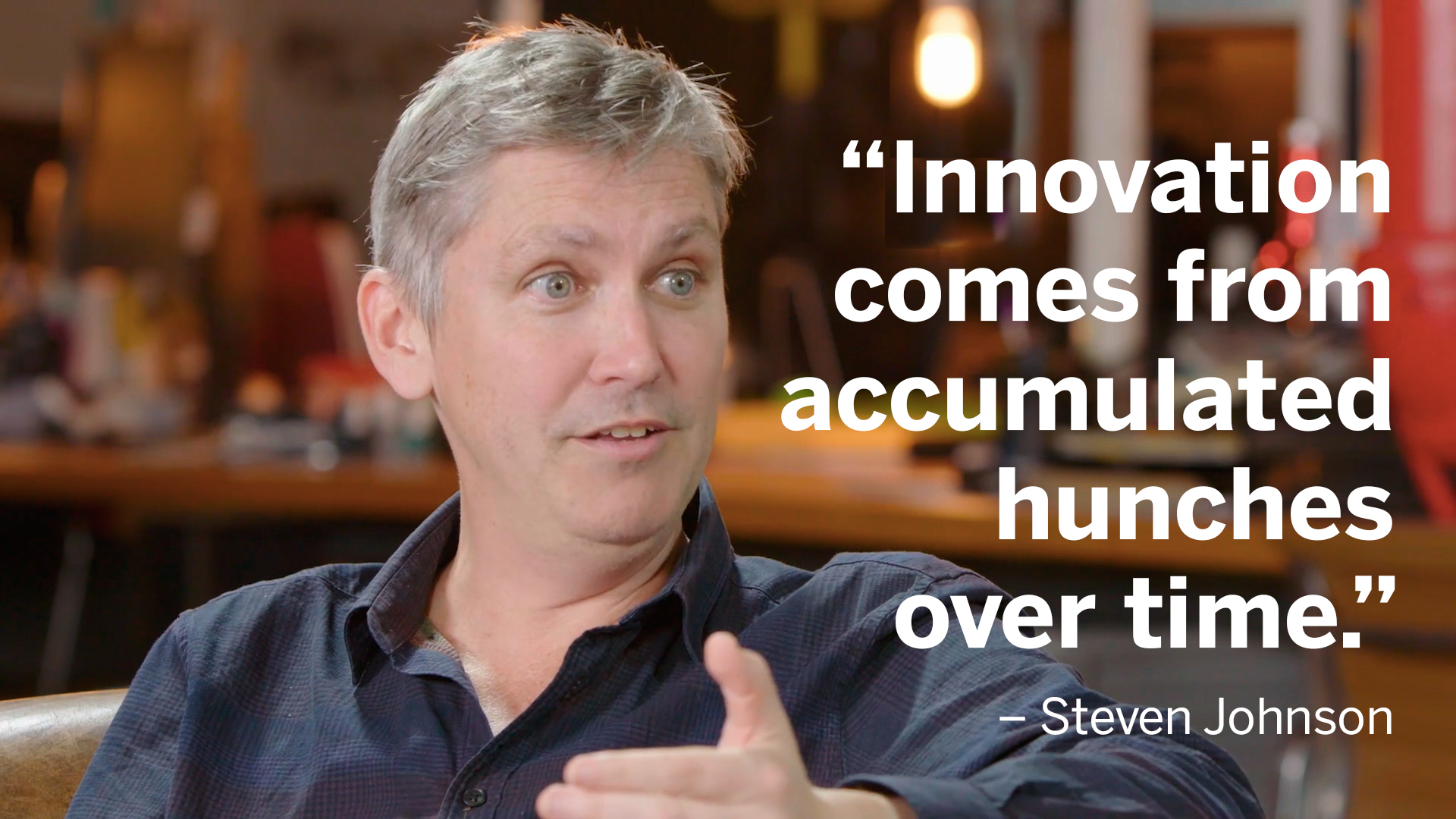
To understand this better, let's hear directly from Johnson as he contrasts the myth of the eureka moment with the reality of the slow hunch.
Where good ideas come from | Steven Johnson
In this segment of his TED talk, Steven Johnson challenges the 'flash of insight' metaphor and introduces the concept of the 'slow hunch,' using Charles Darwin's notebooks as a primary example.
Please watch from 03:21 to 11:11. As you watch, focus on: The Critique of 'Eureka' (03:21 - 04:03): Note how Johnson deconstructs the idea of an idea as a 'single thing' and re-frames it as a 'network'. The Slow Hunch Defined (09:16 - 09:59): Pay attention to the description of important ideas having long incubation periods, lingering for decades in the back of people's minds. The Darwin Example (10:02 - 11:11): Observe the critical difference between Darwin's own memory of a 'eureka moment' and what his private notebooks actually reveal about the gradual formation of his theory.
As Johnson points out, Darwin had the full theory of natural selection months before he supposedly had his great epiphany. The idea had been forming, connecting, and solidifying in his mind—it had faded into view. This is the essence of a slow hunch.
2. Analysing the Development Process
If a breakthrough is the result of gradual accumulation, what are the mechanisms that drive this process? A hunch can't develop in a vacuum. It needs to be fed, connected, and tested.
Let's explore three key mechanisms.
A. Incubation and the Subconscious Mind
A slow hunch is often a feeling that you're at what one psychologist calls the "fuzzy edge" of your knowledge. It's a vague intuition that needs time to become concrete. This period of letting an idea sit is called incubation.
This article from Psychology Today provides a clear definition and explains the cognitive processes at work during incubation.
Slow Hunches, Curiosity, and Innovative Ideas - Psychology Today
This article, 'Slow Hunches, Curiosity, and Innovative Ideas,' delves into the psychology behind how hunches develop and why it's productive to follow these vague lines of inquiry.
Please read the introduction and the first two main sections of the article, stopping before the heading 'But how do we distinguish a productive slow hunch from a “dead end?”'. Focus on: The definition of a slow hunch as being at the 'fuzzy edge' of knowledge. The example of Nobel laureate Richard Thaler, who started with a vague feeling about 'anomalies' in economic theory. The three specific ways incubation works: spreading activation, selective forgetting, and restructuring.
Your background in statistics gives you a framework for understanding hypothesis testing. A slow hunch is like a hypothesis in its earliest, most ill-defined stage. The incubation process is how you subconsciously gather and process preliminary data before you're even ready to formally state the null and alternative hypotheses. The three mechanisms mentioned—spreading activation (finding new connections), selective forgetting (getting unstuck from a bad approach), and restructuring (reframing the problem)—are the mental engines that refine the hunch over time.
B. Slow-Motion Multitasking
One of the most powerful ways to cultivate slow hunches is to have several of them at once. Working on multiple, seemingly unrelated projects allows ideas from one domain to cross-pollinate another. It also provides a productive escape when you get stuck on one problem, allowing for the "selective forgetting" we just discussed.
Economist and author Tim Harford calls this "slow-motion multitasking."
A powerful way to unleash your natural creativity | Tim Harford
In this talk, Tim Harford argues that highly creative people often work on multiple projects simultaneously, allowing ideas to develop slowly in the background. He uses Charles Darwin as a prime example of this practice.
Please watch from 00:41 to 09:49 and then from 12:06 to 16:16. Defining the Concept (00:41 - 04:35): Grasp the difference between frantic multitasking and the 'slow-motion' version. Note the finding from Bernice Eiduson's research about how often top scientists switch topics. The Three Benefits (04:35 - 09:49): Analyse the three reasons Harford gives for why this works: transferring ideas, cross-training the mind, and getting unstuck. The Darwin Case Study (12:06 - 16:16): This is a detailed look at the diagram of Darwin's projects. See how his decades-long work on earthworms, barnacles, and his own children's development all fed into and supported the 'slow hunch' of evolution.
Harford's analysis of Darwin is a masterclass in the slow hunch. The theory of evolution wasn't a single project; it was the gravitational center of a vast solar system of other projects. His work on earthworms gave him an appreciation for slow, cumulative change. His study of barnacles gave him deep expertise in taxonomy. These parallel pursuits were not distractions; they were the very activities that allowed his central hunch to accumulate the evidence and structure it needed to become a revolutionary theory.
C. Connecting with Data and Other Minds
A hunch, no matter how promising, remains speculative until it connects with external validation—either through data or through collision with someone else's hunch.
The story of John Snow and the 1854 London cholera outbreak is a perfect example. Snow had a slow hunch that cholera was spread by contaminated water, not by "miasma" in the air, which was the prevailing theory.
The Slow Hunch: How Innovation is Created Through Group ...
This blog post recounts the story of John Snow, illustrating how a slow hunch can be transformed into a breakthrough by connecting it with data.
Please read the section that begins 'Innovation is often made possible...' and describes the John Snow cholera example. Focus on how Snow combined his hunch with a new resource—public death statistics—to create his famous map and pinpoint the source of the outbreak.
Snow's map was the moment his hunch crystallised into evidence. By plotting the data points of cholera deaths, he made the pattern visible, proving that the cases clustered around a single water pump. This is a powerful illustration of how a hunch accumulates strength by connecting with external information.
3. Application: Analysing a Hunch in a Vee Relationship
Let's apply this to your interest in non-monogamy. The previous practical exercise was on lingerie design, so this one will be on relationship dynamics.
Scenario:
Imagine a person, Alex, who is the "hinge" in a "Vee" relationship. Alex is in relationships with two partners, Bo and Casey, who are not in a relationship with each other. For months, Alex has had a slow hunch that something is fundamentally inefficient and stressful about how they manage their time and emotional energy between Bo and Casey. There are no major fights, but there's a persistent, low-grade friction. The default "equal time" approach feels fair on the surface, but it doesn't seem to be making everyone happy.
Analysis & Strategy Exercise (Approx. 20 minutes):
Based on the concepts from this lesson, please analyse the development of Alex's slow hunch.
- Deconstruct the Hunch: What specific, vague observations might make up this hunch? (e.g., Noticing that Bo values long, uninterrupted weekends while Casey prefers shorter, more frequent check-ins; feeling a sense of dread before the weekly "schedule negotiation"; observing that a calendar entry for a date doesn't capture the quality of the connection needed.)
- Analyse the Path of Accumulation: Describe a realistic process through which Alex could develop this hunch into a workable solution. How could they use the mechanisms we discussed?
- Slow-Motion Multitasking: How might Alex apply skills or ideas from their professional life (e.g., concepts from project management, social research methods, or even statistical resource allocation) to this personal problem?
- Incubation & Connecting with Others: What actions could Alex take to let the hunch incubate while also feeding it new information? (e.g., Reading books/blogs on polyamory, talking to other "hinges" in a peer support group, listening to podcasts on relationship dynamics). How might connecting with another person's "half-idea" lead to a breakthrough?
- Hypothesize the Breakthrough: After this period of accumulation, what might the "breakthrough" look like? Describe a potential new system or insight that is more nuanced than the original "equal time" approach. (e.g., It might not be a single solution, but a new framework for discussing needs, moving from "time equality" to "needs equity," inspired by a concept they learned from an unrelated field).
Conclusion
Today we've dismantled the myth of the "eureka moment" and replaced it with the more realistic and powerful concept of the slow hunch. These hunches are the starting point of innovation, but they require a long period of development to reach their full potential.
Key Takeaways:
- Breakthrough ideas rarely appear fully formed. They begin as slow hunches—vague, incomplete intuitions that incubate over time.
- The development of a hunch is an active process of accumulation. This happens through mechanisms like slow-motion multitasking (allowing for cross-pollination of ideas), incubation (letting the subconscious restructure the problem), and connecting the hunch to external data and other people's ideas.
- Cultivating an environment that supports these long, uncertain incubation periods is crucial for fostering genuine innovation.
You have now analysed the "S" in your LAPS SEE mnemonic.
In our next lesson, we will examine Serendipity. While slow hunches are about the long, patient process of development, serendipity is about the unexpected-but-fortunate discoveries that often provide the missing piece of the puzzle, turning a long-held hunch into a complete idea.