Introduction
Welcome to your third lesson in Module 3. In our last session, we explored the Adjacent Possible, analysing it as the set of next-step innovations available from our current resources. We saw that creativity is often a process of exploring this combinatorial space, one step at a time.
Today, we will examine the "P" in your LAPS SEE mnemonic: Platforms. Platforms are a critical concept because they are systems specifically designed to radically expand the adjacent possible for everyone who uses them. They provide a stable foundation that allows others to create and combine ideas in new ways.
Your learning outcome for this lesson is to analyse how platforms enable idea generation by providing shared infrastructure for recombination. We will define what constitutes a platform beyond just technology, analyse the mechanics of how they work, and then apply this concept to a modern platform for fashion design.
1. What is a Platform?
At its core, a platform is an innovation that spawns many more innovations. It's a base—of technology, standards, or rules—that others can build upon. By providing a common ground, platforms lower the barrier to entry for creation and encourage the recombination of ideas.
This diagram illustrates the core feedback loop of a successful platform. It creates a space where "producers" and "consumers" can interact, exchange value, and even switch roles, driving a cycle of innovation.
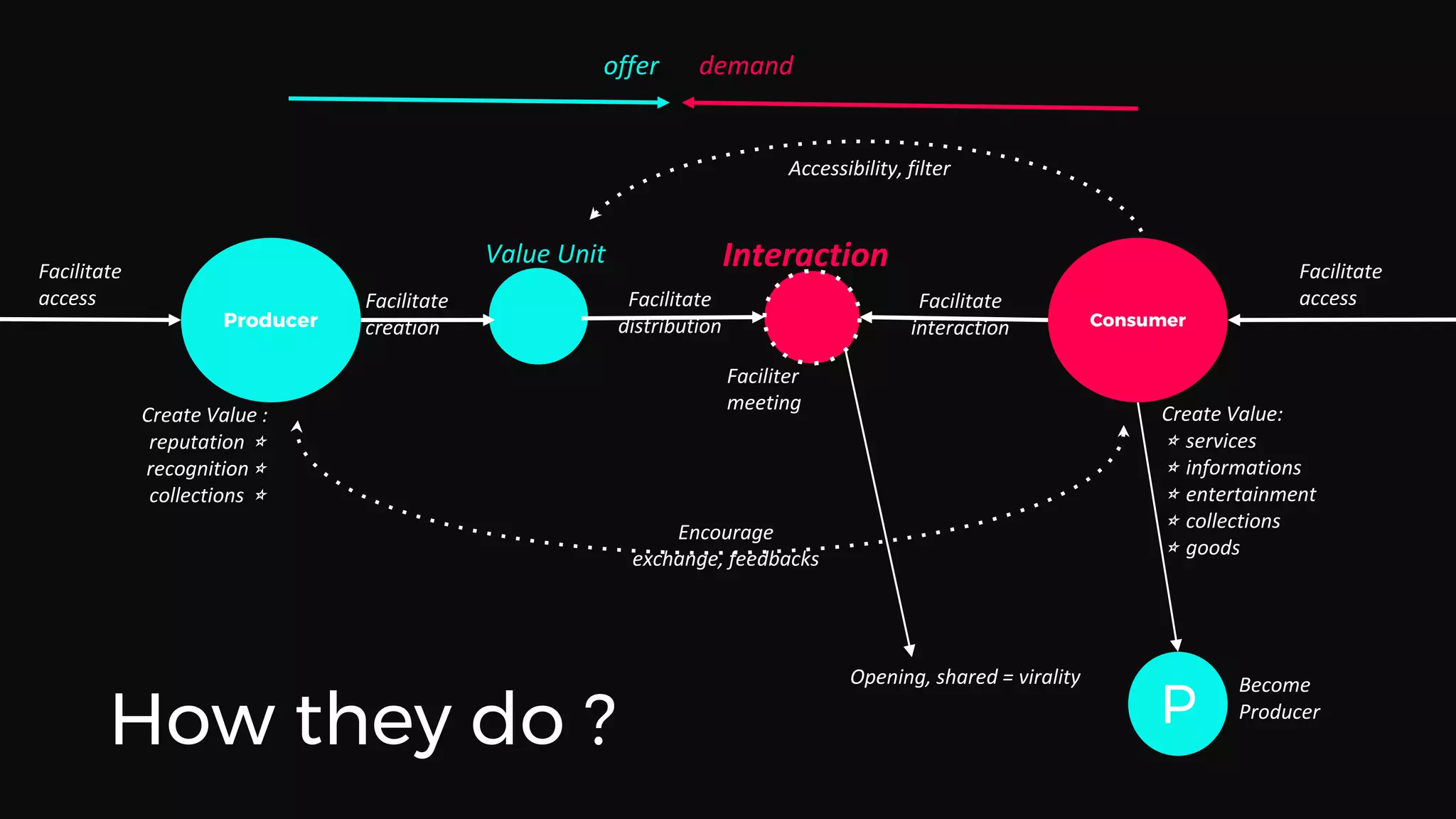
While we often think of platforms as digital (like iOS, Facebook, or the web itself), the concept is much broader. To understand this, let's turn to Steven Johnson, whose work you've encountered in previous lessons.
How We Got to Now - Six Innovations That Made the Modern World - By Steven Johnson
In this talk, Steven Johnson provides a concise definition of a platform and then uses a powerful historical example to illustrate how a non-technological agreement can function as a world-changing platform.
Please watch from 00:32:38 to 00:39:17. First, pay attention to how Johnson expands the definition of a platform from software to any 'standardized way of describing something or measuring something' (00:33:38). Then, follow the story of standardized time zones in the US. As you watch, identify: The Platform: What was the fundamental agreement? The Problem it Solved: What was the initial, intended purpose? The Unforeseen Innovation: What entirely new industry did this platform enable through recombination?
The story of standardized time is a perfect illustration of our learning outcome.
- Shared Infrastructure: The agreement on four standardized time zones across the country.
- Idea Generation: The ability to coordinate schedules nationally.
- Recombination: This new ability to coordinate was combined with radio technology, enabling the creation of live, national broadcast networks—an idea that was unthinkable when every town had its own local time.
This platform wasn't a piece of technology; it was a social agreement, a shared standard.
2. Platforms as Combinatorial Engines
Your background in probability theory is useful here. You can think of a platform as a system that provides a set of well-defined 'components' and a set of 'rules' for combining them. This dramatically simplifies the creative process. Instead of having to invent every component from scratch, an innovator can focus on new and interesting combinations.
In the previous lesson, you watched a TED talk ("The playful wonderland behind great inventions") that traced the origins of the computer. Let's revisit two key moments from that talk through the lens of platforms:
- The Musical Keyboard: The layout of a keyboard became a physical platform. Once this standard was established, innovators could combine it with different sound-producing mechanisms (pipes for an organ, strings for a piano) and eventually with mechanical arms to create the typewriter. The keyboard was the shared infrastructure.
- The Punch Card System: Originally developed for looms, the punch card was a platform for storing instructions. Charles Babbage repurposed this platform, combining it not with threads, but with gears and calculators, to design his Analytical Engine—the conceptual precursor to the modern computer.
To deepen this understanding, let's look at some more modern examples.
Steven Johnson: Where Good Ideas Come From Book Summary
This summary of Steven Johnson's book 'Where Good Ideas Come From' provides excellent, concise examples of modern platforms.
Please read the section titled 'Platforms'. Pay close attention to the examples of GPS and Twitter. Note how they were built by repurposing other technologies and then became platforms themselves, enabling further innovation.
The Twitter example is particularly insightful. Twitter's founders built their service by combining existing platforms (SMS and the internet). But their crucial decision was to make Twitter itself an open platform. By allowing others to build on it, they captured "cooperative advantage." Users, not the founders, invented the @ reply and the # hashtag. These user-generated innovations were then incorporated back into the platform, making it even more powerful for everyone. This is the combinatorial engine at its best.
3. Application: Analysing a Modular Design Platform
Now, let's apply this framework to your interest in lingerie design. In modern fashion, one of the most powerful applications of platform thinking is the concept of modular design, often powered by AI.
A modular design system works by creating a library of interchangeable components—different types of cups, straps, bands, fabrics, and closures for a bra, for example. The designer's job shifts from drafting every single new design from zero to creatively combining these pre-existing, pre-vetted modules.
This diagram shows how a "Product Platform" is a central element of a comprehensive "Modular Design" strategy.

The following article describes a real-world company using this exact approach.
Embracing AI in Fashion: Six Atomic's Modular Design Library
This article from Six Atomic describes their 'Modular Design Library,' a perfect example of a platform for fashion innovation.
Please read the sections titled 'Revolutionising Fashion Design with Six Atomic’s Modular Design Library and AI Pattern Grading', 'Strategic Benefits Brought to You By Modular Library', and 'Harmonising AI with Human Creativity: A Partnership for the Future'. Focus on how this system works and the benefits it provides to designers.
Analysis & Strategy Exercise (Approx. 20 minutes):
Imagine you are a lingerie designer tasked with developing a new line of cleavage-enhancing bras. You have access to a platform like Six Atomic's Modular Design Library.
Using the concepts from this lesson, please analyse this platform.
- Identify the Shared Infrastructure: What are the core components or "building blocks" that this platform provides to you as a designer? (e.g., base patterns for different bra types, a library of virtual cups, straps, bands, lace patterns, closures, etc.)
- Explain the Recombination: Describe how you would use this platform to generate a wide variety of new design ideas. How does it change your creative process from traditional sketching and pattern-making?
- Analyse the Benefits for Idea Generation: The article lists benefits like speed and cost reduction. Go deeper. How do these benefits specifically help you in the creative phase of designing a new bra line? How does automating repetitive tasks (like pattern grading) "unlock creative possibilities" as the article claims?
- Connect to the Adjacent Possible: In our last lesson, we defined the adjacent possible as the set of "first-order combinations" of what you already have. Explain how a modular design platform dramatically expands a designer's adjacent possible compared to a traditional design process where every new bra is a completely new project.
Conclusion
Today, we've unpacked the concept of platforms, seeing them not just as software but as any shared system that enables innovation. By providing a stable infrastructure of components and rules, platforms act as powerful engines for idea generation, allowing creators to focus on novel combinations.
Key Takeaways:
- A Platform is a system (technical, social, or procedural) that provides a shared infrastructure, enabling others to build upon it.
- Platforms accelerate innovation by facilitating the recombination of existing components, rather than requiring everything to be built from scratch.
- By creating a common standard, platforms massively expand the adjacent possible, opening up vast new territories for exploration, as seen with standardized time and modular design libraries.
You have now covered the "P" in your LAPS SEE mnemonic.
In our next lesson, we will explore Slow Hunches. While platforms and networks provide the environment for ideas to connect, the ideas themselves often don't appear in a single flash of insight. They are frequently 'slow hunches' that linger and evolve over time, gradually connecting to other ideas until they are ready to emerge as a full-fledged innovation.