Introduction
Welcome to Module 3 of our course. In the previous modules, you've built a robust toolkit for divergent thinking with SCAMPER and for exploring possibilities with the RCS PPB framework of thought experiments. You've learned how to generate and structure ideas. Now, we shift our focus to where those ideas come from in the first place.
This module is guided by your mnemonic LAPS SEE, which stands for Liquid Network, Adjacent Possible, Platforms, Slow Hunches, Serendipity, Error, and Exaptation.
Today, we will tackle the first concept: Liquid Networks. Your learning outcome for this lesson is to analyse how liquid networks foster innovation through diverse, loosely connected interactions. We will explore what a liquid network is, the social science principles that make it so powerful, and how you can consciously build one to fuel your own creative projects.
1. Defining the Liquid Network
The term "liquid network" was popularised by the science writer Steven Johnson. At its core, it describes an environment where a high density of diverse ideas can mix, collide, and combine in fluid, unpredictable ways.
To get a feel for this concept, let's start with a video where Johnson introduces the idea using a fantastic historical example.
Where good ideas come from | Steven Johnson
In this famous TED talk, 'Where good ideas come from', Steven Johnson explains the concept by looking at the role of English coffeehouses in the Enlightenment and the structure of scientific labs.
Please watch two segments: The introduction to the English coffeehouse (00:39 - 02:17). Notice the key ingredients: a new stimulant (coffee), a new type of space, and the mixing of people from different backgrounds. The discussion of Kevin Dunbar's research on science labs (08:00 - 09:16). Pay close attention to where breakthrough ideas actually happened and Johnson's definition of a 'liquid network' at the end of this clip.
As Johnson illustrates, a liquid network is not just about having lots of people in one place. It is about the quality and diversity of their interactions. To formalise this, let's turn to a short reading that provides a useful analogy.
A synopsis of Steven Johnson's book “Where Good Ideas Come From
This synopsis of Johnson's book provides a clear breakdown of the core concepts. We'll focus on its description of liquid networks.
Please read the section titled 'Liquid Networks'. It introduces a helpful analogy comparing idea networks to states of matter (gas, solid, liquid). Focus on why the 'liquid' state is ideal for innovation.
From these resources, we can distil the three key characteristics of a liquid network:
- Density: There must be a sufficient concentration of people and ideas. A lone genius in a vacuum is a myth; ideas need to be in proximity to other ideas.
- Plasticity (or Fluidity): The environment must allow connections to be made easily. Information needs to be able to "spill over" from one person to another. Rigid, siloed structures prevent this flow.
- Diversity: The network must contain people with different backgrounds, expertise, and perspectives. This is the crucial ingredient that prevents groupthink and introduces novel combinations.
2. The Engine of Liquid Networks: The Strength of Weak Ties
The concept of liquid networks is deeply rooted in sociology, specifically in network theory. As a social researcher, you may be familiar with Mark Granovetter's seminal 1973 paper on "The Strength of Weak Ties," which provides the analytical engine for why these networks are so innovative.
Let's explore this foundational theory.
Social network Analysis Lecture 5–Strength of weak ties paradox
This lecture handout on Social Network Analysis provides a concise yet thorough explanation of Granovetter's theory and its implications.
This is a slightly more technical resource that aligns with your background. Please read the following parts: Read the section 'Strong vs weak ties' to understand the core definitions. Read the sections on 'Local bridge' and 'Triadic closure' to grasp the mechanics of why weak ties are structurally important. Skim the section on 'Structural holes' to see a related concept from Ronald Burt that reinforces the informational advantage of bridging different groups.
To summarise the key argument from Granovetter:
- Strong Ties: These are your close friends and colleagues. You interact frequently and share a high degree of trust and common knowledge. While essential for support, they often provide redundant information because you all exist in the same social cluster.
- Weak Ties: These are your acquaintances—people you know, but not intimately. They tend to belong to different social clusters. These ties act as bridges, providing access to novel information, fresh perspectives, and new opportunities that you would never encounter within your close-knit group.
The following images illustrate this principle perfectly.
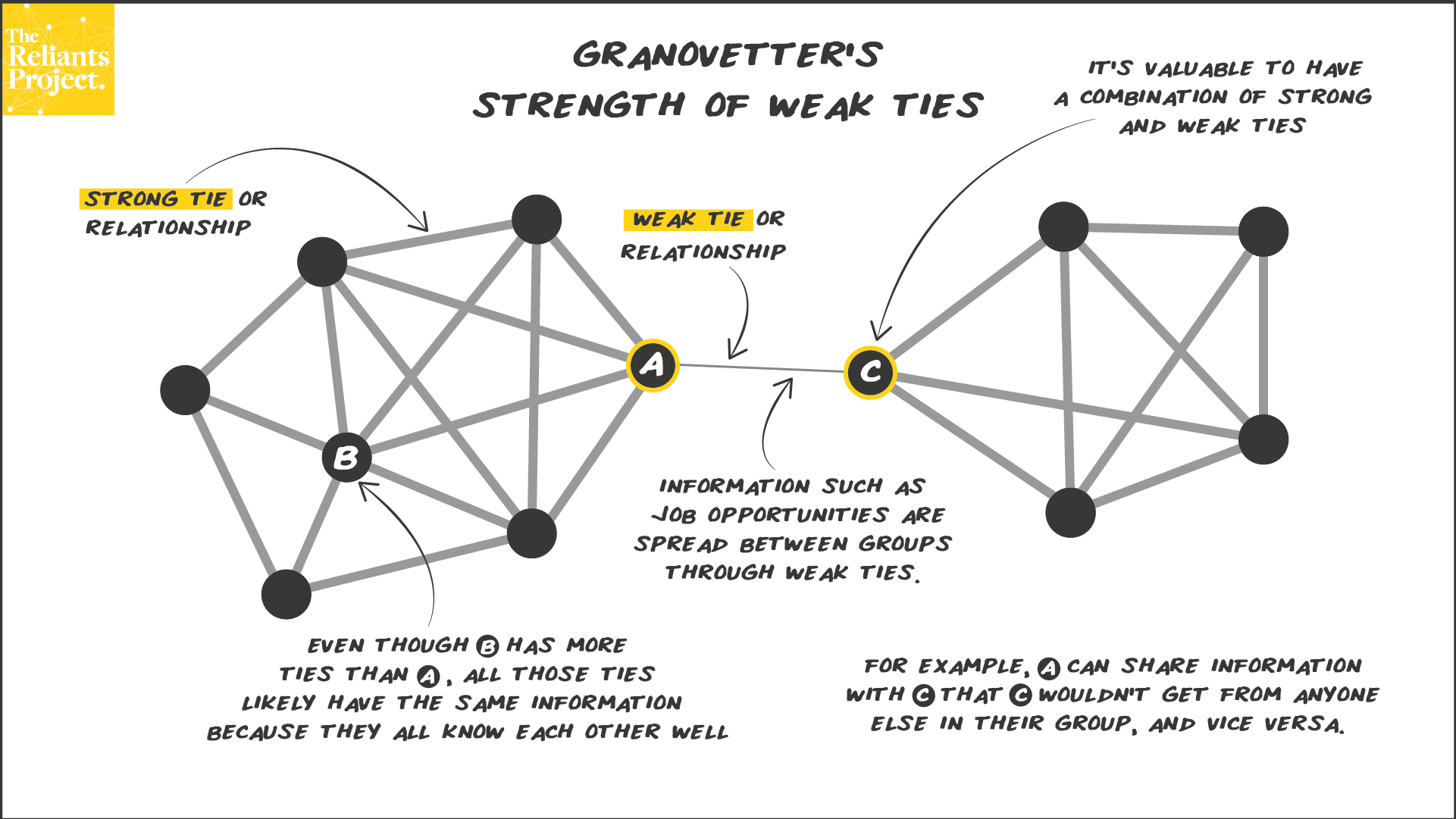

A liquid network, therefore, is an environment that is rich in weak ties. The "coffeehouses" and "lab meetings" Johnson describes are physical spaces that facilitate the formation and activation of these crucial, information-bearing bridges.
3. Application: Designing a Liquid Network for Innovation
Now, let's apply this theory to one of your specific interests. Following our alternating pattern, this lesson's application will focus on lingerie design.
Imagine you are working on a new design for a cleavage-enhancing bra. Your initial ideas feel stale, and you're iterating on the same old concepts (e.g., padding, underwire). You decide to deliberately engineer a "liquid network" to break out of this rut and spark genuine innovation.
Please take about 15 minutes to outline your strategy.
Analysis & Strategy Exercise:
Part A: Analyse Your Current Network (Strong Ties)
- List 3-4 types of people who likely form your strong ties in the context of lingerie design. (e.g., other designers, fabric suppliers, pattern-makers).
- What kind of information do these strong ties provide? Why might this information be redundant or limiting for breakthrough innovation?
Part B: Design Your Liquid Network (Cultivating Weak Ties)
Based on the principles we've discussed, devise a plan to build and engage with a liquid network. Be specific.
-
Identify Diverse Expertise (Weak Ties): Who would you seek out? List at least four professions or fields of expertise completely outside of fashion or lingerie design that could offer a novel perspective on "cleavage enhancement." For each one, explain what kind of unique insight they might offer.
- Hint: Think about structure, materials, human anatomy, perception, and comfort.
-
Find Your "Coffeehouse": Where would you go to create these connections and encourage "information spillover"? Propose two specific types of places or events (physical or digital) that could serve as your modern-day coffeehouse.
- Hint: Think beyond fashion industry events. Where do people from your target fields in B1 gather?
-
Engage the Network: How would you initiate conversations to tap into this network? Describe a question you might ask that isn't "how do I design a better bra?" but is designed to elicit unexpected connections and ideas.
- Hint: Recall the story of GPS from Johnson's talk. The innovation began with a simple, curious question in an informal setting.
Conclusion
In this lesson, we have begun our exploration of the sources of innovation by analysing the concept of liquid networks. You have learned that these environments are not magical, but are underpinned by sociological principles that you can strategically leverage.
Key Takeaways:
- Liquid networks are dense, fluid, and diverse environments where ideas can collide and create novel combinations.
- Their innovative power comes from the "strength of weak ties." While strong ties offer support, it is the weak ties—your acquaintances—that act as bridges to new information and perspectives.
- You can actively engineer a liquid network by identifying gaps in your current network, seeking out diverse expertise, and creating opportunities for informal, curiosity-driven conversations.
You have now covered the "L" in your LAPS SEE mnemonic.
In our next lesson, we will continue to the "A" and explore the concept of the "Adjacent Possible." We will analyse how innovation doesn't come from giant leaps into the unknown, but from creatively exploring the possibilities that lie just one step away from what is already known. Liquid networks help you see these adjacent possibilities.