Introduction
Welcome to the final lesson in our module on thought experiments. In our last session, we explored prefactual thinking, a method for simulating various possible futures to anticipate challenges and build resilience. Using techniques like the premortem, we asked, "What could happen, and how can I prepare?"
Today, we transition from exploring possibilities to creating a concrete plan for a single, desirable future. We will cover Backcasting, the "B" in your RCS PPB mnemonic. Instead of starting from the present and extrapolating forward, backcasting starts with a clear vision of a preferred future and works backward to identify the steps needed to get there.
Your learning outcome for this lesson is to apply backcasting to chart a pathway from a desired future state back to the present.
As a statistician, you are very familiar with forecasting—using current data and trends to predict what is likely to happen. Backcasting is a fundamentally different, normative approach. It doesn't ask what is probable, but rather, "Given a future we want, how can we achieve it?"
1. Defining Backcasting: Planning Backwards from Success
Forecasting projects the present into the future. Backcasting, in contrast, connects a desired future back to the present. It is a goal-oriented process used for strategic planning when you want to create transformational change rather than just react to current trends.
To ground this concept, please read the following brief section from a paper on design and decision-making.
[PDF] Design and Decision Making : Backcasting using principles to ...
This reading, from 'Design and Decision Making: Backcasting using principles to...', provides a concise definition of backcasting and clearly distinguishes it from forecasting.
Please read the section titled 'Strategy: Backcasting and strategic guidelines'. Focus on the definition of backcasting and the core differences between it and forecasting, particularly the idea that backcasting is a 'normative' process for attaining desirable, rather than likely, futures.
The key takeaway is that backcasting is not about prediction; it's about intentional design. You define a successful outcome first, and then you build the path to it. This makes it an incredibly powerful tool for tackling complex, long-term goals, whether in business, social change, or personal development.
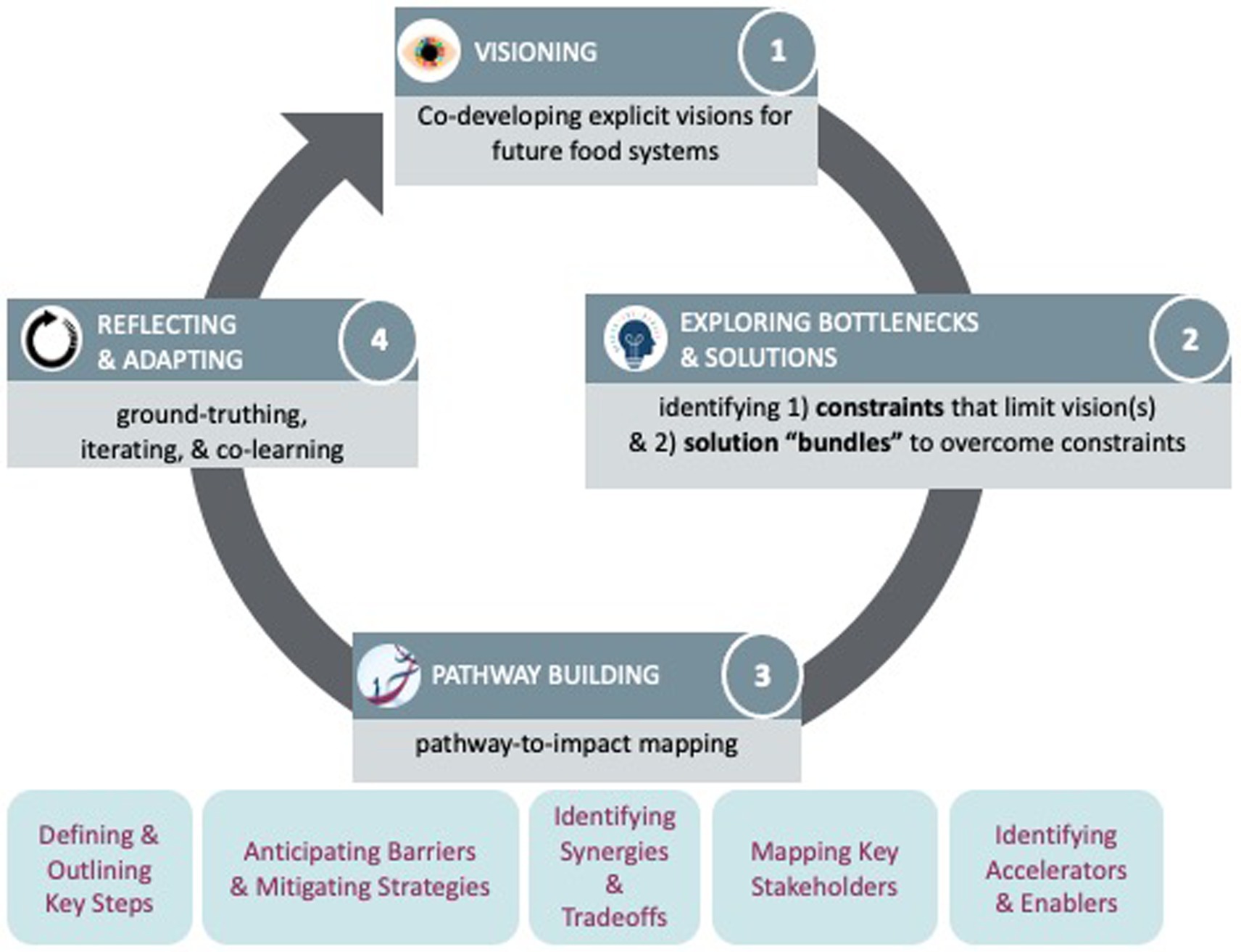
The following diagram illustrates where this kind of pathway building fits into a strategic planning cycle. The process begins with a vision and then moves to identifying the steps needed to build a pathway towards it.
2. The Backcasting Wheel: A Structured Method
Now that we understand the "what" and "why" of backcasting, let's focus on the "how." A practical and detailed method for this is the Backcasting Wheel. It provides a structured, step-by-step process for mapping the path from your future vision back to your present actions.
Let's dive into the mechanics of this method.
[PDF] The Backcasting Wheel for Mapping a Pathway to a Preferred Future
The paper 'The Backcasting Wheel for Mapping a Pathway to a Preferred Future' introduces and explains this method in detail. Reading this will give you the complete blueprint for the exercise we'll do shortly.
First, read the 'Introduction' to reinforce the definition of backcasting. Next, read 'The Backcasting Wheel' section to understand the overall concept. Finally, carefully study the six steps outlined in the section that begins with 'Given a clear vision or goal...'. These steps form the core of the technique.
To summarize and structure the process described in the paper, the Backcasting Wheel involves these six key steps:
- Identify Key Dimensions of Success: Start with your clearly defined future goal. Then ask: "What are the essential components that make up this success? How would we know we've achieved it?" These dimensions become the main branches of your plan.
- Identify Signposts: For each dimension of success, identify "signposts"—recognizable future events that signal you are on the right track. Ask: "What milestones would prove we are making progress toward this dimension?"
- Identify Opportunities and Obstacles: For each signpost, brainstorm what could help you achieve it (opportunities) and what could get in your way (obstacles). This step is similar to the risk/opportunity analysis in a premortem.
- Identify Concrete Management Actions: This is where the plan becomes real. For each opportunity, what specific action can you take to leverage it? For each obstacle, what specific action can you take to overcome or avoid it? The key here is to be concrete and actionable.
- Scoring Round: Prioritize your actions. You can score them based on importance (how critical is this action?) and timing (how urgent is it?). This helps you focus your immediate efforts where they will have the most impact.
- Analysis: Synthesize all the information into a coherent action plan. This plan shows not only what you need to do but also in what order to build the path to your desired future.
3. Your Turn: Backcasting a Harmonious Vee Relationship
For our last exercise in this module, we will return to the domain of personal relationships. Your task is to apply the backcasting process to map out a pathway toward a stable and happy long-term Vee relationship.
The Desired Future State (The "Center" of the Wheel):
"In two years, our Vee relationship (husband, wife, and metamour) is a stable, harmonious, and emotionally secure unit. The metamour is fully and happily integrated into our family life, all three individuals feel valued and supported, and the structure is sustainable for the long term."
Your Task (25 minutes):
Work through the first four steps of the Backcasting Wheel for this scenario. Write down your thoughts for each step.
Step 1: Identify Key Dimensions of Success
What are the 3-4 most critical components of this "stable, harmonious, and emotionally secure" future?
- Hint: Think about broad categories. Examples might include: "Financial & Domestic Integration," "Emotional Security for All Partners," "Clear Boundaries & Communication Protocols," or "Strong Dyadic Relationships" (i.e., the health of each individual pair within the triad).
Step 2: Identify Signposts
For one of the key dimensions you just identified, brainstorm 2-3 "signposts" or milestones that would indicate you are successfully achieving it.
- Example: If your dimension is "Emotional Security for All Partners," a signpost might be: "All three partners can express jealousy or insecurity without it causing a major crisis," or "The metamour independently plans activities with the shared household, feeling confident in their place."
Step 3: Identify Opportunities & Obstacles
Choose one of your signposts from the previous step. Brainstorm 1-2 opportunities that could help you reach it and 1-2 obstacles that might prevent it.
- Example: For the signpost "Metamour independently plans activities," an opportunity might be a shared family calendar that empowers them to schedule things. An obstacle could be the wife's lingering feelings of territoriality about running the household.
Step 4: Identify Concrete Actions
For the obstacle(s) you just identified, what is a concrete, specific action you could take now or in the near future to mitigate it?
- Example: To address the obstacle of "wife's lingering feelings of territoriality," a concrete action might be: "The wife and metamour will collaboratively plan the family's meals for one week each month, with the wife explicitly teaching the metamour the household shopping system." Another action for the husband might be: "Schedule a dedicated 'just us' weekend trip with the wife within the next three months to reinforce their primary bond."
Take your time to think through these steps. The goal is to see how a big, abstract vision can be broken down into a series of tangible, manageable actions.
Conclusion
Congratulations on completing the module on thought experiments! Today, you learned how to use backcasting to transform a desirable future from a vague dream into an actionable plan.
Key Takeaways:
- Backcasting is a normative planning tool: It starts with a defined, desirable end state and works backward, making it ideal for creating proactive, goal-oriented change.
- It complements forecasting: While forecasting tells you where you're likely going, backcasting helps you build a bridge to where you want to go.
- The Backcasting Wheel provides a clear process: By systematically identifying dimensions of success, signposts, obstacles, and concrete actions, you can create a detailed and robust roadmap to achieve your most ambitious goals.
You have now completed your RCS PPB toolkit for exploring different ways of thinking about the past, present, and future.
In our next module, we will shift our focus. Instead of analyzing how to generate and structure ideas, we will begin exploring where innovative ideas come from in the first place. Our first lesson will be on the concept of Liquid Networks, analyzing how diverse and loosely connected interactions can become a powerful engine for creativity.