Hello! In our last lesson, we explored the critical difference between I/O-bound and CPU-bound tasks, establishing a clear framework for choosing between asyncio for concurrency and multiprocessing for true parallelism.
This lesson builds directly on that foundation. Now that we can run many I/O-bound tasks concurrently, we need a robust way to manage them. What if we have a thousand tasks to run, but we only want 50 running at any one time to avoid overwhelming an external API? How do our concurrent tasks communicate their results safely?
Today, we will implement one of the most powerful patterns in concurrent programming: the producer-consumer pattern, using asyncio.Queue. This pattern is fundamental to building scalable, resilient systems where different parts of your application can work together without being tightly coupled. You will learn to create workflows where "producer" coroutines generate work and "consumer" coroutines process it, all coordinated by a central queue.
The Producer-Consumer Pattern
At its core, the producer-consumer pattern involves three components:
- Producers: Tasks that create work items (e.g., fetching URLs to be scraped, receiving incoming requests).
- Consumers: Tasks that process the work items (e.g., scraping the webpage, handling the request).
- Queue: A communication channel that sits between producers and consumers. Producers add items to the queue, and consumers remove them.
This pattern is analogous to a restaurant kitchen. Waiters (producers) take orders from customers and place the tickets on a rail (the queue). The chefs (consumers) pick up tickets from the rail at their own pace and prepare the food. This decouples the waiters from the chefs; a waiter doesn't need to wait for a specific chef to be free.
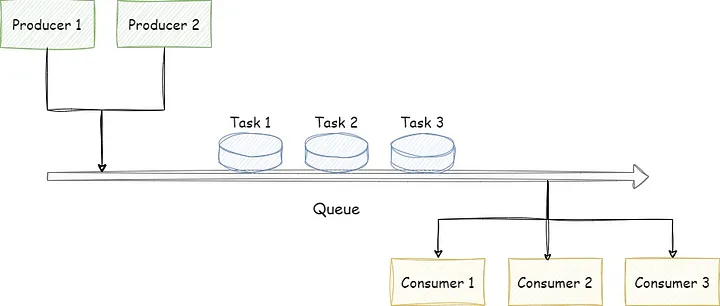
This architectural decoupling provides several key benefits:
- Buffering and Rate Matching: The queue acts as a buffer. If you have a burst of incoming work, the queue can hold it until the consumers catch up. This prevents your system from dropping requests.
- Scalability: If your consumers can't keep up with the work, you can simply add more consumer tasks to increase processing throughput, without changing the producer logic.
- Resilience: If a consumer task fails and restarts, the work items remain safely in the queue, ready to be picked up by another consumer.
The following article provides a great introduction to asyncio queues and the producer-consumer pattern.
Asyncio Queues: Producer-Consumer
This tutorial from Krython introduces the concept of asyncio queues using the conveyor belt and restaurant kitchen analogies and provides a simple code example.
Read the sections "Understanding Asyncio Queues" and "Basic Syntax and Usage." Focus on the "Why Use Producer-Consumer Pattern?" part and study the simple producer and consumer functions in the code example.
Implementing the Pattern with asyncio.Queue
In Python's asyncio library, the asyncio.Queue class is the primary tool for implementing this pattern. It provides a coroutine-based API for safe communication between tasks in the same event loop.
The four essential methods for the producer-consumer workflow are:
| Method | Description |
|---|---|
await queue.put(item) |
Adds an item to the queue. If the queue is full (for bounded queues), it blocks until a slot is free. |
item = await queue.get() |
Removes and returns an item from the queue. If the queue is empty, it blocks until an item is available. |
queue.task_done() |
Signals that a formerly enqueued task is complete. Consumers must call this for every item they get() from the queue. |
await queue.join() |
Blocks until all items that have ever been put into the queue have been processed (i.e., task_done() has been called for each of them). |
This get/process/task_done cycle is crucial. The join() method uses an internal counter that is incremented by put() and decremented by task_done(). It only unblocks when the counter returns to zero.
The following video provides a complete, step-by-step implementation of a robust producer-consumer system. It is one of the most practical and thorough examples available.
AsyncIO: Implementing a Producer-Consumer Model
This video from MathByte Academy, "AsyncIO: Implementing a Producer-Consumer Model," builds a complete system from scratch, explaining every component.
This video is the core of our lesson. Watch it in segments to understand each part: Conceptual Overview (watch here): Understand the problem (managing many tasks) and the proposed architecture with a work queue, workers, and a result queue. Implementing the Components (watch here): Pay close attention to the produce_work, do_work (the consumer), and handle_task_result functions. Notice the core while True loop in the consumer and the put and get calls. Orchestrating the System (watch here): This is the most important part. See how the controller function creates the queues, starts the producer and consumer tasks using asyncio.create_task, and then uses await queue.join() to wait for all work to be completed before gracefully shutting down the workers. Running and Tuning (watch here): Observe the performance difference when changing the number of workers, demonstrating the scalability of the pattern.
The system in the video is a great template for many real-world applications. It includes a work queue, multiple workers (consumers), and even a results queue, forming a simple asynchronous pipeline.
The Worker Pattern: A Second Look
The consumer loop, often called a "worker," is a very common pattern. Let's look at it again in a different context: a web crawler. This example from the mCoding channel reinforces the key get/task_done logic inside a try...finally block, which is a best practice to ensure task_done() is always called, even if an error occurs.
Intro to async Python | Writing a Web Crawler
This clip from "Intro to async Python | Writing a Web Crawler" focuses on the worker queue pattern.
Watch the segment explaining the worker queue. Notice how each worker runs in a while True loop, calls await queue.get(), and uses a try...finally block to guarantee that queue.task_done() is executed. This prevents the system from deadlocking if one task fails.
The pattern is:
async def worker(queue):
    while True:
        try:


            # Wait for an item from the producer
            item = await queue.get()


            # Process the item
            print(f"Processing {item}...")
            await asyncio.sleep(1) # Simulate work

        finally:


            # Signal that the item is done
            queue.task_done()
Managing Backpressure with Bounded Queues
A common production issue arises when producers generate work much faster than consumers can process it. With an unbounded queue (asyncio.Queue()), this can lead to the queue growing indefinitely, consuming all available memory and crashing your service.
The solution is to use a bounded queue: asyncio.Queue(maxsize=N).
When a bounded queue is full, any further calls to await queue.put() will pause the producer coroutine until a consumer calls get() and frees up a slot. This automatic throttling is known as backpressure. It creates a self-regulating system that is far more stable.
Bounded Queues and Backpressure
This section from the dev.to article "The Queue: Producer-Consumer Patterns" clearly explains and demonstrates backpressure.
Read the section and study the bounded_queue_demo code. Observe how the fast_producer is forced to wait when the queue of maxsize=5 fills up, allowing the slow_consumer to catch up. This is a critical concept for system stability.
Conclusion
You have now mastered a powerful and essential pattern for building asynchronous applications. The producer-consumer model using asyncio.Queue allows you to build scalable, decoupled, and resilient systems. You can manage large volumes of work, adjust throughput by scaling consumers, and build self-regulating pipelines using backpressure.
Key Takeaways:
- The producer-consumer pattern decouples work generation from work processing using a shared queue.
asyncio.Queueis the primary tool for implementing this pattern for coroutines in a single event loop.- The
put,get,task_done, andjoinmethods form the core API for coordinating work between producers and consumers. - Placing
queue.task_done()in afinallyblock is a crucial best practice for preventing deadlocks. - Bounded queues (
maxsize) provide backpressure, a vital mechanism that prevents fast producers from overwhelming consumers and exhausting memory.
Preview of the Next Lesson:
We've now covered how to coordinate tasks within a single Python service. However, a microservices architecture is all about communication between services. In our next lesson, we will begin Module 5 by diving into the technologies that enable high-performance communication: Protocol Buffers (Protobuf) and gRPC. You will learn how to define structured data with Protobuf and understand why this binary format is a cornerstone of modern distributed systems.