Hello! In our last few lessons, we've taken a deep dive into the practical mechanics of Celery, culminating in building resilient tasks with automatic retries and exponential backoff. You now have the hands-on skills to make a background job robust against transient failures.
This lesson zooms out from the code to the architecture. We'll explore the fundamental why behind using systems like Celery. You will learn to articulate the architectural role that dedicated task queues play in any modern microservices system. This understanding is crucial for system design, as it allows you to justify and explain your design choices—a key skill for any senior engineer. We will focus specifically on how task queues enable decoupling and resilience, two of the most important goals in distributed systems.
1. The Peril of Synchronous Communication
Imagine a user signs up for your e-commerce platform. In a simple synchronous design, your User Service might handle the request by performing a series of blocking operations:
- Write the user's details to the primary database.
- Make a synchronous RPC/HTTP call to the
Email Serviceto send a welcome email. - Make another synchronous call to the
Recommendations Serviceto create an initial user profile. - Finally, return a
200 OKresponse to the user.
What's wrong with this picture?
- High Latency: The user has to wait for all three operations to complete. Sending an email can be slow, especially if the third-party email provider is having issues. This results in a poor user experience.
- Low Resilience: What happens if the
Email Serviceis down for maintenance? The entire signup request fails. The user sees an error, even though the most critical part (creating their account) succeeded. A failure in a non-essential downstream service causes a failure in a critical upstream service. This is a classic example of cascading failure. - Tight Coupling: The
User Serviceis now tightly coupled to theEmail ServiceandRecommendations Service. It needs to know their network addresses, and its own availability is directly dependent on theirs. Changes to theEmail ServiceAPI might require changes to theUser Service. This creates a fragile system that is difficult to maintain and scale.
Using the restaurant analogy you like: this is like a single cashier taking an order, running to the storeroom to get ingredients, then personally cooking the meal, and finally plating it, all while a long line of customers waits. If the storeroom is locked, the entire process grinds to a halt.
2. The Task Queue as an Architectural Solution
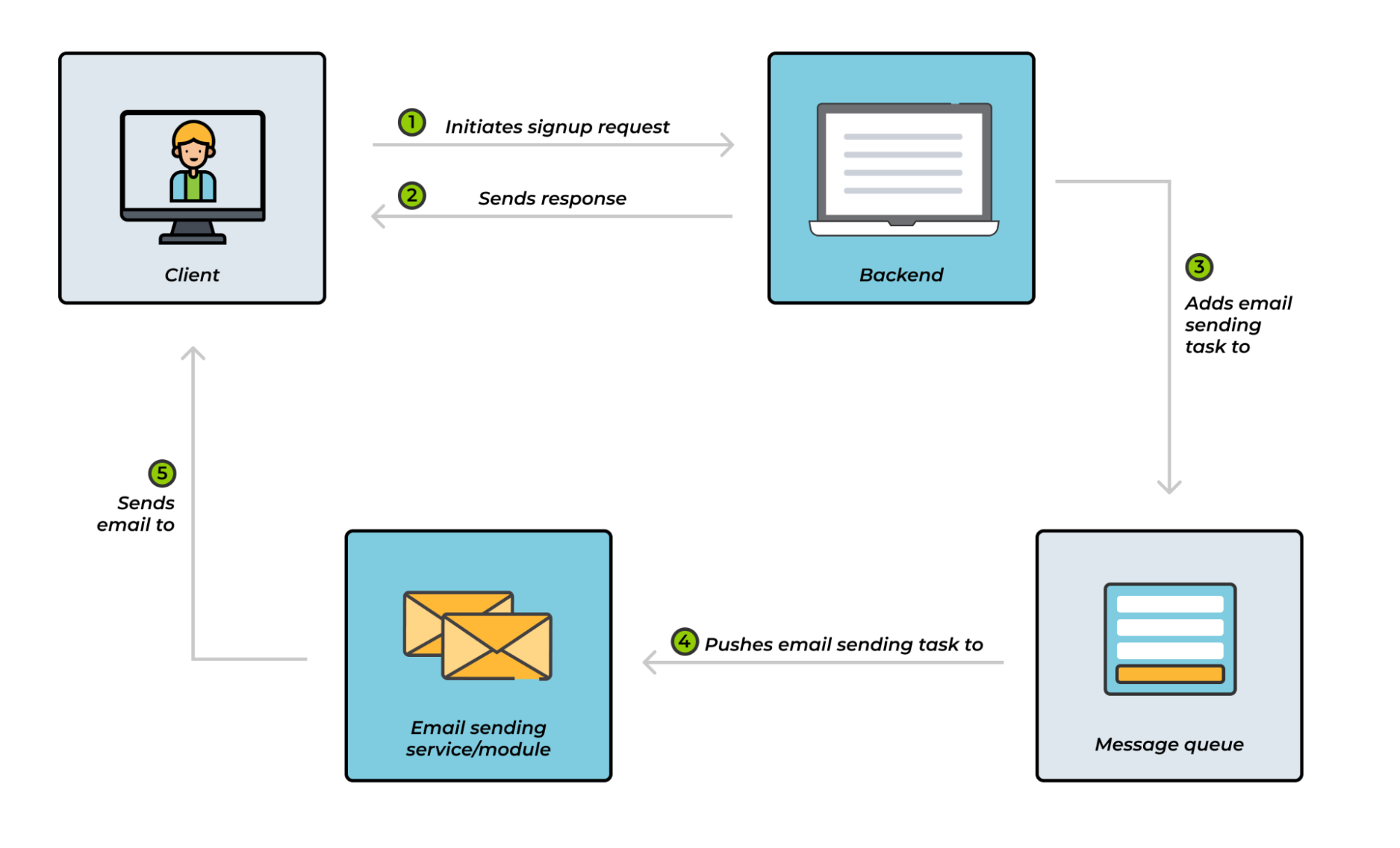
The solution is to introduce a task queue as an intermediary. Instead of performing all operations synchronously, the User Service's responsibility shrinks dramatically:
- Write the user's details to the database.
- Publish a
UserCreatedmessage (or task) to a message broker (like Redis or RabbitMQ). - Immediately return a
200 OKresponse to the user.
Separate, independent worker processes then consume these messages from the queue. An EmailWorker picks up the task and sends the welcome email. A RecommendationWorker picks it up and creates the user profile.
This architectural shift provides three immense benefits: decoupling, resilience, and scalability.
Decoupling Services
Decoupling means developing components that are self-reliant and not dependent on other components to function. A task queue achieves this beautifully.
The video below provides a fantastic, practical demonstration of this principle. It shows how to take a tightly coupled monolith and decouple a secondary action (sending an email) using a message broker.
Message Driven Architecture to DECOUPLE a Monolith
Watch this segment from the video "Message Driven Architecture to DECOUPLE a Monolith" by CodeOpinion. It perfectly illustrates the problem we're discussing.
Pay close attention to the example of placing an order and sending a confirmation email. See how a failure in the email service causes the entire order to fail. Then, watch how introducing a message queue decouples these two concerns, allowing the order to succeed even when the email service is down. This directly demonstrates the power of decoupling for resilience.
The following article explains this using a pizza store analogy, which provides another clear mental model for understanding the shift from synchronous to asynchronous processing.
Microservices and Message Queues, Part 1: Understanding ...
This CloudAMQP article provides excellent analogies and formal definitions for the role of message queues.
Read the sections "How a Message Queue saved a Pizza store" for an intuitive analogy, "Message Queues: A formal definition" to solidify your understanding of producers and consumers, and "Decoupled systems with Message Queues" for a clear explanation of the architectural benefits.
Improving Resilience and Responsiveness
By decoupling the User Service from the background workers, the system becomes far more resilient.
- Failure Isolation: An outage in the
Email Serviceno longer affects user signups. Messages for the email worker will simply queue up until the service recovers. The core functionality of the application remains online. - Enhanced User Experience: The user gets an immediate response. The slow, non-critical work of sending an email happens in the background, making the application feel much faster.
The video below explains how queues are used to handle asynchronous API calls for long-running tasks, which directly improves user experience and system reliability.
Why Every (great) System Design Uses Queues
This video, "Why Every (great) System Design Uses Queues", gives a high-level overview of the architectural patterns enabled by queues.
First, watch the segment on making APIs asynchronous. It uses a video upload example, but the principle is identical to our email sending scenario. Then, watch the section on handling failures. It introduces visibility timeouts and Dead Letter Queues (DLQs), concepts that build directly on the retry logic you learned in the previous lesson, showing how the queue itself provides a layer of resilience.
This diagram visually represents the asynchronous flow we've been discussing.
3. Task Queue vs. Message Queue: A Crucial Distinction
You will often hear the terms "message queue" and "task queue" used interchangeably, but for a system architect, the distinction is important.
- A Message Queue (like RabbitMQ, Apache Kafka, or AWS SQS) is the underlying infrastructure. It's a message broker whose primary purpose is to reliably transfer messages from a producer to a consumer. It's a tool for asynchronous communication.
- A Task Queue (like Celery or RQ) is an application-level concept or framework built on top of a message queue. Its purpose is to distribute units of work (tasks) to a pool of workers for execution. It's a tool for distributed task execution.
Celery is a task queue framework. It uses a message queue (which Celery calls a "broker") to send messages that describe the function to be executed and its arguments. The Celery workers consume these messages and execute the corresponding code.
The following resource provides a clear, tabular comparison that summarizes this difference perfectly.
Message Queue vs. Task Queue - System Design
This article from GeeksForGeeks offers a concise comparison.
Focus on the table under the heading "Differences between Message Queue and Task Queue". This table clearly lays out the differences in purpose, communication model, and use cases, which will help you articulate the distinction in a system design interview.
4. The Architectural Role: A Summary
In a microservices architecture, a dedicated task queue is not just a utility; it's a fundamental architectural pattern that serves several critical roles:
- Decoupling: It acts as a buffer between services, breaking synchronous dependencies. This allows services to be developed, deployed, and scaled independently.
- Resilience: It isolates services from downstream failures. The main application can remain operational even if background workers or their dependencies are temporarily unavailable. The queue, combined with worker-side retry logic, creates a powerful fault-tolerance mechanism.
- Scalability: It allows you to scale producers and consumers independently. If you have a surge in signups, you can scale the
User Service. If email generation becomes a bottleneck, you can add moreEmailWorkerinstances without touching any other part of the system. - Load Leveling / Buffering: It can absorb sudden spikes in traffic. If you get a burst of 10,000 requests to generate reports, the queue can hold them, and the workers can process them at a steady, sustainable rate, protecting your database and other downstream resources from being overwhelmed.
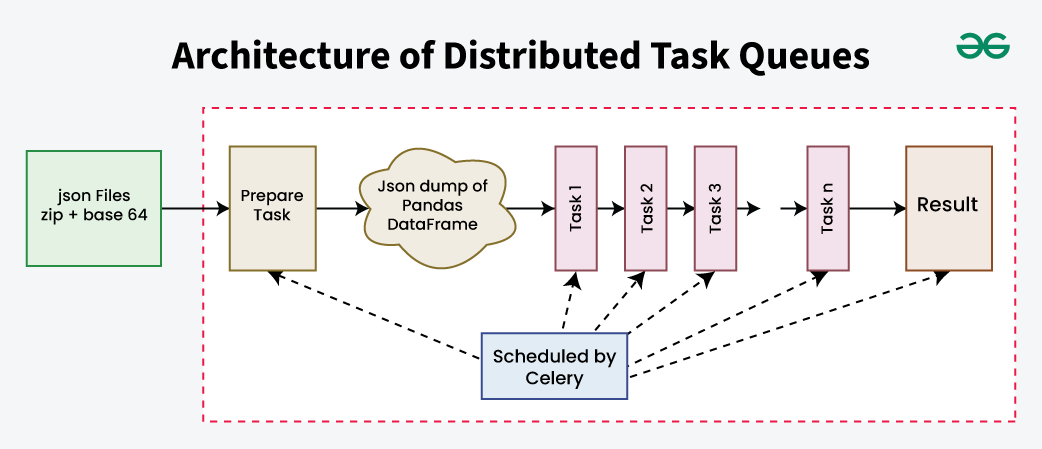
This diagram illustrates a more complex workflow managed by Celery, showing how a series of dependent tasks can be orchestrated.
Conclusion
In this lesson, we stepped back from the code to appreciate the architectural significance of the tools you've been learning. You can now confidently explain why a task queue is an indispensable pattern for building modern, scalable, and resilient applications.
Key Takeaways:
- Synchronous inter-service communication creates tight coupling and leads to brittle systems with poor latency.
- Task queues provide temporal decoupling, allowing producers and consumers to operate independently and at their own pace.
- This decoupling is the foundation for resilience (isolating failures) and scalability (scaling components independently).
- Task queues improve user experience by offloading long-running or non-critical work from the synchronous request-response cycle.
- A message queue is the communication infrastructure, while a task queue is the application framework for distributing work.
Preview of the Next Lesson
We have now designed and learned how to implement resilient, decoupled services. The next logical step is to prepare them for deployment. In the first lesson of our next module, "Containerizing Microservices with Docker," we will get hands-on with Docker. You will learn how to write a production-ready Dockerfile for an async Python microservice, turning your application code into a portable, reproducible container image. This is the first and most critical step toward running your microservices architecture anywhere.