Introduction
Welcome to your third lesson. In our last session, we built a robust four-pillar framework—Cost, Scalability, Integration, and Compliance—to systematically evaluate HR technology. You learned how to use a decision matrix to move beyond marketing claims and make objective, data-driven choices.
Now, it's time to put that framework into practice. Your goal is to find tools that you can potentially implement immediately, without a significant budget. Therefore, this lesson focuses on identifying and comparing the leading free and freemium HR tools available specifically for the Indian market. We will cover the three core system types you'll encounter most often:
- Human Resource Information Systems (HRIS): For managing employee data.
- Applicant Tracking Systems (ATS): For streamlining recruitment.
- Payroll Systems: For automating salary and compliance.
By the end of this lesson, you will have a clear map of the most viable free options and understand the trade-offs associated with each, enabling you to shortlist tools for your own organization or for a future role.
The "Freemium" Landscape: No Such Thing as a Free Lunch?
In the software world, "free" can mean several different things. It's crucial to understand the models to apply your TCO (Total Cost of Ownership) analysis from the last lesson correctly.
- Free Trial: You get full access to the software for a limited time (e.g., 14-30 days). After the trial, you must pay to continue. This is good for intensive testing.
- Free Forever: The core product is free indefinitely, usually for an unlimited number of employees. The company makes money from optional paid add-ons or services.
- Freemium: A limited version of the software is free forever, but with restrictions. These limits are typically on:
- The number of users/employees (e.g., free for up to 25 employees).
- The available features (e.g., core HRIS is free, but performance management is a paid module).
- The level of customer support (e.g., only email or community support for free users).
Freemium is often the most strategic starting point for SMEs. It allows you to adopt a system, solve immediate problems, and prove its value before committing to a budget. As the company grows and your needs become more complex, you can then scale into a paid plan with the same vendor.
This image provides a good overview of how different HRIS vendors structure their offerings, often using a freemium approach. Notice the columns for "Free Users" and the checkmarks indicating which features are included.

Identifying the Key Players in India
To begin our comparison, let's get an overview of the HR software landscape in India.
15 HR Software In India: Shortlisted Best Solution for India
The article '15 HR Software In India' by ZingHR provides a helpful comparison table that we can use as a starting point. It will help us quickly identify vendors who offer free or low-cost solutions tailored for SMEs.
Review the 'Quick Comparison Table' at the beginning of the article. Pay close attention to the 'Pricing' and 'Target Business' columns. Identify the tools that explicitly mention a 'Free' or low-cost model suitable for SMEs.
From that table, three names should stand out as prime candidates for our freemium analysis:
- Kredily (listed as "Free Forever")
- greytHR (listed with a free option)
- Zoho People (listed with a low per-user cost, and well-known for its freemium plan)
Let's dive into each of these to compare their models.
A Comparative Analysis of Leading Freemium Tools
We'll now examine our top three contenders, applying the evaluation framework from our previous lesson.
1. Kredily: The "Free Forever" Champion
Kredily positions itself as a completely free solution for core HR and payroll, making it highly attractive to startups and small businesses focused on minimizing costs.
15 HR Software In India: Shortlisted Best Solution for India
Let's look at what the ZingHR article says about Kredily's model and features.
Read the section on 'Kredily'. Note its target audience (SMEs and startups) and the core features offered in its free plan.
- Model: Free Forever for core HRIS and Payroll. They also have paid plans (
ProandPremium) that add more advanced features like performance management, an ATS, and enhanced support. - Strengths:
- Cost: Unbeatable entry point with zero software cost for essential functions.
- Comprehensiveness: The free plan includes not just employee database management but also leave, attendance, and full payroll processing—a rare combination.
- Potential Trade-offs (applying our framework):
- Scalability: While it serves small companies well, larger or more complex organizations might find the advanced features in the paid tiers less mature than those of competitors. The lower average software rating (3.8) might hint at this.
- Support: Premium support is likely reserved for paying customers. Free users may rely on self-service resources.
2. greytHR: The Scalable Freemium Path
greytHR is one of the most established names in the Indian HR tech market. Their model is designed to onboard small companies for free and grow with them.
15 HR Software In India: Shortlisted Best Solution for India
Now, let's examine greytHR. It's a very popular choice for SMEs in India.
Read the section on 'greytHR'. Focus on the details of its free offering and its reputation in the market.
- Model: Freemium. The "Starter Pack" is free for up to 50 employees and includes core HR, payroll, leave, and attendance.
- Strengths:
- Scalability: This is greytHR's biggest advantage. The free plan is a direct pathway to their powerful paid plans. As your company grows beyond 50 employees or needs more advanced modules, the upgrade path is seamless.
- Compliance: As a long-standing Indian company, their payroll and compliance engine is robust and regularly updated.
- Potential Trade-offs:
- Cost: The transition from free to paid can be a significant jump. You must analyze the TCO for when you cross the 50-employee threshold.
- Feature Gating: The most desirable features (e.g., advanced reporting, onboarding, performance management) are locked behind the paid tiers.
3. Zoho People: The Integrated Ecosystem Player
Zoho is a giant in the SaaS world, offering a vast suite of business applications. Zoho People's strength lies in its ability to integrate deeply with this ecosystem.
- Model: Freemium. Zoho People offers a "Free Forever" plan for up to 5 users. While this seems small, it's perfect for very small teams or for a single HR manager to set up and test the entire system. The real value is testing its capabilities.
- Strengths:
- Integration: If your company already uses or plans to use other Zoho products (like Zoho Books for accounting or Zoho Recruit for a dedicated ATS), the integration is seamless. This creates a powerful, unified system.
- Customization: Zoho is known for its high degree of customization, even in its more affordable plans.
- Potential Trade-offs:
- User Limit: The 5-user limit on the free plan is restrictive for any growing company, making a paid plan almost inevitable.
- Complexity: The sheer number of options and settings can sometimes be overwhelming compared to more straightforward solutions like Kredily.
Visualizing the Comparison
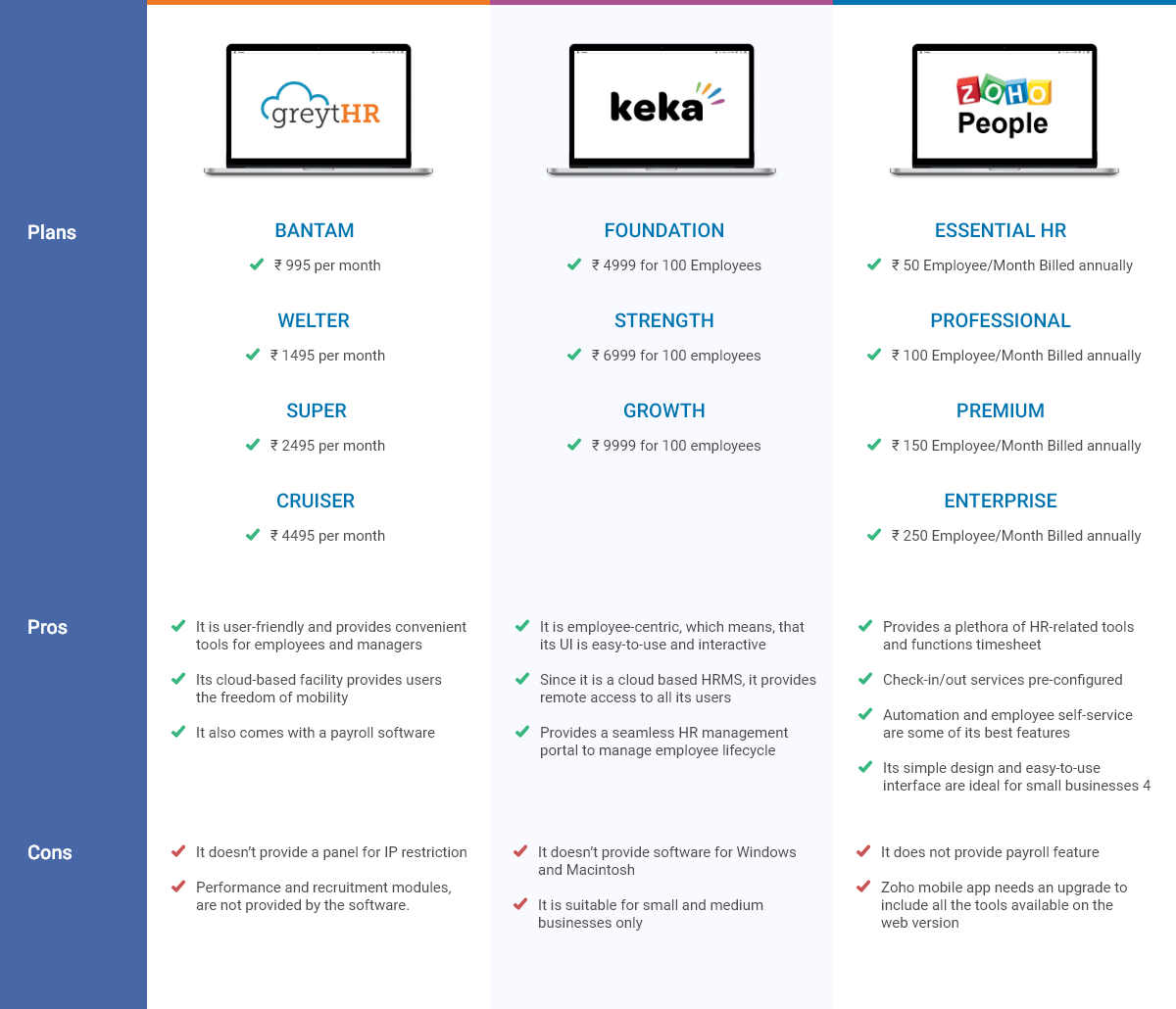
This image compares greytHR and Zoho People (along with Keka, a popular paid tool). It provides a great at-a-glance summary of their pros and cons, which aligns with our analysis.
Test your understanding!
A 30-person startup in Bangalore needs its first HR system. Their top priority is automating payroll and statutory compliance (PF, ESI) correctly. They have no budget for software this year but expect to grow to 70 people next year.
Based on our analysis, which tool would you recommend they start with, and why? Justify your choice by referencing the tool's model and strengths.
Show answer
Recommendation: greytHR's free Starter Pack.
Justification:
- Fits Current Needs: The free plan supports up to 50 employees, which covers their current headcount of 30.
- Addresses Top Priority: The plan includes a robust, compliance-focused payroll module, which is exactly what they need for automating PF and ESI. greytHR has a strong reputation for Indian statutory compliance.
- Future-Proof (Scalability): When they grow to 70 employees next year, they can seamlessly transition to a paid greytHR plan. They won't need to migrate to a new system, which is a major disruption.
- Low Risk: They can implement and use the system for a full year with zero software cost, proving its value before needing a budget.
While Kredily is also free, greytHR's established reputation for compliance and its clear scalability path make it a slightly safer and more strategic bet for a company with clear growth plans. Zoho People's 5-user limit makes its free plan unsuitable for a 30-person company.
Focusing on Payroll and ATS
While the all-in-one HRIS platforms we've discussed include payroll and basic ATS features, sometimes a specialized "best-of-breed" tool is a better fit.
Top 10 Payroll Software in India: Simplify Your Payroll in 2025
For a deeper look into payroll-specific software, let's turn to the 'Top 10 Payroll Software in India' article from Kredily. It provides a detailed comparison of tools dedicated to this critical function.
First, quickly scan the 'Detailed Overview of the Top 10 Payroll Software' section to see how it describes Kredily and greytHR, reinforcing what we've learned. Then, read the entry for 'RazorpayX Payroll'. Finally, read the 'Choosing the Right Payroll Software for Your Business' section for practical advice.
Key takeaways on specialist tools:
- Payroll: For tech startups already using the Razorpay payment gateway, RazorpayX Payroll is a compelling option. It offers deep integration with their payment ecosystem, automating salary disbursement and compliance. It often comes with a free plan for a limited number of employees.
- Applicant Tracking System (ATS): The free ATS modules within Kredily and Zoho People are often sufficient for SMEs. However, if recruitment is a major focus, you might consider a specialist tool. Freshteam (from Freshworks, another Indian SaaS success story) offers a free-forever plan for up to 50 employees that provides more dedicated recruitment features than a typical HRIS.
Conclusion
You are now equipped with a market map of the most prominent free and freemium HR tools available in India. You can see how the abstract evaluation framework from the previous lesson becomes a powerful, practical guide when applied to real products.
Key Takeaways:
- The Big Three: For a general-purpose HRIS, Kredily, greytHR, and Zoho People are the top freemium contenders in the Indian market.
- Model Matters: The choice between "Free Forever" (Kredily), "Scalable Freemium" (greytHR), and "Ecosystem Freemium" (Zoho People) depends entirely on your company's current size, budget, and future growth strategy.
- No Perfect Tool: "Free" always comes with trade-offs, usually in features, user limits, or support. Your task is to choose the tool whose limitations you can live with today and whose growth path aligns with your company's tomorrow.
- Specialist Options Exist: For high-priority functions like payroll or recruitment, dedicated tools like RazorpayX Payroll or Freshteam might offer more powerful free plans than the modules within an all-in-one HRIS.
Preview of the next lesson:
So far, we have focused on the core systems that manage employee data and processes (HRIS, Payroll, ATS). These are the foundational "systems of record." In the next lesson, we will move up a level to discuss a more strategic concept: the Employee Experience Platform (EXP). We'll define what an EXP is, why it's strategically valuable, and how it differs from the core systems you've just learned about.