Hello! Welcome back to our module on Advanced Automation & Personalization for Hotels.
In our last lesson, we focused on personalizing communications for past guests using dynamic content based on their stay history. We learned to tailor offers to make them more relevant and effective. Today, we're shifting our focus from past guests to potential guests.
Our goal is to learn how to create a lead scoring system to identify high-intent potential guests. Instead of treating every new lead the same, we'll learn to systematically rank them based on their potential value to your hotel. This allows you to prioritize your sales and marketing efforts, focusing your time and budget on the people most likely to book. We will cover the fundamentals of building a rules-based scoring system and also touch on how AI is shaping the future of this practice, aligning with your goal of mastering marketing for 2026 and beyond.
1. What is Lead Scoring and Why is it Crucial for Hotels?
Lead scoring is a methodology used to rank prospects on a scale that represents their perceived value. Each lead is assigned a numerical score based on their attributes (like their job title or company) and their behaviors (like which pages they visit on your website). The purpose is to determine who is ready for a sales conversation and who needs more nurturing.
For a hotel, this is incredibly valuable. You deal with a wide range of potential guests, from a student planning a single-night stay to a corporate event planner looking to book 100 rooms for a conference. A lead scoring system helps you cut through the noise and identify the high-value opportunities automatically.
A customer feedback platform empowers hotel project managers ...
To understand the specific challenges and opportunities for lead scoring in hospitality, let's start with this article from Zigpoll. It frames the problem perfectly for a hotel context.
Please read the introductory section 'Understanding the Challenges of Lead Scoring Optimization in Hotels' and the concluding section 'Business Outcomes of Effective Lead Scoring Optimization'. These sections will explain why lead scoring is so important for differentiating between lead types (like corporate vs. leisure) and the tangible benefits it brings.
The ultimate output of a lead scoring system is a clear, prioritized list of leads, often categorized by "temperature."

2. How to Build a Lead Scoring System: The Five-Step Framework
Creating a lead scoring system is a logical process. We can break it down into five core steps, which provide a clear roadmap for designing your own model.
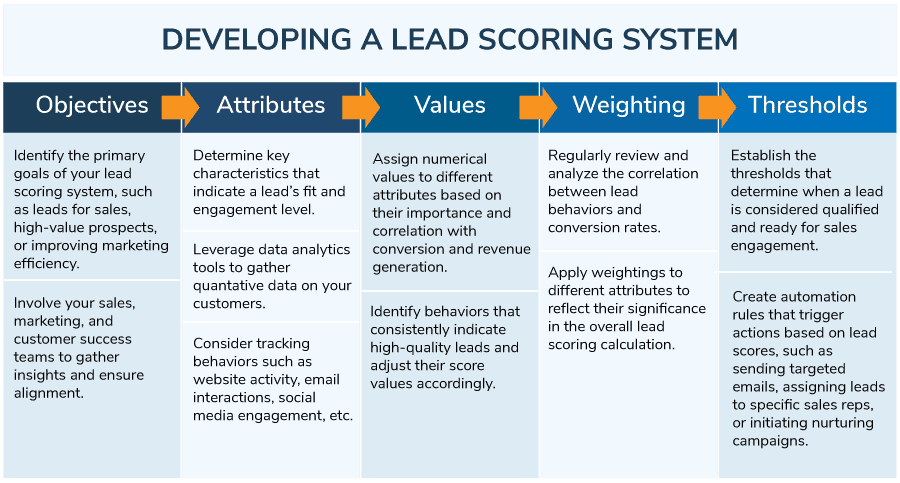
Let's walk through these steps in the context of your hotel.
Step 1: Define Objectives and Segment Your Leads
First, you need to know what you're scoring for. The criteria for a high-value leisure guest are very different from those for a corporate event planner. As the Zigpoll article highlights, a key first step is segmentation.
Your primary segments might be:
- Corporate Clients: Booking conferences, meetings, or block room bookings.
- Leisure Travelers: Booking individual or family stays, weekend getaways, etc.
- Event Planners: Booking weddings, parties, or other social functions.
You will build a slightly different scoring model for each primary segment.
Step 2: Identify Scoring Attributes
Next, you identify the data points that indicate a lead's quality and intent. These fall into two categories:
- Explicit Data (Demographics/Firmographics): Information the lead tells you directly.
- For Corporate: Job title (e.g., "Event Manager," "Executive Assistant"), company size, industry.
- For Leisure: Location (local vs. international), stated interest (e.g., "Spa," "Golf").
- Implicit Data (Behavioral): Information you gather by observing their actions.
- Visiting high-value pages (e.g., "Conference Facilities," "Luxury Suites").
- Downloading a brochure (e.g., "Wedding Packages PDF").
- Email engagement (opening promotional emails, clicking on offers).
- Number of visits to the website.
Step 3: Assign Point Values
This is where you translate attributes into numbers. You'll assign positive points for actions that indicate high intent and, importantly, negative points for actions that indicate a poor fit.
Let's build a simplified example model based on the one in the Zigpoll article.
Sample Hotel Lead Scoring Model
| Lead Attribute / Behavior | Corporate Lead Points | Leisure Lead Points |
|---|---|---|
| Explicit Data | ||
| Job Title contains "Event" or "Planner" | +20 | 0 |
| Company Size > 100 employees | +15 | 0 |
| Inquiry is for a weekend stay | 0 | +10 |
| Implicit Data | ||
| Visited "Corporate Events" page | +15 | -5 |
| Visited "Spa Packages" page | +5 | +15 |
| Downloaded "Conference Brochure" | +25 | 0 |
| Opened 3+ marketing emails in 30 days | +10 | +10 |
| Visited "Careers" page | -20 | -20 |
| Submitted a contact form | +30 | +30 |
Step 4: Set Lead Thresholds
Once a lead accumulates points, you need to define what those scores mean. These are your "temperature" thresholds that trigger specific actions.
- Hot (e.g., 70+ points): Sales-Qualified Lead (SQL). This lead is ready for direct, personal outreach. Your system should automatically create a task for a sales manager to call them.
- Warm (e.g., 31-69 points): Marketing-Qualified Lead (MQL). This lead is interested but not yet ready to buy. They should be added to a targeted marketing automation sequence (like the ones we've discussed in previous lessons) to nurture them with relevant content and offers.
- Cold (e.g., 0-30 points): Nurture. The lead is aware of you but not showing strong intent. They can receive your standard newsletter but don't require intensive resources.
Test your understanding!
A person named Alex fills out a contact form on your website (+30 points). Her job title is "Office Manager" at a 250-employee company (+15 points). In her session history, you see she visited the "Corporate Events" page (+15 points) and the "Careers" page (-20 points).
Using the Corporate Lead Points from the table above, calculate Alex's lead score. What "temperature" is this lead, and what should the next action be?
Show answer
Let's calculate the score:
- Contact Form: +30
- Company Size > 100: +15
- Visited "Corporate Events" page: +15
- Visited "Careers" page: -20
Total Score: 30 + 15 + 15 - 20 = 40 points.
Based on our example thresholds, a score of 40 makes Alex a Warm Lead (MQL). The appropriate next action would be to enroll her in an automated nurturing sequence focused on corporate bookings, perhaps sending her case studies of successful events you've hosted or a special offer for first-time corporate clients.
To get a complete picture of this process, the following reading provides a detailed, step-by-step guide tailored for hotels.
A customer feedback platform empowers hotel project managers ...
The Zigpoll article provides a full step-by-step guide that puts our five-step framework into action with hotel-specific examples.
Please read the sections 'What Is Lead Scoring Optimization and Why Is It Essential for Hotels?', 'Essential Components of an Effective Hotel Lead Scoring Model', and 'Step-by-Step Guide to Implementing Lead Scoring Optimization in Hotels'. Focus on how lead attributes, behavioral signals, and scoring rules come together to form a cohesive system.
3. Gathering Scoring Data with an Interactive Assessment
A major challenge is gathering the explicit data needed for scoring. How do you find out a lead's budget or their primary obstacle without being pushy? An interactive online quiz or assessment is an elegant and effective solution.
You can create a "Find Your Perfect Hotel Package" or "Assess Your Event Readiness" quiz that not only provides value to the user but also gathers critical scoring data for you.
The $1 Million Landing Page (Works For Normal People)
While not about hotels specifically, this video from Daniel Priestley provides an excellent framework for creating a lead-generating quiz. It shows how to ask qualifying questions in a way that feels helpful to the user.
Please watch the section on 'The Quiz Questions' (from 04:13 to 08:13). Pay close attention to the 'big five questions' he recommends asking. Think about how you could adapt these questions for a hotel context to qualify potential guests.
Adapting Priestley's "big five" questions for a hotel:
- Current Situation: "Which best describes your upcoming trip?" (e.g., Corporate conference, Family vacation, Romantic getaway).
- Desired Outcome: "What's most important for your stay?" (e.g., Relaxing by the pool, Exploring the city, Productive business meetings).
- Obstacle: "What's your biggest challenge in planning?" (e.g., Sticking to a budget, Finding activities for everyone).
- Preferred Solution: "How do you prefer to plan?" (e.g., An all-inclusive package, A flexible
a la cartebooking, Help from a coordinator). - Anything Else?: An open field where a lead might volunteer crucial information like "I have to spend my budget by the end of the quarter."
The answers to these questions can be directly mapped to your lead scoring system, providing rich, explicit data points.
4. The Future: AI-Powered Lead Scoring
The rules-based system we've designed is powerful, but it's static. You have to manually define the rules and update them. The future of lead scoring, and a key trend for 2026, is the use of Artificial Intelligence (AI).
AI lead scoring models analyze all your data—from your CRM, website analytics, and booking history—to find complex patterns that a human might miss. Instead of you telling the system that visiting the "Conference" page is worth +15 points, the AI learns on its own which behaviors and attributes are the strongest predictors of a booking. It's dynamic, self-optimizing, and can significantly improve accuracy.
Ultimate Guide to AI Lead Scoring for Hotels
To understand how AI takes lead scoring to the next level, this guide from Wingenious.ai provides a clear overview of the implementation process and key considerations.
Please read the sections 'Steps to Implement AI Lead Scoring in Your Hotel' and 'Best Practices and Common Challenges'. Focus on the four main stages of implementation and the critical importance of data quality, privacy (GDPR), and avoiding bias.
While you might start with a rules-based system, understanding the principles of AI-driven scoring will prepare you for the next evolution in marketing automation.
Conclusion
Today you've learned how to design a system that transforms a messy list of leads into a prioritized action plan. By scoring potential guests, you ensure your most valuable resource—your team's time—is spent on the opportunities most likely to generate revenue.
Key Takeaways:
- Lead scoring prioritizes potential guests by assigning points based on their demographic and behavioral data.
- The goal is to categorize leads as "Hot," "Warm," or "Cold" to trigger the right action (sales call, nurture sequence, etc.).
- A robust scoring system is built by defining objectives, segmenting leads, identifying attributes, assigning points, and setting action thresholds.
- Interactive quizzes are a powerful tool for collecting explicit data to fuel your scoring model.
- AI represents the future of lead scoring, offering a dynamic and self-optimizing alternative to static, rules-based systems.
What's Next?
Now that we know how to identify and segment our most valuable leads, the next logical step is to use these segments for targeted advertising. In our next lesson, we'll learn how to sync segmented customer lists from an automation platform to Google and Meta Ads for retargeting, allowing you to reach your high-scoring leads with tailored ads on the world's biggest platforms.