Hello! Welcome to the next lesson in our journey to master Google Ads for your hotel.
In our last session, we created the architectural blueprint for our advertising by structuring campaigns into tightly themed ad groups (STAGs). We established the golden rule: all keywords in an ad group should be so similar that the exact same ad is perfectly relevant for all of them.
Today, we're going to furnish that structure by writing the ads themselves. An effective ad is the bridge between a potential guest's search and your hotel's website. It needs to grab their attention, answer their query, and persuade them to click.
By the end of this lesson, you will be able to write effective responsive search ads with compelling, hotel-specific headlines and descriptions that drive bookings.
1. The Anatomy of a Modern Search Ad
When a potential guest searches on Google, your ad competes for their attention against other hotels and booking sites. Your goal is to stand out with a relevant and compelling message.
Here's an example of what ads for a hotel search look like in the real world:
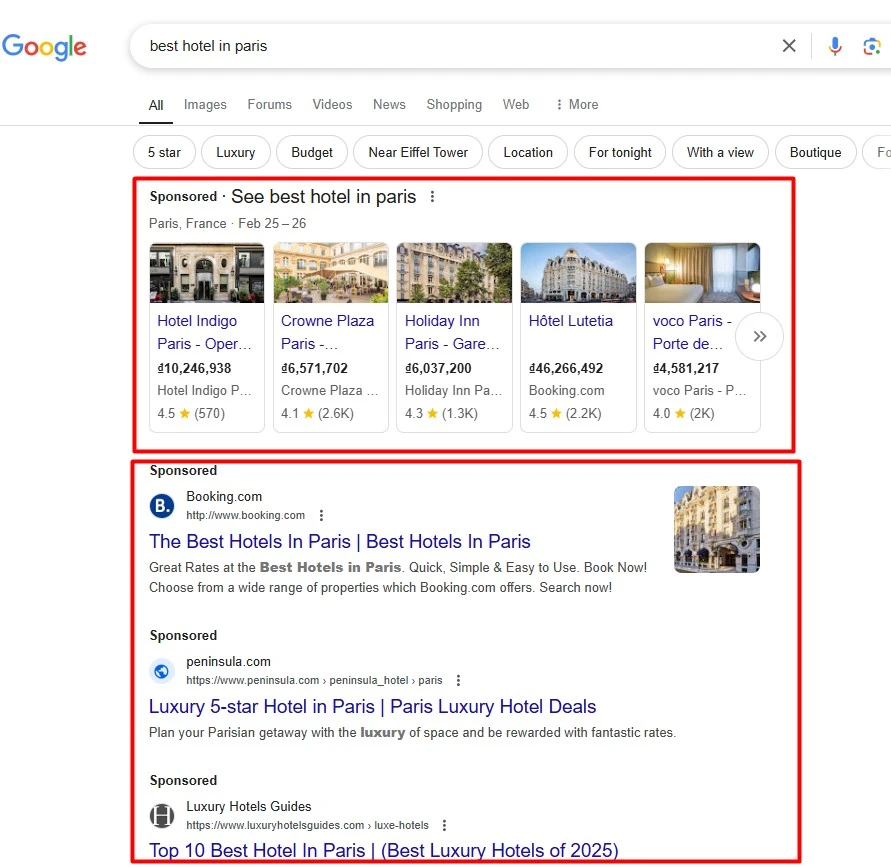
The standard ad format today is the Responsive Search Ad (RSA). Instead of writing one static ad, you provide Google with a set of "ingredients"—up to 15 headlines and 4 descriptions. Google's AI then tests different combinations of these assets to find the best-performing ad for each individual search auction.
Google Ads Responsive Search Ads Example and Best Practices
To start, let's get a clear visual of how RSAs are built inside Google Ads. This short clip from Surfside PPC will walk you through the basic structure.
Watch from the beginning to 02:11. Focus on understanding the core components: the final URL, the 15 headline slots, and the 4 description slots. This is the canvas we'll be working with.
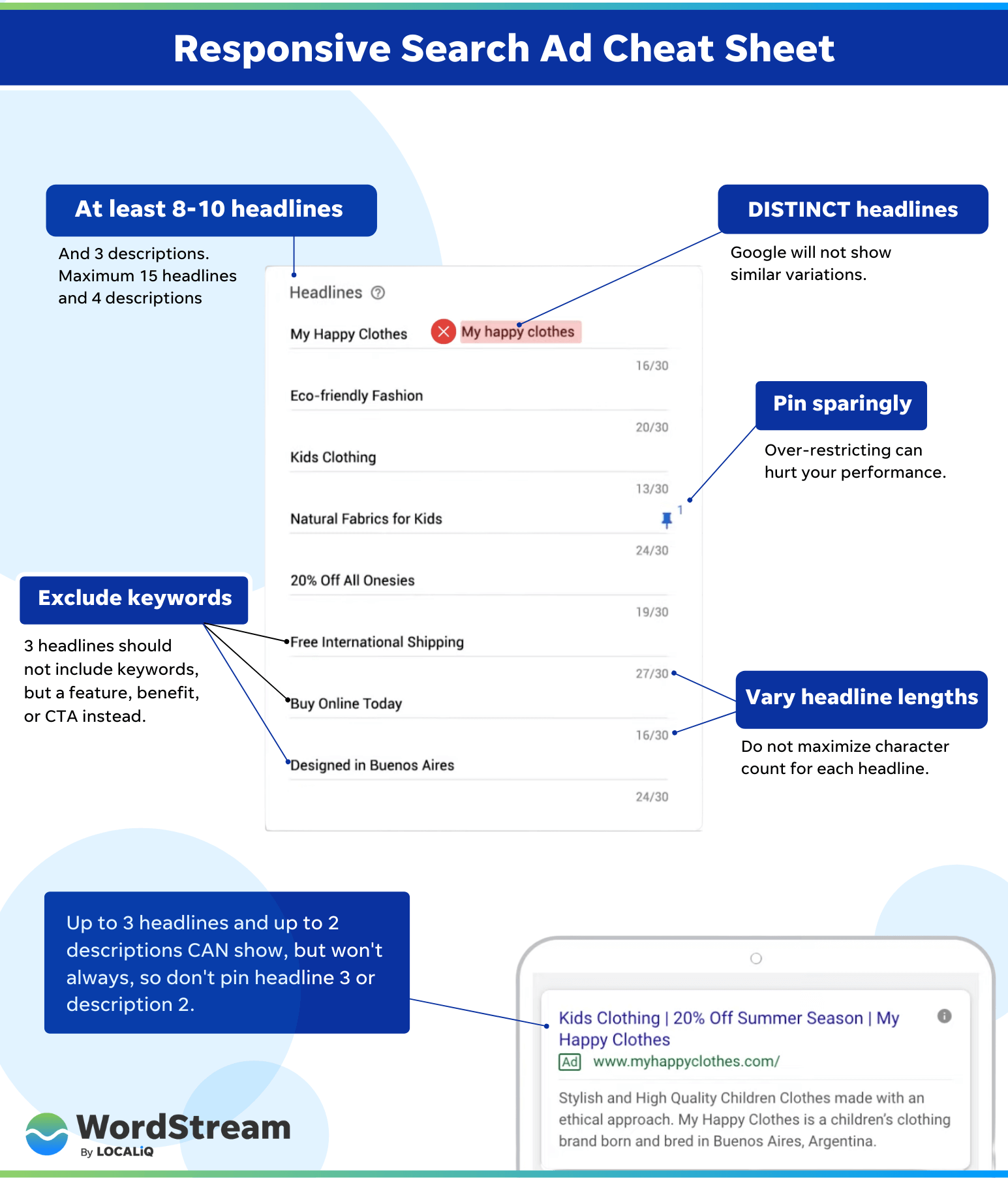
Your job is not to guess the single "best" ad combination. Your job is to provide Google with a diverse and high-quality set of headlines and descriptions so it can build the best ad for any situation.
2. The Four Pillars of High-Converting Ad Copy
Writing ad copy that works is both an art and a science. While creativity is important, a simple, proven framework can guide your efforts and ensure you cover the most critical elements.
Write Ad Copy That Gets clicks & CONVERSIONS for Google Ads
Aaron Young provides an excellent and memorable framework with four key elements that every great ad should have. Pay close attention to his hotel-related example—it's a perfect illustration of using emotional triggers.
Please watch from 03:27 to 08:45. As you watch, identify the four core elements. The example of the Bali villa ad shows how these pillars come together to create a powerful message.
As the video explains, your ads should be built on these four pillars:
- Keyword Focus: Your ad must reflect what the user searched for. This creates an immediate sense of relevance and is a key factor in Google's Quality Score. This is why our tightly themed ad groups from the last lesson are so important.
- Brand Mention: You are paying for the ad, so don't miss the chance to build your brand. Including your hotel's name reinforces recognition.
- Strong Call to Action (CTA): Tell the user exactly what you want them to do next. "Book Now," "Check Rates," or "View Rooms" are clear and direct.
- Emotional Triggers: People don't just buy a room; they buy an experience, a feeling, or a solution to a problem. Speak to their desires ("Your Romantic Getaway Awaits") or fears ("Limited Rooms Available").
The CTA you use should align with the user's intent. Someone searching for "hotels in London" is likely in the consideration phase, whereas someone searching "book grand plaza hotel tonight" is ready to convert.
Google Ads - Ad Copywriting: Call-to-Action Frameworks
This resource from the Digital Marketing Laboratory offers a sophisticated way to think about CTAs by tying them to the marketing funnel we discussed in the first module.
Read the section titled 'Call-to-Action Frameworks by Funnel Stage'. Notice the difference in language between CTAs for awareness (e.g., 'Explore Options'), consideration ('View Pricing'), and conversion ('Buy Now').
3. Crafting Compelling Headlines and Descriptions
Now, let's put this framework into practice. With 15 headlines and 4 descriptions, you have plenty of space to incorporate all four pillars and test different angles.
Writing Your Headlines
A common and effective strategy is to think about your headlines in three categories:
-
Category 1: What is it? (Keyword Focus)
- These headlines should closely match the keywords in your ad group.
- Examples: "Luxury Hotel in Downtown", "Hotel With Rooftop Pool", "Family-Friendly Edinburgh Hotel"
-
Category 2: Why choose us? (Benefits & Features)
- What makes your hotel special? What does the guest get?
- Examples: "Stunning City Views", "Award-Winning Restaurant", "Free Breakfast & WiFi", "Steps from The Royal Mile"
-
Category 3: What should you do? (CTA, Brand & Trust)
- These headlines prompt action and build confidence.
- Examples: "Book Direct & Save 15%", "Official Site - Best Rates", "Your Perfect Stay Awaits", "The Grand Plaza Hotel"
The key is variety. Don't write 15 headlines that are slight variations of each other. Google needs genuinely different options to work with. Think about questions ("Need a Pet-Friendly Hotel?"), social proof ("Voted #1 by Travelers"), and urgency ("Book Now for Summer").
Writing Your Descriptions
Your descriptions (90 characters each) are where you can expand on the promise of your headlines. Use this space to:
- Add more detail about key features.
- Mention a secondary benefit.
- Reinforce your call to action.
- Overcome potential objections (e.g., "Free Cancellation Included").
Example for a "Luxury Hotel Downtown" ad group:
Description 1: Experience 5-star service in the heart of the city. Our elegant rooms feature premium linens & city views.
Description 2: Book direct on our official site for the guaranteed best rate and a complimentary welcome drink.
Finding Inspiration
Finding the right words can be tough. The best copy often evokes a feeling or paints a picture.
20 Hotel Copywriting Examples: Historic Hotels
For inspiration, look at how other successful hotels describe their properties. This article from Five Star Content is a goldmine of evocative language and hotel-specific copywriting examples.
Spend about 10 minutes browsing through the various hotel examples. You don't need to read every word, but pay attention to the descriptive language they use (e.g., 'old fashioned glamour sparkles with a new luster', 'an architectural ode to Europe’s Belle Epoque'). Also, look at the 'Word Bank' near the end for ideas.
Test your understanding!
Let's say you're writing an ad for the "Hotel with a Pool" ad group we discussed in the last lesson. Your hotel is in London.
Write 5 different headlines that cover at least three of the four pillars (Keyword Focus, Benefit/Feature, CTA/Brand, Emotional Trigger).
Show answer
Here are some possible examples:
- London Hotel With Rooftop Pool (Keyword Focus)
- Heated Infinity Pool & Bar (Feature)
- Your Urban Oasis Awaits (Emotional Trigger)
- Book Your Poolside Escape (CTA + Emotional Trigger)
- Stunning Views of The City (Benefit)
Notice how each headline offers a different piece of information and a different reason to click. This diversity is what makes RSAs powerful.
4. Advanced Strategy: Pinning, Extensions, and DKI
Once you have your assets, there are a few strategic levers you can pull to refine your ads.
Pinning: Control vs. Performance
You can "pin" a headline or description to a specific position (e.g., ensure "The Grand Plaza Hotel" always appears in Headline 1). This gives you control, but it severely restricts the number of combinations Google can test.
Google Ads - Ad Copywriting: Headline and Description Asset Strategy
The decision to pin is a strategic one with significant trade-offs. This resource provides an expert take on when to pin and when to let the algorithm have full flexibility.
Please read the section 'Headline and Description Asset Strategy (Pinning vs. Flexibility)'. The key takeaway is the balanced approach: use pinning sparingly for mission-critical elements, but otherwise, trust the algorithm.
Best Practice for Hotels:
- Good use of pinning: Pinning your official brand name to position 1 or 2 can be a good idea for brand-building and recognition. Pinning a crucial offer like "Book Direct & Save" to position 2 can also be effective.
- Avoid over-pinning: Do not pin all three headline positions. This turns your RSA into an old, less effective ad format and harms performance. In most cases, one or two pinned assets is the maximum you should use.
Making Your Ad Bigger and Better with Extensions
Ad extensions are extra pieces of information that can show with your ad, making it larger and more informative. They don't cost extra and almost always improve performance. Think of them as free upgrades. For a hotel, the most important are:
- Sitelinks: Links to specific pages on your site (e.g., Rooms, Dining, Spa, Special Offers).
- Callouts: Short, non-clickable benefits (e.g., Free WiFi, 24/7 Reception, Best Rate Guarantee).
- Structured Snippets: Highlights of your amenities under a specific header (e.g., Amenities: Pool, Fitness Center, Pet-Friendly).
- Image Extensions: Show a picture of your hotel right in the search ad (crucial for hospitality!).
We won't dive deep into setting them up today, but know that a great ad is always accompanied by a full suite of relevant extensions.
Dynamic Keyword Insertion (DKI)
DKI is an advanced feature that inserts the user's actual search query into your ad. The syntax is {KeyWord:Default Text}. For an ad group with keywords like "hotel near tower bridge" and "lodging near tower bridge," DKI could make your headline "Book Your Hotel Near Tower Bridge," perfectly matching the search. It's a powerful tool for relevance but should be used with caution in tightly themed ad groups to avoid awkward phrasing.
Conclusion
You now have a complete framework for writing compelling Responsive Search Ads that are tailored to your hotel business. Remember, this is an iterative process. You'll write your first set of ads, let them run, and then analyze the asset performance data to replace the weaker headlines and descriptions with new ideas.
Key Takeaways:
- Responsive Search Ads (RSAs) are Google's standard ad format; your goal is to provide a diverse set of high-quality headlines and descriptions for Google's AI to test.
- Build your ad copy on the four pillars: Keyword Focus, Brand Mention, Strong Call to Action (CTA), and Emotional Triggers.
- Create headline diversity by covering what you are, why a guest should choose you, and what they should do next.
- Use pinning strategically and sparingly for mission-critical information like your brand name, but prioritize flexibility for better performance.
- Draw inspiration from great hotel copywriting to create evocative and persuasive language.
What's Next?
We've now built our campaign structure and written compelling ads to drive clicks. But how do we know if those clicks are actually leading to bookings? The most critical piece of the puzzle is measurement. In our next lesson, we will implement conversion tracking for Google Ads using the Google Tag Manager setup you've already configured. This will connect your ad spend directly to business results.