Hello! Welcome back to our module on Meta Ads Optimization & Analysis.
In our previous lesson, we dove into Ads Manager to analyze campaign performance. You learned how to use breakdowns and a "What vs. Why" metric framework to understand who is responding to your ads, where they're seeing them, and which creatives are driving results. Analysis tells you what has already happened. Now, we'll focus on how to use those insights to shape the future.
This lesson is designed to help you master the learning outcome: Implement A/B tests to systematically improve campaign elements. We will move from observation to experimentation, giving you a structured process to make your ads consistently better and more profitable for your hotel. Think of it as applying the scientific method to your marketing.
1. The Core Idea: What is A/B Testing?
At its heart, A/B testing (or split testing) is a simple but powerful concept. You create two or more versions of an ad, show them to similar audiences, and see which one performs better against your goal (e.g., generating the most bookings).
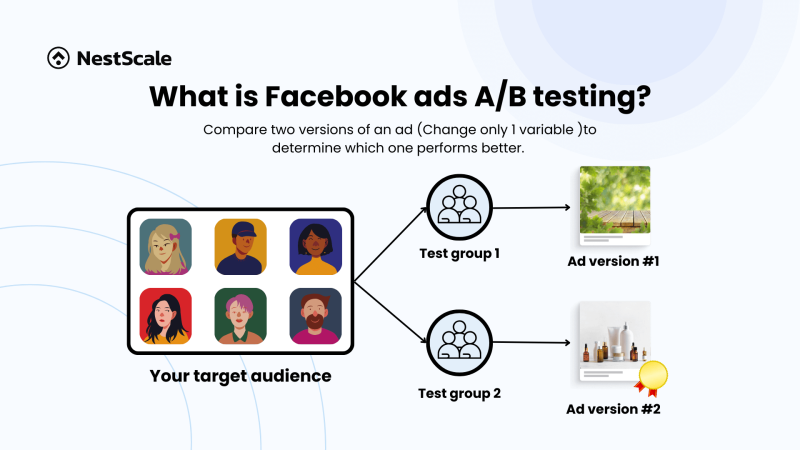
The golden rule of A/B testing is to change only one variable at a time. If you test a new image and a new headline simultaneously, you'll never know which change was responsible for the difference in performance.
Forming a Hypothesis
Every good test starts with a hypothesis—an educated guess about what you think will happen. This turns random changes into a structured experiment. A simple format is:
"We believe that [the change] will result in [the desired outcome] because [the reason]."
Hotel Example:
"We believe that a video creative featuring a family actively enjoying our pool will result in a lower cost per booking for our 'Summer Family Package' because it allows potential guests to visualize the experience they are buying, making it more emotionally resonant than a simple photo of an empty room."
This hypothesis gives your test a clear purpose and a benchmark for success.
What Can You Test?
You can test almost any element of your campaigns, but not all tests are created equal. It's crucial to prioritize the elements that will have the biggest impact, or the "big needle movers."
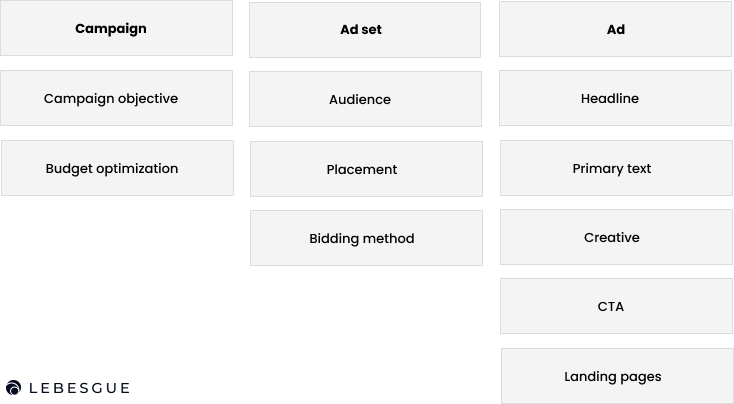
To learn how to prioritize your tests for maximum impact, let's turn to marketing strategist Ben Heath.
The Easy Way To Test Facebook Ads in 2026
In this video, Ben Heath explains the importance of testing the most impactful elements first. This strategic approach ensures you're not wasting time and budget on minor tweaks when bigger opportunities exist.
Please watch from 07:06 to 11:47. Focus on: The concept of a testing hypothesis. The hierarchy of what to test, starting with the biggest 'needle movers' like the offer and creative format, before moving to smaller details like headlines or CTA buttons.
As Ben explained, you should start by testing big changes related to:
- Offer: A new package, a different discount (e.g., "4th night free" vs. "20% off").
- Creative Format & Style: Video vs. Carousel, or User-Generated Content (UGC) vs. a polished professional video.
- Headline & Copy: Testing the core message.
Only after you've optimized these big elements should you move on to smaller variables like the Call-to-Action (CTA) button.
2. How to Implement a Creative A/B Test: A Practical Workflow
Now for the practical part: setting up and running a test. While Meta has a built-in "A/B Test" feature, many experienced advertisers prefer a manual approach because it offers more flexibility and control. We'll focus on this manual method.
The goal is to create a controlled environment where new creatives get a fair chance to prove their worth, without being overshadowed by your existing, long-running ads. The best way to do this is with a dedicated testing campaign.
This next video provides a fantastic, step-by-step walkthrough of this exact process.
How To A/B Test Your Meta Ads Creatives (+ Free Cheat Sheet)
Let's watch this detailed guide from Vertex Marketing Agency. It will show you precisely how to structure a manual A/B test for your creatives in a separate campaign.
Please watch from 03:32 to 18:36. This is a longer clip, but it's the core of this lesson's practical application. Pay close attention to: Campaign Setup (04:39): Why he creates a new campaign and uses Ad Set Budget Optimization (ABO) instead of CBO. Ad Set Setup (08:25): How he keeps the audience the same as the main campaign to isolate the creative variable. Creative Variations (11:47): The rule of using 2-6 creatives and not mixing formats (e.g., video vs. carousel) in the same ad set. Launch & Monitor (14:24): How long to let the test run (minimum 5 days). Identify Winners & Scale (15:54): How to analyze the results and move winning ads into your main 'scaling' campaign.
Let's summarize that workflow:
-
Create a "Testing Campaign":
- Use the same objective as your main campaign (e.g., Sales).
- Turn off Campaign Budget Optimization (CBO). This forces you to use Ad Set Budget Optimization (ABO), giving you direct control over the budget for each test.
-
Create a Test Ad Set:
- Use the exact same audience as your best-performing ad set in your main campaign. This ensures you're testing the creative, not the audience.
- Set a daily budget that is sufficient to get meaningful results. A good rule of thumb is to set it at or above your target Cost Per Booking. If your target CPA is $50, a $50/day budget gives you a chance to get at least one conversion per day.
-
Add Ad Variations:
- Inside the ad set, create 2-4 ad variations based on your hypothesis.
- Remember to only change one variable. For example, you might test four different videos but keep the headline and primary text the same for all of them.
- Give your ads clear names for easy analysis (e.g.,
Video_PoolFun_FamilyFocus,Video_RoomTour_LuxuryFocus).
-
Launch, Monitor, and Analyze:
- Let the test run for at least 5-7 days without making changes. The algorithm needs time and data to optimize.
- After the learning period, analyze your primary metrics: Cost per Booking and ROAS. Is there a clear winner that is outperforming your existing ads?
-
Scale the Winner:
- If you have a winning ad, duplicate it and add it to your main "scaling" campaign (which is likely using CBO).
- Don't immediately turn off the successful test! As the video mentioned, if the testing ad set itself is profitable, you can let it run and even scale its budget slowly.
Test your understanding!
You want to test if a new User-Generated Content (UGC) style video of a guest unboxing a welcome gift performs better than your current, polished video showing a drone shot of the hotel. You add the new UGC ad into your main, high-budget CBO campaign, which already contains 5 other high-performing ads. After 3 days, the new ad has almost no spend and zero bookings.
What is the most likely reason for this, and what is a better way to structure this test?
Show answer
The most likely reason is that the Campaign Budget Optimization (CBO) algorithm allocated the budget to the existing, proven ads that already have a history of performance and social proof. The new ad was never given a fair chance or enough budget to exit the learning phase.
A better way to structure the test would be to follow the manual workflow:
- Create a separate testing campaign with Ad Set Budget Optimization (ABO).
- Create a single ad set within that campaign, targeting the same audience as your main campaign.
- Assign a dedicated daily budget to this ad set.
- Place both the new UGC ad and the current polished video ad inside this ad set to compete head-to-head on a level playing field.
3. A Hotel Case Study: Testing Strategy, Not Just Creative
A/B testing isn't limited to images and headlines. You can also test fundamental strategies, such as comparing a manual campaign setup to one of Meta's automated solutions. This is exactly what the Barceló Hotel Group did.
Barceló Hotel Group: boosting Bookings with an Automated Meta Advantage+ Shopping Campaign
This case study is highly relevant to your work. It shows how a major hotel chain used a simple A/B test to validate a new, automated campaign type, leading to significant performance gains.
Please read through this short case study. Pay attention to how they structured their A/B test: Cell A (The Control): Their traditional, manual campaign setup. Cell B (The Test): The new, automated Advantage+ Shopping campaign. Notice the impressive results they achieved simply by testing a new strategic approach offered by the platform.
The Barceló case study is a powerful reminder that testing should be an ongoing process. As platforms like Meta release new tools (like Advantage+), you can use the A/B testing framework to see if they work for your hotel, giving you a competitive edge.
Conclusion
You now have a complete framework for moving from analysis to action. By systematically testing your ideas, you replace guesswork with a data-driven process for continuous improvement.
Key Takeaways:
- A/B testing is a methodical process of comparing two or more versions of an ad by changing one single variable to see which performs better.
- Always start with a clear hypothesis and prioritize testing "big needle movers" like your offer, creative format, and core message.
- A manual testing campaign using ABO provides a controlled and flexible environment to give new creatives a fair chance to prove their worth.
- Be patient. Let tests run for 5-7 days to gather enough data before declaring a winner.
- You can test more than just creatives. Use the A/B testing framework to validate new strategies and platform features, as seen in the Barceló Hotel Group example.
What's Next?
All ads, no matter how successful, eventually stop performing as well as they once did. This phenomenon is called "ad fatigue." In our next lesson, we will focus on how to diagnose and resolve ad fatigue by analyzing frequency and performance trends. The continuous testing process you learned today is your single most powerful tool for combating it.