Hello! Welcome back to our module on Meta Ads Optimization & Analysis.
In our last lesson, you learned how to systematically improve your campaigns by implementing A/B tests. We established that having a constant pipeline of new, tested ad creatives is essential. Today, we'll explore exactly why that is so critical.
This lesson will help you master the learning outcome: Diagnose and resolve ad fatigue by analyzing frequency and performance trends. We’ll examine why even the most successful ads eventually lose their effectiveness and equip you with a practical framework to spot this decline early and take decisive action to keep your hotel's campaigns profitable.
1. What is Ad Fatigue and Why is it Critical for Hotels?
Ad fatigue is the point at which your audience has seen your ad so many times that they become "blind" to it, stop paying attention, and stop taking action. The result is a predictable decline in performance: click-through rates fall, and your cost per booking rises.
To start, let's get a clear definition.
How To Overcome Facebook Ad FATIGUE
Ben Heath provides a concise explanation of what ad fatigue is and why it's a common issue for advertisers running campaigns over an extended period.
Watch the first 35 seconds of this clip (from 00:25 to 01:00) to get a foundational understanding of the concept.
For hotels, this concept is especially important. Booking a stay is an emotional, high-consideration purchase. A potential guest is dreaming of relaxation, exploration, or a romantic escape. If your ads become repetitive and annoying, they don't just get ignored—they can actively detract from the positive experience you're trying to sell.
Let's explore this idea from a hotel marketing perspective.
'Ad Fatigue' in Hotel E-Commerce: Selling Without Consuming the Consumer
This article from a hotel marketing expert on LinkedIn digs into the psychology of ad fatigue specifically within the hotel industry. It explains why the tactics many hotels use can be particularly prone to causing fatigue.
Please read Section 1, 'What is Ad Fatigue?', and Section 3, 'Why Do Hotel Advertisements Fatigue Consumers More?'. Focus on: The concepts of 'cognitive overload' and 'decision fatigue' in the context of planning a vacation. The specific reasons hotel ads can become tiring, such as monotonous, price-focused messages ('LAST 2 ROOMS!') and the misuse of retargeting.
As the article highlights, when a potential guest feels "stalked" by your hotel's ads or sees the same discount message repeatedly, it can create stress and erode trust, directly undermining the sense of escape and luxury you want your brand to represent.
2. How to Diagnose Ad Fatigue in Ads Manager
Diagnosing ad fatigue is a process of connecting two key data points: rising frequency and declining performance.
Key Metric: Frequency
Frequency is a metric in Ads Manager that tells you the average number of times each person in your audience has seen your ad. It's calculated as:
- Impressions: The total number of times your ad was shown.
- Reach: The number of unique people who saw your ad.
A high frequency means the same people are seeing your ad over and over.
The core signal of ad fatigue is simple: when frequency goes up, performance goes down. You'll see your Cost Per Booking or Cost Per Lead rise while your Click-Through Rate (CTR) and Return On Ad Spend (ROAS) fall.
The image below shows a table of daily ad performance. Notice how as "Impressions per Person" (Frequency) climbs past 4, the Cost Per Lead (CPL) begins to increase significantly.

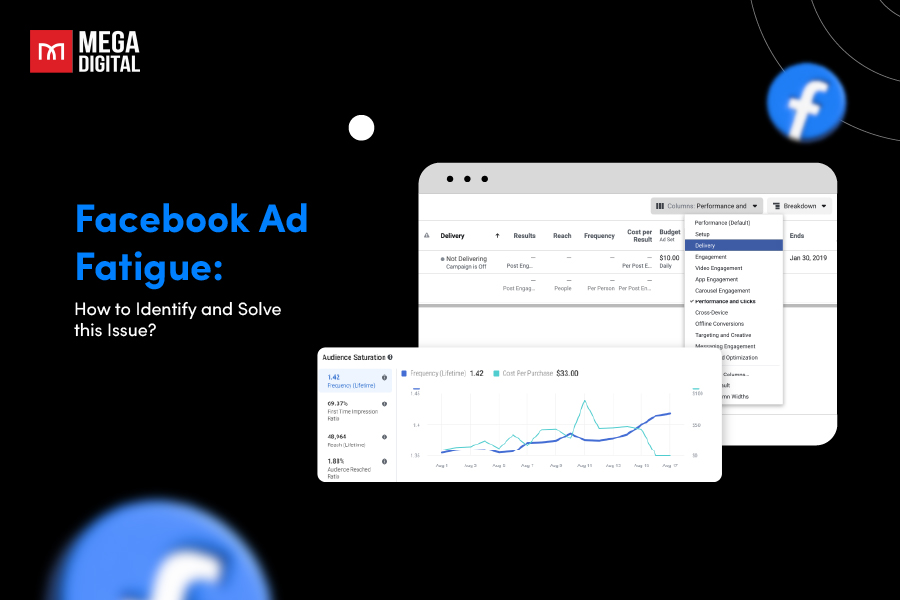
This next image from Ads Manager shows this relationship visually. The graph plots Frequency against Cost Per Purchase, demonstrating how costs can escalate as an audience becomes saturated.
So, what's a "high" frequency?
How To Overcome Facebook Ad FATIGUE
Let's return to Ben Heath's video, where he demonstrates how to find the Frequency metric and provides some general benchmarks.
Watch from 01:00 to 03:33. Pay attention to: How to switch your columns view to 'Delivery' to see the Frequency metric. The general frequency threshold for cold audiences (prospecting). Why warm audiences (retargeting) can tolerate a much higher frequency.
As a rule of thumb for your hotel's prospecting campaigns (reaching new people who don't know your brand), you should start investigating for ad fatigue when frequency approaches 2.5 - 3. For retargeting campaigns, you can often sustain much higher frequencies, but you still need to watch for the point where performance begins to degrade.
Meta's Creative Fatigue Tool
To help advertisers, Meta has also built an automated tool to flag this issue. It lives within the "Ads Reporting" section of Ads Manager.
Meta Creative Fatigue and Similarity Score: Complete Guide
This guide from Admetrics.io explains Meta's built-in 'Creative Fatigue' feature, which automatically identifies ads that are underperforming due to overexposure.
Read the sections 'Understanding the Core Features', 'Why Meta Built This Tool', and 'Deep Dive: Creative Fatigue Detection'. This will give you a clear overview of how Meta's automated system works and its benefits and limitations.
This tool is a great starting point, but always combine its alerts with your own analysis of the performance trends.
3. A Hierarchy of Solutions to Resolve Ad Fatigue
Once you've diagnosed ad fatigue, you need a plan to fix it. The best approach is to work through a hierarchy of solutions, starting with the easiest and most impactful changes.
How To Overcome Facebook Ad FATIGUE
This video provides a fantastic, structured approach to resolving ad fatigue, starting with the most important element: your creative.
Watch the sections covering the main solutions, from 03:33 to 07:58 and then from 10:50 to 11:38. Focus on the four key strategies presented: Changing the Creative (the primary solution) Making Audiences Larger Changing the Offer (a last resort) Expanding Placements
Let's organize these solutions into a clear workflow for your hotel.
1. The Priority Fix: Refresh Your Ad Creative
If a campaign has run long enough to cause fatigue, it means the core strategy (your offer and your audience targeting) was likely working well. The ad itself is the problem. Therefore, the first and most effective solution is to introduce fresh creative.
This is where our previous lesson on A/B testing comes directly into play. Your "testing campaign" should be your engine for generating a constant supply of new, validated creatives. When you spot fatigue in your main "scaling" campaign, you should already have a winning creative ready to swap in.
What to change:
- Imagery/Video: Use a completely different photo or video. If you were showing a room, show the pool. If you were showing the exterior, show the restaurant.
- Format: If you used a single image, test a carousel or a video.
- Ad Copy/Hook: Change the first line of your ad text or the headline to present a new angle. For example, instead of focusing on a discount, focus on a unique experience ("Your view from the breakfast terrace awaits.").
2. The Scaling Fix: Expand Your Audience
If new creative doesn't solve the problem, or if you're operating with a large budget, your audience may simply be too small. A smaller audience leads to higher frequency more quickly.
What to do:
- Increase Lookalike Percentages: If you're using a 1% lookalike of past bookers, test a 1-3% or 3-5% lookalike to give Meta more people to find.
- Broaden Interests: If you're targeting very niche interests, try adding broader related interests.
- Expand Geographically: If your hotel attracts international travelers, consider adding new countries or regions to your targeting.
3. The Quick Fix: Widen Your Placements
This is a simple change that can sometimes provide a small boost. If you've restricted your ads to only show on Instagram Feeds, for example, switch to "Advantage+ Placements" (formerly Automatic Placements) to allow Meta to show the ad on Facebook, in Stories, Reels, etc. Seeing the ad in a new context can make it feel fresh.
4. The Last Resort: Change Your Offer
This should be your last option because it involves changing a fundamental part of a previously successful campaign. If you've exhausted all creative and audience options, you can test a new offer.
Hotel Examples:
- Instead of "20% Off Your Stay," test a "4th Night Free" package.
- Instead of a room discount, test an offer that includes "Free Breakfast & Late Checkout."
Test your understanding!
Your campaign promoting a "Weekend Spa Package" for your hotel has been performing well for six weeks, but in the last 10 days, the Cost Per Booking has nearly doubled. You check Ads Manager and see the frequency for your main ad set is 5.2. Your campaign is profitable but declining.
What is the most likely problem, and what are the first two actions you should take to resolve it, in order of priority?
Show answer
-
The Problem: The campaign is suffering from ad fatigue. The high frequency of 5.2 combined with the doubling in Cost Per Booking is the classic sign.
-
Actions to Take:
- Priority 1: Refresh the Creative. Following the hierarchy, the first step is to pause the underperforming ad and introduce new creative. This could be a new video showcasing the spa facilities, a carousel of guest testimonials, or new images with a different angle. This new creative should ideally come from your ongoing A/B testing efforts.
- Priority 2: Expand the Audience. If the new creative also fatigues quickly, your audience may be too small for your budget. You could test a larger lookalike audience (e.g., expand from 1% to 3%) or add new, relevant interest targeting layers to give the algorithm more room to run.
Conclusion
Ad fatigue is a natural part of the campaign lifecycle, not a sign of failure. By understanding its causes and symptoms, you can turn a reactive problem into a proactive management strategy.
Key Takeaways:
- Ad fatigue occurs when your audience sees an ad too often, leading to decreased performance (lower CTR, higher CPA/Cost Per Booking).
- For hotels, fatigue is especially damaging as it can create a negative, annoying brand perception that clashes with the desired feeling of relaxation and luxury.
- Diagnose fatigue by monitoring the Frequency metric in Ads Manager and watching for a drop in performance as frequency rises above 2.5-3 for prospecting campaigns.
- Resolve fatigue by following a clear hierarchy: 1) Refresh creative, 2) Expand audiences, 3) Widen placements, and 4) Change the offer as a last resort.
- Your A/B testing process is your best defense, providing a continuous stream of fresh creatives to combat fatigue before it significantly hurts your budget.
What's Next?
We've now covered how to analyze performance, systematically test for improvements, and deal with the inevitable decay of your ads. However, sometimes ads don't deliver properly for other reasons. In our next lesson, we will troubleshoot common ad delivery issues related to bids, budgets, and audience saturation, giving you a complete diagnostic toolkit for your Meta campaigns.