Welcome to the final module of our course, "Interview Readiness and Practical Application." In our last lesson, we concluded our deep dive into systems by architecting a scalable vector database, understanding everything from ANN algorithms like HNSW to the cloud-native microservices that support them. You've built an incredible foundation of technical knowledge. Now, we shift our focus from what you know to how effectively you can communicate your value and impact. This is the crucial bridge from being a strong engineer to being hired as an elite one.
This lesson addresses the learning outcome: Apply the STAR method to structure responses for behavioral questions about leadership, conflict, and failure. While often called "soft skills," at top-tier companies like Google and Meta, the ability to articulate your experiences in a structured, impactful way is a hard requirement. It's how they evaluate your seniority, ownership, and cultural fit.
We will deconstruct this topic into five interconnected concepts, engineering a systematic approach to mastering the behavioral interview:
- Why Behavioral Interviews Are a High-Signal Test
- The STAR Method: A Data Structure for Your Stories
- The Story Selection Algorithm: Choosing for Seniority
- Crafting the Narrative: From Dry Facts to Engaging Demos
- Applying the Framework: Conflict, Failure, and Leadership Scenarios
1. Why Behavioral Interviews Are a High-Signal Test (Easy)
-
Technical Explanation:
Behavioral interviews operate on a simple premise: past performance is the best predictor of future performance. At elite companies, an engineer's success is determined not just by their coding ability, but by their capacity to navigate complex human and organizational systems. Interviewers are not just listening to your stories; they are actively searching for signals that map to their company's core values or leadership principles.For example, Amazon famously structures its entire behavioral evaluation around its 16 Leadership Principles.
Amazon Behavioral Interview Questions and Answers ...
To understand the 'why' behind these questions, let's look at how a company like Amazon formalizes its cultural values into a concrete evaluation framework.
Read the first two main sections: 'What is the Amazon behavioral interview?' and 'What are Amazon’s leadership principles?'. As you read, notice how principles like 'Ownership', 'Dive Deep', and 'Have Backbone; Disagree & Commit' are not vague suggestions but are tied to specific, testable behaviors.
Interviewers use your past experiences to assess your proficiency in areas like:
*   **Ownership:** Do you take responsibility for failures and see projects through to completion?
*   **Handling Ambiguity:** Can you take a vague problem statement and deliver a concrete solution?
*   **Collaboration & Influence:** Can you resolve conflict, align stakeholders, and drive cross-team initiatives?
*   **Judgment & Impact:** Do you make sound decisions and focus on work that delivers meaningful results?
- Metaphor for a 5-Year-Old:
Imagine you're building a giant, amazing Lego castle with a team. A technical interview checks if you know how to snap the bricks together properly. A behavioral interview checks if you're the person who, when someone else wants to build a round tower but you think a square one is stronger, can have a good conversation and figure out the best plan. It also checks what you do if the tower you built falls over—do you blame someone else, or do you figure out why it fell and build a stronger one next time?
2. The STAR Method: A Data Structure for Your Stories (Easy)
-
Technical Explanation:
The STAR method is a structured format for answering behavioral questions. Think of it as a simple, standardized data structure or API schema for your career stories. It ensures you provide a complete, easy-to-follow narrative that gives the interviewer all the information they need.S.T.A.R. stands for:
- Situation: Briefly set the context. Where were you working? What was the project? Who was involved? Provide just enough detail to understand the stakes.
- Task: Describe your specific responsibility in that situation. What was the goal or objective you were tasked with?
- Action: Detail the specific, individual steps you took to address the task. This is the most important part of your answer. Always use "I" not "we." What did you code? What did you analyze? Who did you talk to?
- Result: Explain the outcome. Quantify the impact whenever possible. What happened as a result of your actions? What did you learn?
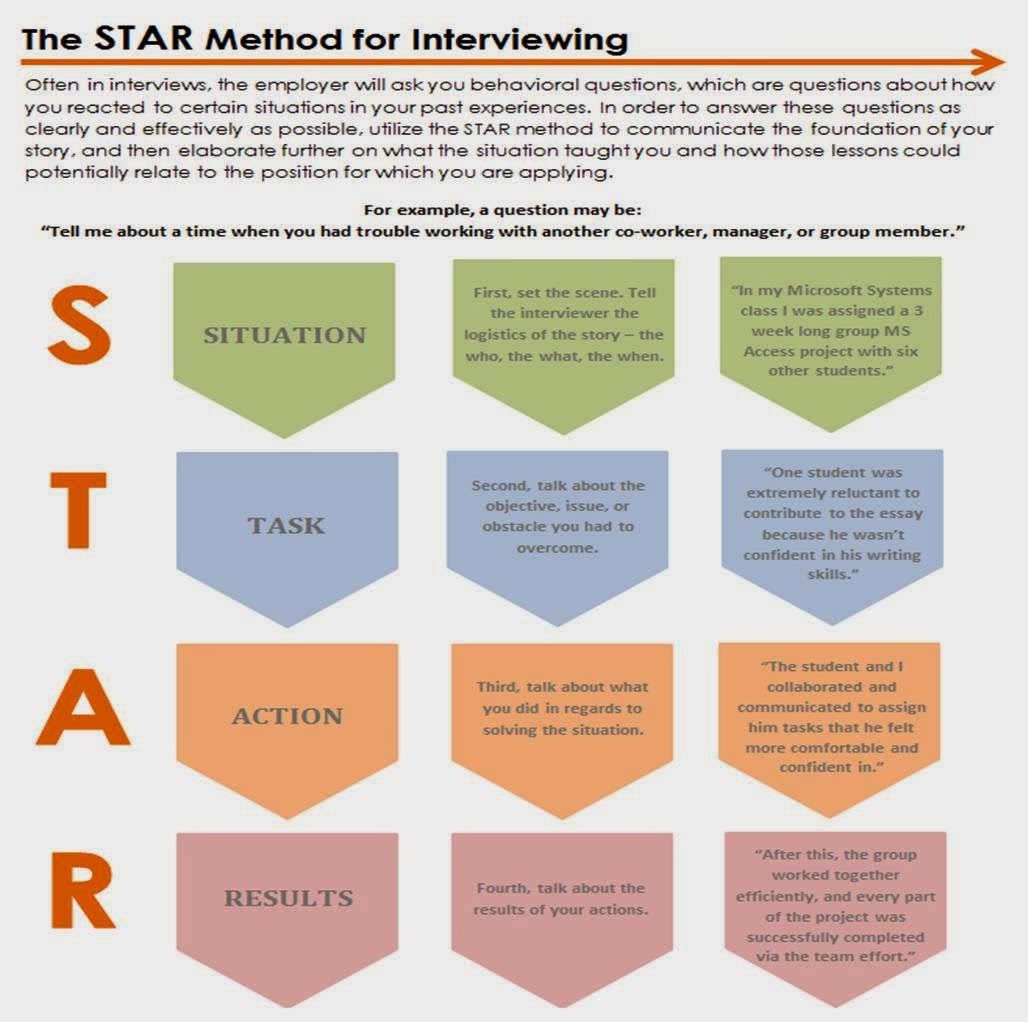
*This image breaks down the STAR method with definitions and a simple example, illustrating how to structure a response about a teamwork challenge.*
-
Metaphor for a 5-Year-Old:
The STAR method is like telling a story with a beginning, a middle, and an end.- Situation: "We were all supposed to draw a picture of a farm together." (The beginning)
- Task: "My job was to draw the barn." (What you had to do)
- Action: "I picked a red crayon, drew a big square, and then a triangle on top for the roof." (The middle part, what you did)
- Result: "The barn looked great and everyone knew where to draw their animals!" (The end, what happened)
-
Anchor Resource:
To see the STAR method in action, let's review a concrete example.
Amazon Behavioral Interview Questions and Answers ...
This article from Exponent provides a clear definition of the STAR method and a well-articulated example of its application.
Scroll down to the section titled 'Using the STAR Framework'. Read this section and the following example, 'Sample Q1: Short-term sacrifice for long-term gain'. Notice how the example breaks the story down into the four distinct parts, providing a clear and concise narrative.
3. The Story Selection Algorithm: Choosing for Seniority (Medium)
-
Technical Explanation:
For senior and staff-plus roles, simply using the STAR format is table stakes. The single biggest factor that separates a senior-level hire from a down-leveled candidate is story selection. The story you choose must demonstrate a scope and complexity that aligns with the level you're targeting.A senior engineer's conflict story can't be about a minor disagreement on a code review. It needs to involve cross-functional stakeholders, ambiguous requirements, or significant business impact. The key is to show a delta—a clear difference in complexity compared to the work of a more junior engineer.
A great way to approach this is to think like a computer scientist and use a "pre-computation algorithm" to prepare your stories.
-
Metaphor for a 5-Year-Old:
If you're trying to prove you're strong enough to be on the school's basketball team (a senior role), you don't tell a story about how you lifted a teddy bear (a junior task). You tell the story about the time you carried the big, heavy box of library books all by yourself. The kind of story you choose proves how strong you are. -
Anchor Resource:
This article by an ex-Meta and Amazon engineering leader is perhaps the most important resource for any senior candidate preparing for behavioral interviews. It details a systematic, 5-step algorithm for selecting and preparing high-impact stories.
Stop memorizing STAR. Start selecting better stories.
This article explains why story selection is more critical than delivery at senior levels and provides a brilliant 5-step algorithm to prepare.
Read this article carefully. Focus on these key ideas: The 'Why': Understand why a perfect STAR answer can still lead to a rejection if the story's scope is too small. The '5-step pre-compute algorithm': Internalize the steps: Brainstorm, Identify scope, Gather evidence, Filter ruthlessly, and Craft your title. This is your preparation framework. 'Before and after' examples: Pay close attention to the tables showing 'Stories rejected' versus 'The story that survived' for questions on conflict and backbone. This is the practical application of the algorithm.
4. Crafting the Narrative: From Dry Facts to Engaging Demos (Hard)
-
Technical Explanation:
Once you've selected a high-impact story, the final step is to deliver it effectively. A common mistake is to present the story as a dry recitation of facts. An elite candidate delivers it as an engaging narrative that reveals their thought process, acknowledges challenges, and demonstrates self-awareness.Two advanced techniques are crucial here:
- Show, Don't Tell: Instead of saying "I was persistent," describe the actions that show your persistence. Share your raw, unfiltered thoughts and emotions in a professional way. For example: "In that moment, I was frustrated because it felt like my analysis was being dismissed. However, I knew the data was strong, so I decided to take a different approach..." This makes you more authentic and your story more memorable.
- Future Pacing: At the end of your story, explicitly connect your learnings to the role you're interviewing for. This helps the interviewer envision you succeeding on their team. For example: "...and that experience taught me how to align stakeholders with competing priorities. I know at a scale like Meta's, this skill will be critical when driving initiatives across teams like Ads and Integrity."
-
Metaphor for a 5-Year-Old:
Imagine you're showing your teacher a drawing you made.- Telling (Boring): You just hand them the drawing and say, "I drew this."
- Showing (Engaging): You say, "I wanted to draw a sunny day, but I couldn't find a yellow crayon. At first, I was sad, but then I had an idea! I mixed some orange and white together to make a new kind of yellow. I learned that even if you don't have what you need, you can invent a new way. If I get to help with the class mural, I know how to make new colors if we run out!"
-
Anchor Resource:
This video provides a masterclass in narrative delivery, contrasting a weak story with a strong one and explaining the principles of "Show, Don't Tell" and "Future Pacing."
The best interview advice you never got (get into Google, BCG, top 1% roles)
Watch how the same set of facts can be presented in two vastly different ways. This video will teach you how to make your stories engaging and memorable.
Watch the following segments: (05:14 - 12:50): Pay close attention to the two back-to-back stories ('Candidate 1' vs. 'Candidate 2'). Note the differences in detail, the inclusion of thoughts/feelings, and the final connection to the future role. (13:33 - 16:32): This part explains the 'Show, Don't Tell' principle by talking about your 'raw unfiltered thoughts.' (16:32 - 19:42): This segment explains 'Future Pacing'—connecting your past learnings to the future role.
5. Applying the Framework: Conflict, Failure, and Leadership Scenarios (Harder)
-
Technical Explanation:
Now let's apply this complete framework (Story Selection + STAR + Narrative Craft) to the three most common and challenging categories of behavioral questions.- Conflict: The goal is not to show you "win" arguments. It's to demonstrate empathy, professionalism, and a focus on finding the best outcome for the business. Choose a story where the disagreement was substantive and the other party was rational. Your actions should focus on seeking to understand their perspective, using data to find common ground, and preserving the relationship.
- Failure: This is often a "trapdoor" question. The key is to select a "recoverable" failure. Do not choose a story where the failure was due to negligence or poor judgment (e.g., "I didn't write any tests and the code broke"). Instead, frame the failure as a reasonable decision made with incomplete information or a calculated risk that didn't pay off. Your story must center on what you learned and how you corrected the issue or applied the learning later.
- Leadership / "Proudest Project": This is your chance to demonstrate seniority. Use the 5-step algorithm from Concept 3 to select a project that showcases high scope, complexity, and ambiguity. The story should highlight your specific contributions to planning, execution, handling roadblocks, and delivering impact.
-
Anchor Resource:
This long-form video with two ex-FAANG senior managers provides an incredibly detailed breakdown of how to answer these exact questions at a senior level.
Behavioral Interview: Common Questions Broken Down by Ex-Meta & Amazon Senior Managers
This video is a deep dive into the specific strategies for tackling questions about conflict, failure, and proudest projects, with an emphasis on senior-level expectations.
This is a rich discussion. Focus on these key parts: Conflict (01:56 - 15:36): Absorb the advice on how to choose a conflict story, the importance of empathy, seeking win-win solutions, and preserving relationships. Proudest Project (27:42 - 43:30): Listen to the discussion on selecting projects based on impact, scope, and personal contribution, and how expectations change with seniority (e.g., L5 vs. L6). Failure (47:28 - 56:10): Pay close attention to the section on 'trapdoor' questions. Understand the concept of choosing 'recoverable' failures and framing them around a believable hypothesis.
Test your understanding!
Let's put it all together. An interviewer at Google asks you: "Tell me about a time you had a significant disagreement with a product manager on a technical roadmap decision."
Using the principles from this lesson, outline your response. You don't need to write the full story, but structure your thoughts:
- Story Selection: Briefly describe a hypothetical project that would be appropriate for a senior/staff level engineer to discuss. What makes it a "senior-level" conflict?
- STAR Outline: Write one-sentence bullet points for the S, T, A, and R of this story.
- Narrative Craft: Mention one "Show, Don't Tell" detail (e.g., a thought/feeling) you would include and how you would "Future Pace" the ending.
Show answer
-
Story Selection (Senior Level):
- Hypothetical Story: A conflict over whether to build a new data processing service in-house or use a third-party vendor solution.
- Why it's Senior Level: This is not a simple feature debate. It has long-term architectural implications, budget impact ($X00k/year), and involves multiple stakeholders (Eng, Product, Finance, Legal). The disagreement is about strategic trade-offs (control vs. speed, cost vs. features), not just implementation details.
-
STAR Outline:
- S: We were building a new ML feature platform, and for the data ingestion component, my PM was adamant about using a specific third-party vendor to hit our Q3 launch deadline.
- T: My task was to finalize the technical architecture, and my initial analysis showed that while the vendor was fast, it had critical scalability and customization limitations that would hurt us long-term.
- A: I built a data-driven case by creating a PoC of a lightweight in-house solution, ran performance benchmarks showing its superior scalability, and worked with finance to project a 3-year TCO that was 40% lower.
- R: The PM, seeing the concrete data on scalability and cost, agreed to my proposal; we launched one quarter later but avoided a costly migration two years down the line, and the core service is now used by three other teams.
-
Narrative Craft:
- Show, Don't Tell Detail: "Initially, I was concerned about directly challenging my PM's direction, as the pressure to launch quickly was immense. But I knew that a short-term win could lead to a massive long-term engineering tax, and I felt a strong sense of ownership to prevent that."
- Future Pacing: "...This experience reinforced for me the importance of balancing product velocity with long-term engineering excellence. I know that at Google's scale, making the right build-vs-buy decision early on can save years of engineering effort, and I'd bring that data-driven, long-term perspective to my role here."
Conclusion
You have now engineered a complete system for acing behavioral interviews. It’s not about memorizing answers; it’s about having a structured process for selecting, crafting, and delivering stories that powerfully demonstrate your experience.
Key Takeaways:
- Behavioral interviews are a systematic evaluation of your past performance against a company's desired competencies.
- The STAR method is the essential data structure for your stories: Situation, Task, Action, Result.
- For senior roles, story selection is more important than delivery. Choose stories that demonstrate complexity, scope, and impact appropriate for the level.
- Elevate your delivery by showing, not telling (sharing your thought process) and future pacing (connecting your learnings to the role).
- Apply this framework strategically to difficult questions about conflict (show empathy), failure (show learning), and leadership (show scope).
Next Lesson Preview
With the frameworks for technical and behavioral interviews in place, the final step is to put them into practice under realistic conditions. In our next lesson, we will move into full simulation mode: Execute a full-length mock interview focused on data structures and algorithms. Be ready to apply everything you've learned from the first six modules in a timed, interactive setting.