Welcome to Lesson 2 of our final module, "Interview Readiness and Practical Application." In our last lesson, we engineered a framework for mastering behavioral interviews using the STAR method. You learned that how you communicate your experience is just as critical as the experience itself.
Today, we put all your algorithmic and data structure knowledge to the test. This lesson is a full-scale simulation designed to mirror a 45-minute technical screen at a top-tier company like Google or Meta. We'll move beyond just knowing the concepts and focus on performing under pressure—communicating your thought process, analyzing trade-offs, and writing clean, efficient code.
This lesson directly addresses the learning outcome: Execute a full-length mock interview focused on data structures and algorithms.
We will structure this simulation into five distinct phases, mirroring your preferred "daily dose" format and the natural flow of a technical interview:
- The Interview Framework: Setting the Stage for Success
- Problem #1 - Clarification & Brute-Force: Deconstructing the Ask
- Problem #1 - Optimization & Implementation: Engineering the O(1) Solution
- Follow-up Question: Adapting Your Design for Duplicates
- The Debrief: Analyzing Performance Against an Elite Rubric
Let's begin.
1. The Interview Framework: Setting the Stage for Success (Easy)
(Tutor speaking)
Before we jump into the simulation, let's establish the ground rules and the evaluation framework. A technical interview isn't just a test of your ability to produce a correct answer. It's an evaluation of your problem-solving process, communication skills, and technical depth.
Most top companies expect you to follow a systematic approach. We'll use a standard, highly effective framework.
Google Coding Interview (questions and prep)
This article from 'I Got An Offer' perfectly outlines the four-step process that interviewers at Google and other top companies are trained to look for. Internalizing this framework is the first step to a successful interview performance.
Read section 3.1, 'Google coding interview framework'. Focus on the four key steps: Clarify, Plan, Implement, and Test & Optimize. Understand what is expected at each stage. This is the blueprint for our mock interview today.
- Metaphor for a 5-Year-Old: Imagine your parents ask you to build a Lego car.
- Clarify: You'd ask, "How big should it be? What color? Should it have wings?"
- Plan: You'd say, "Okay, first I'll find four wheels, then build the body, then put a driver in."
- Implement: You start snapping the bricks together.
- Test: You push the car to see if the wheels spin and make sure nothing falls off.
Now, let's switch to interview mode.
(Interviewer speaking)
"Hi, thanks for joining me today. My name is Alex, and I'm a Senior Engineer here. We'll spend the next 45 minutes or so working through a coding problem. I'm really interested in seeing how you approach problems, so please think out loud as much as possible.
Before we dive into the code, could you briefly tell me about a recent technical project you worked on that you're proud of?"
(Pause for you to mentally apply the STAR method from our last lesson...)
"Great, thanks for sharing that. Let's move on to our coding problem. I'm pasting it into the document now."
2. Problem #1 - Clarification & Brute-Force: Deconstructing the Ask (Medium)
(Interviewer speaking)
The Problem:
Design a data structure that supports the following operations in average O(1) time:
insert(val): Inserts an itemvalinto the set if not already present.remove(val): Removes an itemvalfrom the set if present.getRandom(): Returns a random element from the current set of elements. Each element must have an equal probability of being returned.You can assume that
valwill be an integer.
"Take a moment to read the problem, and then walk me through your initial thoughts."
Your Turn (Guided Thinking):
This is the Clarify and Plan stage. Before writing any code, what questions would you ask?
- What happens if we try to insert a value that's already there?
- What happens if we try to remove a value that doesn't exist?
- What should
getRandom()do if the set is empty? - What are the expected data types? (Already given as integers).
- Is there a limit on the number of elements?
Next, think about a brute-force or simple solution. Which data structures come to mind for each operation?
insert(val): A hash set (setin Python) is great for O(1) average time insertion and automatically handles duplicates.remove(val): A hash set also provides O(1) average time removal.getRandom(): This is the tricky part. A hash set is unordered. To get a random element, you'd have to convert it to a list first. What would be the time complexity of that conversion?
This is the point where you identify the core trade-off. A set is great for insert and remove, but terrible for getRandom. An array or list is great for getRandom (pick a random index), but terrible for insert (checking for duplicates is O(n)) and remove (finding the element is O(n)).
How can we get the best of both worlds? This leads us to the next step.
3. Problem #1 - Optimization & Implementation: Engineering the O(1) Solution (Hard)
(Interviewer speaking)
"You've correctly identified that a hash set is slow for getRandom, and an array is slow for insert and remove. That's a great analysis. How could you combine data structures to achieve O(1) for all three operations?"
Your Turn (Guided Thinking):
This is the core of the problem. Think about what each data structure does well:
- Hash Map (Dictionary in Python): Provides O(1) lookups. What if we use it to store the location of each value?
map = {value: index_in_array}. - Array (List in Python): Provides O(1) random access via index. We can store the values themselves here.
Now, let's re-evaluate the operations with these two structures:
insert(val): Appendvalto the array. Store its index (the new length of the array - 1) in the hash map. Both are O(1).getRandom(): Pick a random index from the array. This is O(1).remove(val): This is the new challenge. Removing from the middle of an array is O(n). How can we make it O(1)? The only O(1) removal from an array is popping the last element.
This leads to the key insight: the swap-and-pop trick.
- Find the index of the element to remove using the hash map (O(1)). Let's call it
index_to_remove. - Get the last element in the array.
- Move the last element to
index_to_remove. - Update the hash map for the element you just moved: its new index is
index_to_remove. - Pop the last element from the array (O(1)).
- Delete the original
valfrom the hash map (O(1)).
Now, it's time to Implement and Test.
Mock Google Coding Interview with a Meta Intern
The thought process we just walked through is complex. Let's watch a video of a mock interview where the candidate solves this exact problem. Pay close attention to how they articulate the trade-offs and arrive at the swap-and-pop solution.
Watch the segment from 01:44 to 29:32. Observe the following: (01:44 - 05:34): The clarification phase. (05:34 - 12:49): The initial proposal using a set and the discussion of its O(N) getRandom complexity. (13:47 - 17:57): The brainstorming of the optimized array + hash map solution, leading to the swap-and-pop insight. (17:57 - 29:32): The coding implementation and a detailed walk-through of a test case. Notice the small bug the candidate catches during the dry run—this is a strong signal to the interviewer!
4. Follow-up Question: Adapting Your Design for Duplicates (Harder)
(Interviewer speaking)
"This looks great. The code is clean and the logic is sound. Now, let's consider a follow-up. What if we do allow duplicates in our data structure? How would your implementation of insert, remove, and getRandom need to change? The O(1) time complexity requirement still holds."
Your Turn (Guided Thinking):
This is where strong candidates shine. They can adapt their initial design to new constraints.
- Analyze the Bottleneck: The current hash map
map = {value: index_in_array}can't work because a value can now have multiple indices. - Propose a Change: What if the value in the hash map is no longer a single index, but a collection of indices?
map = {value: [index1, index2, ...]}. Asetis even better for the collection to allow for O(1) addition and removal of indices:map = {value: {index1, index2, ...}}. - Re-evaluate Operations:
insert(val): Appendvalto the array. Get the new index. Add this index to the set of indices for that value in the hash map:self.map[val].add(new_index). This is still O(1).getRandom(): Unchanged. Still O(1).remove(val): This is again the most complex part.- Get an arbitrary index to remove from the set in the hash map:
index_to_remove = self.map[val].pop(). - Perform the same swap-and-pop logic as before: move the last element to
index_to_remove. - Update the map for the moved element: remove its old index (the last index) and add its new index (
index_to_remove). - Pop from the array.
- If the set of indices for the removed
valis now empty, delete the key from the map.
- Get an arbitrary index to remove from the set in the hash map:
Mock Google Coding Interview with a Meta Intern
Let's see how the candidate in the video handles this exact follow-up. This demonstrates how to reason about modifying a data structure on the fly.
Watch the segment from 29:32 to 36:54. Notice how the candidate first identifies that the hash map is the issue and suggests changing its value to be a list or set. They then correctly reason through the modifications needed for the remove logic.
5. The Debrief: Analyzing Performance Against an Elite Rubric (Hardest)
(Interviewer role ends, Tutor speaking again)
Excellent work. The simulation is now complete. Let's switch back to tutor mode and analyze the performance.
In a real interview, you're evaluated against a rubric. Your goal is to move from "Hire" to "Strong Hire." Let's look at what that means.
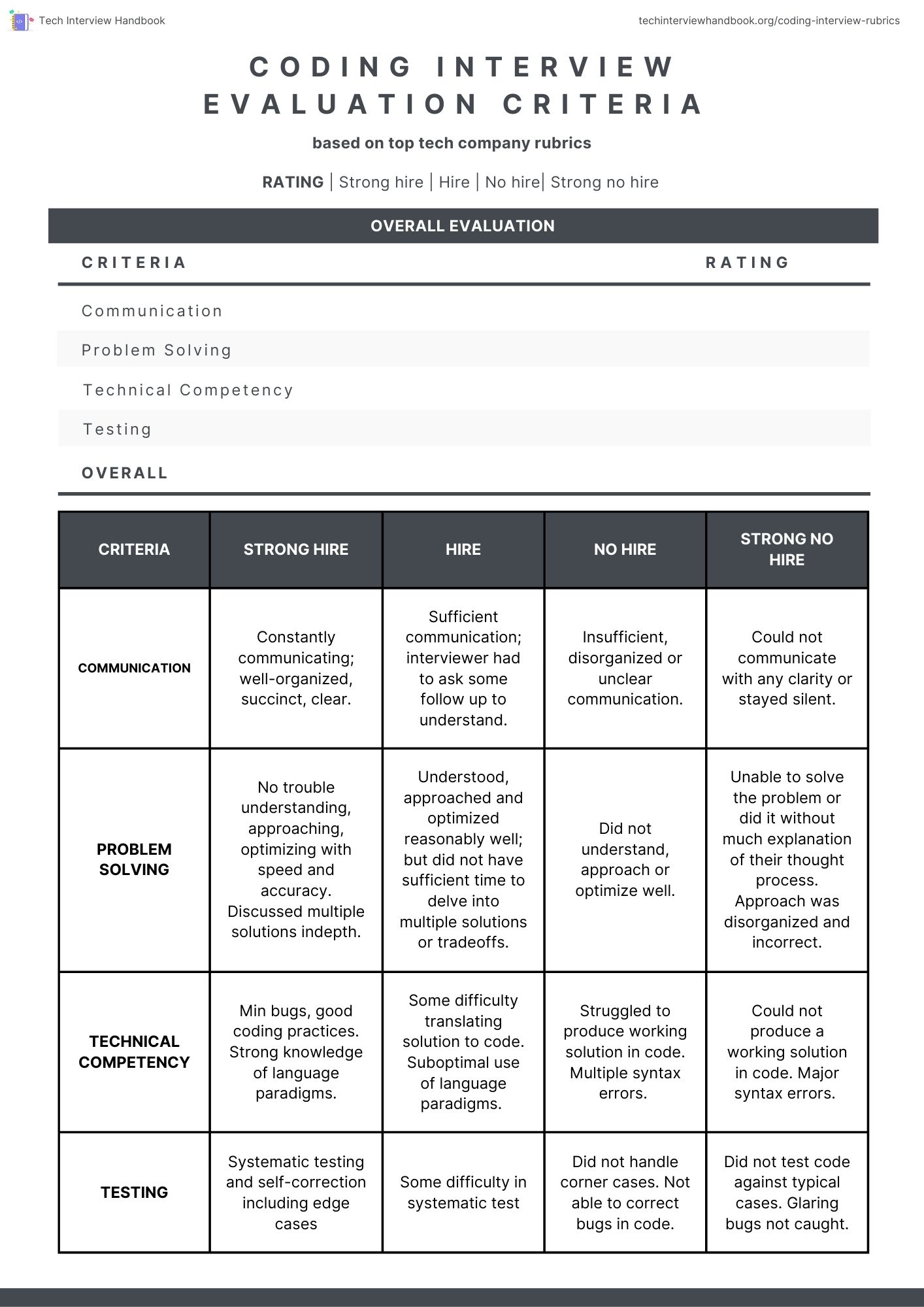
Let's use this rubric to debrief our session:
- Problem Solving: Did you follow the
Clarify -> Plan -> Implement -> Testflow? A "Strong Hire" not only finds the optimal solution but gets there by first analyzing a brute-force approach and clearly articulating the trade-offs that lead to the better solution. This is exactly what we did by comparing thesetvs.arrayapproaches. - Communication: Were you thinking out loud? A good candidate solves the problem. A great candidate makes the interviewer feel like they are a collaborator in solving the problem. The candidate in the NeetCode video (LINK) does a fantastic job of this, constantly explaining his logic.
- Technical Competency: This is about both the correctness of your solution and the quality of your code. Did you choose meaningful variable names? Did you structure the code logically? The swap-and-pop logic is a strong signal of technical depth because it solves a non-obvious performance constraint.
- Testing: A "Hire" candidate tests their code when prompted. A "Strong Hire" proactively tests their code with non-trivial examples and edge cases. In the video (LINK at
00:25:28), the candidate's self-driven test run uncovered a small bug in his swapping logic. Finding and fixing your own bug is one of the strongest positive signals you can send.
Test your understanding!
Based on the Coding with Minmer video (LINK), consider the first problem (Valid Palindrome). The candidate first proposes an O(N) space solution, then moves to an O(1) space two-pointer solution.
- How does this demonstrate the "Plan" stage of the problem-solving framework?
- During the dry run of the O(1) solution (
00:05:39 - 00:10:42), the interviewer points out an edge case (a string with only___). The candidate's code would have crashed. How does the candidate's reaction and fix demonstrate a "Strong Hire" quality in the "Testing" category?
Show answer
-
Planning Demonstration: By first presenting the brute-force/simpler approach (create a new filtered and reversed string) and analyzing its
O(N)space complexity, the candidate establishes a baseline. He then explicitly states he can "do better" and proposes the optimized two-pointer approach, explaining why it improves the space complexity toO(1). This shows a methodical planning process and an understanding of trade-offs, which is a key trait of a senior engineer. -
"Strong Hire" Testing Signal: When confronted with the bug, the candidate doesn't get defensive or flustered. He immediately acknowledges the issue ("now I see the issue"), traces the logic to understand why it fails (out-of-bounds access), and incorporates the interviewer's feedback to add boundary checks (
l < r) to his inner while-loops. This demonstrates coachability, a systematic debugging process, and the ability to handle pressure and criticism gracefully—all hallmarks of a mature engineer and a "Strong Hire."
Conclusion
Today, you didn't just review an algorithm; you simulated the entire process of a high-stakes technical interview. You've seen that success is a function of both technical knowledge and structured communication.
Key Takeaways:
- Adopt a Framework: Consistently apply the Clarify -> Plan -> Implement -> Test framework to every problem.
- Communicate Trade-offs: Articulating why one data structure or algorithm is better than another is more important than just knowing the answer.
- Master the Core Patterns: The "Randomized Set" problem is a classic example of combining data structures (hash map + array) to get the best of both. The swap-and-pop trick is a key optimization pattern for O(1) deletion.
- Embrace Follow-ups: Follow-up questions are designed to test your ability to adapt. See them as an opportunity to showcase your design flexibility.
- Debrief Yourself: After every practice problem, evaluate your performance against a rubric. Identify where you were a "Hire" and what it would take to be a "Strong Hire."
Next Lesson Preview
You have now executed a mock interview for a data structures and algorithms round. In our next lesson, we will move up the stack to the other major type of technical interview: Execute a full-length mock interview focused on high-level system design. We will tackle an ambiguous, large-scale problem like "Design Twitter" and apply a similar structured approach to deconstruct it.