Hello! Welcome to the final lesson in our module on Hashing, Sets, and Range Queries.
In our last lesson, we contrasted Tries and Hash Tables, discovering how choosing the right specialized data structure is critical for performance. We saw that for prefix-based string problems, the Trie's specific design offers fundamental advantages over a general-purpose Hash Table.
Today, we apply that same critical lens to the numeric world. As promised, this lesson is a capstone comparison of two powerful data structures you've already implemented: Segment Trees and Fenwick Trees (also known as Binary Indexed Trees or BITs). Your learning outcome is to contrast Segment Trees with Fenwick Trees for range and prefix query use cases. We will move beyond simple implementations to dissect the nuanced trade-offs that determine which structure to use in an interview setting or a real-world system.
1. The Core Problem: Dynamic Range Queries
Let's begin by formally restating the problem that both data structures are designed to solve.
Technical Explanation
Imagine you have a large array of numbers. You need to support two operations with high efficiency:
- Point Update: Change the value at a specific index
i.update(i, new_value) - Range Query: Calculate an aggregate value (like sum, minimum, or maximum) over a range of indices
[l, r].query(l, r)
A naive approach using a simple array makes updates fast (), but range queries are slow (). Conversely, a prefix sum array makes prefix sum queries fast (), but a single update requires rebuilding the rest of the array, taking time. Both Segment Trees and Fenwick Trees provide a powerful equilibrium, achieving for both operations.
Metaphor: The Financial Analyst's Dashboard
Imagine an analyst tracking a stock's price, updated every second. They constantly need to answer two types of questions in real-time:
- "What was the maximum price in the last hour?" (Range Query)
- "A data feed corrected the price at 10:30:15 AM. Update it now." (Point Update)
Using a simple list of prices would make one of these tasks painfully slow. The analyst needs a specialized tool that can handle both frequent updates and rapid range analysis. Segment and Fenwick Trees are these specialized tools.
Python Code: The Inefficient Alternatives
Let's quickly see why the simple approaches fail at scale.
# A dataset for our examples
data = [2, 5, 1, 4, 9, 3, 7, 6]
n = len(data)

# Approach 1: Simple Array
# Update: O(1)
# Range Sum Query: O(n) - too slow!
def range_sum_naive(arr, l, r):
    return sum(arr[l:r+1])

# Approach 2: Prefix Sum Array
prefix_sums = [0] * (n + 1)
for i in range(n):
    prefix_sums[i+1] = prefix_sums[i] + data[i]

# Range Sum Query: O(1)
def range_sum_prefix(prefix_arr, l, r):
    return prefix_arr[r+1] - prefix_arr[l]

# Update: O(n) - too slow!
# To update data[i], we must rebuild prefix_sums from index i+1 onwards.
This trade-off forces us to seek a better solution.
2. The Segment Tree: The Flexible Generalist
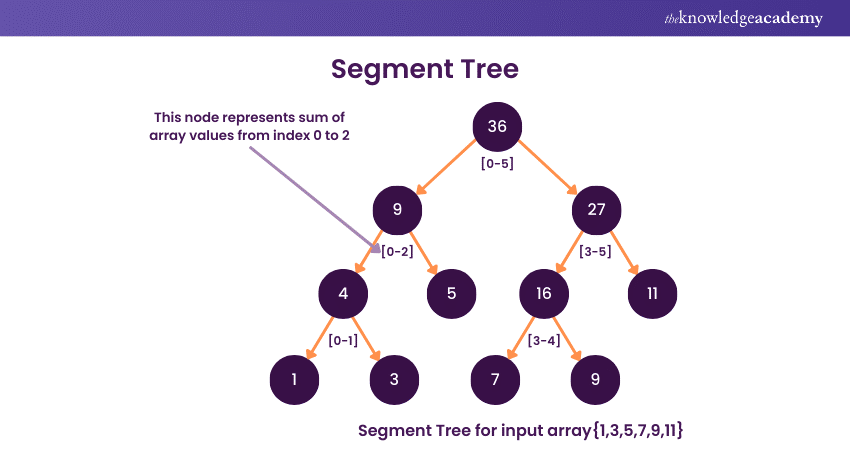
First, let's review the Segment Tree, which you've already implemented. Its main characteristic is its power and flexibility.
Technical Explanation
A Segment Tree is a (usually) perfect binary tree that stores pre-computed aggregates. Its key strength is its versatility. It can be built to handle any associative binary operation. An operation f is associative if f(a, f(b, c)) = f(f(a, b), c). This includes:
- Summation
- Product
- Minimum / Maximum
- Bitwise AND / OR / XOR
Both updates and queries involve traversing a path from the root to a leaf (or a set of paths covering a range), giving them a time complexity of . However, this flexibility comes at a cost: a Segment Tree requires more memory, typically an array of size for simple recursive implementations or for optimized bottom-up versions.
Metaphor: The Swiss Army Knife
A Segment Tree is like a Swiss Army Knife. It's equipped with tools for many different jobs (sum, min, max, etc.). This makes it incredibly versatile and powerful. However, it's also bulkier ( to space) and more complex to build and use compared to a simpler tool.
Python Code: Segment Tree for Range Minimum
To highlight its flexibility, here is a bottom-up implementation for Range Minimum Query, a task where Fenwick Trees fall short.
class SegmentTreeMin:
    def __init__(self, arr):
        self.n = len(arr)
        # Use a large value for infinity
        self.inf = float('inf')
        self.tree = [self.inf] * (2 * self.n)
        # Copy original array to the leaf nodes
        for i in range(self.n):
            self.tree[self.n + i] = arr[i]
        # Build the tree by computing parent nodes
        for i in range(self.n - 1, 0, -1):
            self.tree[i] = min(self.tree[2 * i], self.tree[2 * i + 1])

    def update(self, i, value):
        """Set value at index i. Time: O(log n)"""
        pos = self.n + i
        self.tree[pos] = value
        # Update parents
        while pos > 1:
            pos //= 2
            self.tree[pos] = min(self.tree[2 * pos], self.tree[2 * pos + 1])

    def query(self, l, r):
        """Query for minimum in range [l, r). Time: O(log n)"""
        l += self.n
        r += self.n
        min_val = self.inf
        while l < r:
            if l % 2:
                min_val = min(min_val, self.tree[l])
                l += 1
            if r % 2:
                r -= 1
                min_val = min(min_val, self.tree[r])
            l //= 2
            r //= 2
        return min_val

# Example
st_min = SegmentTreeMin([2, 5, 1, 4, 9, 3, 7, 6])
print(f"Minimum in range [2, 6) is: {st_min.query(2, 6)}") # Query on [1, 4, 9, 3] -> 1
st_min.update(2, 8) # Update original '1' to '8'
print(f"Minimum in range [2, 6) after update is: {st_min.query(2, 6)}") # Query on [8, 4, 9, 3] -> 3
3. The Fenwick Tree: The Specialized Speedster
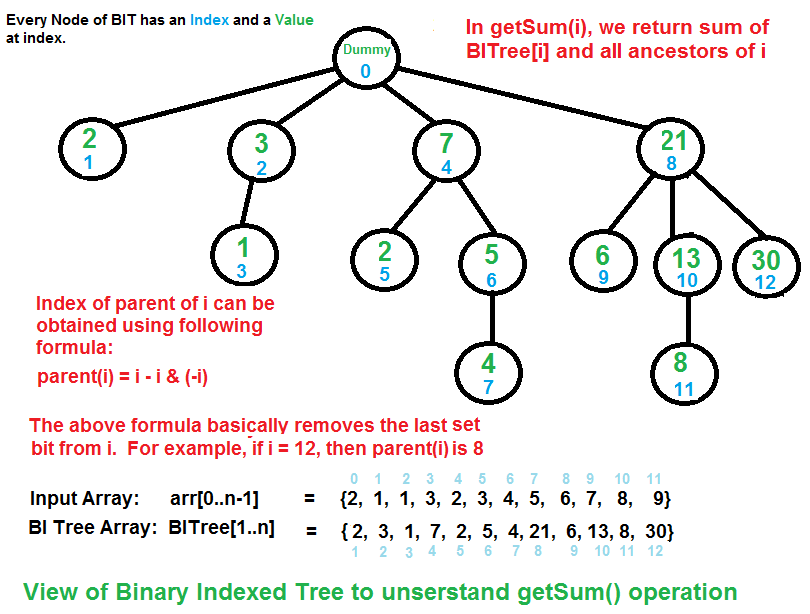
Next, let's revisit the Fenwick Tree (BIT). Its design philosophy is all about lean efficiency for a specific task.
Technical Explanation
A Fenwick Tree uses a single array of size and clever bit manipulation to achieve performance for both point updates and prefix sum queries. A range sum sum(l, r) is then calculated as prefix_sum(r) - prefix_sum(l-1).
Its primary limitation is that the underlying operation must be invertible. Summation is invertible: knowing sum(0, r) and sum(0, l-1) allows you to find sum(l, r). Minimum and Maximum are not invertible: knowing min(0, r) and min(0, l-1) tells you nothing about min(l, r). This specialization is the Fenwick Tree's defining trade-off.
To learn more about this core limitation, the following video explains it very well.
Tutorial: Binary Indexed Tree (Fenwick Tree)
The video 'Tutorial: Binary Indexed Tree (Fenwick Tree)' from JAlgs directly addresses why Fenwick Trees are unsuitable for range min/max queries.
Watch the clip from 16:09 to 17:02. The speaker clearly explains why min/max are not 'reversible' in the way that sum is, making it impossible to compute arbitrary range queries and explicitly suggests Segment Trees as the alternative.
Metaphor: The Racing Bicycle
A Fenwick Tree is like a high-performance racing bicycle. It's extremely lightweight ( space), aerodynamic (fast constant factors), and purpose-built for one thing: going fast on a smooth road (prefix sums). You wouldn't try to take it mountain biking (range min/max) or use it to haul groceries (complex range updates).
Python Code: Fenwick Tree for Prefix Sum
Here is the classic, clean implementation of a BIT for its intended purpose.
class FenwickTreeSum:
    def __init__(self, size):
        self.tree = [0] * (size + 1)

    def update(self, i, delta):
        """Add delta to value at index i. Time: O(log n)"""
        i += 1 # 1-based indexing
        while i < len(self.tree):
            self.tree[i] += delta
            i += i & (-i) # Move to next node to update

    def query(self, i):
        """Query for prefix sum up to index i. Time: O(log n)"""
        i += 1 # 1-based indexing
        s = 0
        while i > 0:
            s += self.tree[i]
            i -= i & (-i) # Move to parent
        return s

    def range_query(self, l, r):
        """Query sum for range [l, r]. Time: O(log n)"""
        return self.query(r) - self.query(l - 1)

# Example
data = [2, 5, 1, 4, 9, 3, 7, 6]
bit = FenwickTreeSum(len(data))
for i, val in enumerate(data):
    bit.update(i, val)

print(f"Sum of range [2, 5] is: {bit.range_query(2, 5)}") # Query on [1, 4, 9, 3] -> 17
bit.update(3, -2) # Update original '4' to '2' (delta is -2)
print(f"Sum of range [2, 5] after update is: {bit.range_query(2, 5)}") # Query on [1, 2, 9, 3] -> 15
4. Head-to-Head: A Feature-by-Feature Showdown
Now we can put them side-by-side to make the trade-offs crystal clear. This is the core of your decision-making framework.
For a detailed breakdown, the following article provides an excellent summary table and analysis.
Fenwick Trees in Data Structures - CSU083
The article 'Fenwick Trees in Data Structures' from dmj.one contains a superb comparison table that summarizes the key differences.
Please read the section 'How Does It Compare to Alternatives?' and pay close attention to the first comparison table. Then, read the section 'Trade-offs in Fenwick Trees' and review the 'Comparison with Segment Trees' table. These two tables provide the data for our analysis.
Synthesizing this information and our analysis, we arrive at the following comparison:
| Feature | Fenwick Tree (BIT) | Segment Tree | Winner & Rationale |
|---|---|---|---|
| Supported Operations | Invertible ops (sum, product, XOR) | Any associative op (sum, min/max, AND/OR) | Segment Tree. Its ability to handle non-invertible operations like min/max is a major advantage. |
| Space Complexity | to | Fenwick Tree. It's significantly more memory-efficient, which can be critical for very large arrays. | |
| Implementation | Simpler logic, fewer lines of code. | More complex, especially recursive versions. | Fenwick Tree. Its elegance and conciseness make it easier to implement correctly under pressure. |
| Performance Constants | Generally faster due to simpler logic and better cache locality. | Slower constant factors due to more complex branching and memory access patterns. | Fenwick Tree. For pure prefix-sum workloads, its leanness often translates to better real-world speed. |
| Range Updates | Possible with modifications, but less intuitive. | The standard extension is Lazy Propagation, a clean and powerful technique. | Segment Tree. Lazy propagation is a more general and conceptually elegant solution for range updates. |
Test your understanding!
You are designing a system to find the peak memory usage within any given time interval [t1, t2] from a stream of memory usage data recorded every second. The data is constantly flowing in. Which data structure is appropriate here, and why?
Show answer
A Segment Tree is the correct choice.
- The Operation: The problem asks for the "peak," which is a Range Maximum Query.
- Invertibility: As we've established, the
maxoperation is not invertible. A Fenwick Tree cannot computemax(t1, t2)frommax(0, t2)andmax(0, t1-1). - Conclusion: The Segment Tree is specifically designed for such associative but non-invertible operations. It is the only suitable choice between the two for this problem.
5. The Interview Perspective: Making the Right Choice
In a system design or algorithm interview, stating the correct choice is good, but justifying it with deep trade-offs is what distinguishes an elite candidate.
A Simple Decision Framework
Here's a mental flowchart to use when confronted with a dynamic range query problem:
-
What operation is required?
- If it's Range Min/Max, your choice is made: Segment Tree.
- If it's Range Sum (or another invertible operation), both are possible. Proceed to the next question.
-
Are Range Updates required? (e.g., "add 5 to all elements from index
ltor")- If yes, a Segment Tree with Lazy Propagation is the standard, most robust answer.
- If no (only point updates), proceed to the next question.
-
Is this a performance-critical, memory-constrained prefix-sum problem?
- If yes, the Fenwick Tree is the superior choice. Its space and faster constant factors make it the specialized tool for the job.
Real-World Context:
- Fenwick Trees are beloved in competitive programming, where problems are often tailored to prefix sums and every millisecond and kilobyte counts.
- Segment Trees are more common in flexible production systems. A service monitoring dashboard might initially only need average latency (a sum-based query) but later need to support peak latency (a max query). Building with a Segment Tree from the start provides that future-proofing. The performance-focused article from
algorithmica.orgshows how much effort goes into optimizing Segment Trees for production use, including bottom-up implementations and cache-aware layouts, reinforcing their importance in high-performance computing.
Conclusion
Today, you've completed a deep comparative analysis of Segment Trees and Fenwick Trees. You've moved from "how to implement them" to "when and why to choose one over the other."
Key Takeaways:
- The Generalist vs. The Specialist: The Segment Tree is a flexible generalist for any associative operation. The Fenwick Tree is a highly efficient specialist for invertible operations like prefix sums.
- The Deciding Factor is the Operation: The need for range min/max is the clearest signal to use a Segment Tree.
- Efficiency Trade-offs: The Fenwick Tree wins on space complexity ( vs. ) and often on raw speed for its specialized task. The Segment Tree's cost is its higher memory footprint and implementation complexity.
- Extensibility: Segment Trees are more naturally extended for complex scenarios like range updates via lazy propagation.
This lesson concludes our module on specialized query structures. You now have a robust toolkit for handling problems involving hashing, sets, strings, and numeric ranges.
Preview of the Next Lesson:
We are now moving into a new, exciting domain: graphs. Our next module, "Graph Algorithms," will explore how to represent and analyze networked data. The first lesson will cover the foundational topic: Representing graphs using adjacency lists and matrices, and analyzing their space-time trade-offs. This will be your entry point into solving a vast new class of problems, from social networks to routing algorithms.