Hello! Welcome to your next lesson.
In our last few lessons, we've focused on data structures optimized for numeric aggregation, like Segment Trees and Fenwick Trees. We finished by contrasting them to understand their respective trade-offs. Today, we pivot from numbers to strings and apply the same critical thinking. Our goal is to contrast two fundamental data structures, Tries and Hash Tables, specifically for solving prefix-based string problems.
Your learning outcome is to contrast the trade-offs between Tries and Hash Tables for prefix-based string problems. We will dissect when one is structurally superior to the other, moving beyond basic definitions to understand the deep architectural and performance implications that influence decisions at companies like Google.
Let's begin by framing the problem. Imagine you're building an autocomplete system. You need to solve two distinct types of problems:
- Exact Match: Does the word "program" exist in our dictionary?
- Prefix Match: What are all the words that start with the prefix "prog"?
A Hash Table excels at the first, but as we'll see, it's poorly suited for the second.
1. The Hash Table Approach (And Its Weakness for Prefixes)
Let's start with the familiar Hash Table (or Hash Map).
Technical Explanation
A Hash Table is designed for near-constant time key-value lookups. It computes a hash of the key (in this case, the entire string) to find an index in an underlying array where the value is stored. This is incredibly efficient for exact-match queries like search("program"). The time complexity is, on average, , where is the length of the string, because the hashing function must process the entire string.
However, for a prefix query like startsWith("prog"), the hash of "prog" tells us nothing about the locations of "program", "progress", or "programmer". The hash function's very design—to create unique, seemingly random outputs even for similar inputs—is a disadvantage here. The only way to find all words starting with "prog" is to iterate through every single one of the strings in your dataset, check if it starts with the prefix, and add it to your results. This leads to a dismal time complexity of .
Metaphor: The Disorganized Bookshelf
Imagine a magical bookshelf where you can instantly find any book by its full, exact title. You tell the librarian "I want The Count of Monte Cristo", and they instantly retrieve it. This is your Hash Table for exact matches.
Now, you ask, "Show me all the books whose titles start with 'The History of...'". The librarian, flustered, says, "The magic only works for full titles! I'll have to pull every single one of the million books on this shelf, read the title, and see if it matches." This slow, manual scan is exactly what a Hash Table has to do for prefix searches.
Python Code: The Inefficient Scan
Here is what that inefficient prefix search looks like in code.
def find_with_prefix_hashtable(dataset: set[str], prefix: str) -> list[str]:
    """
    Finds all words in a hash set that start with a given prefix.
    This demonstrates the inefficient O(N*m) approach.
    """
    matches = []
    # We must iterate through every word in the set (N words)
    for word in dataset:
        # The startswith() check takes O(p) time, where p is prefix length
        if word.startswith(prefix):
            matches.append(word)
    return matches

# Example
word_set = {"program", "progress", "programmer", "cat", "car", "cart"}
print(f"Prefix 'prog': {find_with_prefix_hashtable(word_set, 'prog')}")
print(f"Prefix 'car': {find_with_prefix_hashtable(word_set, 'car')}")
2. The Trie (Prefix Tree): Built for the Job
This is where the Trie comes in. It's a data structure specifically designed to solve prefix-based problems efficiently.
Technical Explanation
A Trie is a tree-like data structure where each node represents a single character. A path from the root to any node represents a prefix. To store a word, you traverse the tree, adding nodes for characters that don't already exist. A special flag on a node (e.g., is_end_of_word) marks the completion of a valid word.

The power of this structure is that finding all words with a given prefix is now trivial. To find words starting with "prog", you simply traverse the Trie along the path p-r-o-g. The subtree rooted at the 'g' node contains only words that start with "prog". The search time to find the prefix node is , where is the length of the prefix. Collecting all the words from that point on depends on the number of results, .
Metaphor: The Ultimate Dictionary
Unlike the disorganized bookshelf, a Trie is like a perfectly organized multi-volume encyclopedia. To find all topics starting with "PROG", you don't scan the entire library. You go to the 'P' volume, find the 'PR' section, then the 'PRO' subsection, and finally the 'PROG' entry. All related topics are right there, neatly grouped together. You've navigated directly to the right place.
Implement Trie (Prefix Tree) - Leetcode 208
To see this structure in action, watch this clip from NeetCode's 'Implement Trie' video. It provides an excellent conceptual breakdown of how a Trie is built and why it's so efficient for prefix operations.
Watch from the beginning to 06:52, and then from 07:49 to 08:20. Pay close attention to how words are inserted and how the 'search' (exact match) and 'startsWith' (prefix match) operations differ. The second clip directly contrasts this with a Hash Map.
3. Python Implementation of a Trie
Let's solidify this with a full implementation. A Trie is composed of TrieNode objects. Each node needs to know its children (which character leads to which next node) and whether it marks the end of a word. A hash map is a perfect choice for storing children, mapping a character to its corresponding TrieNode.
TrieNode and Trie Classes
class TrieNode:
    """A node in the Trie structure."""
    def __init__(self):
        # Maps a character to a TrieNode
        self.children: dict[str, TrieNode] = {}
        # True if this node marks the end of a complete word
        self.is_end_of_word: bool = False

class Trie:
    """Trie data structure for efficient prefix-based string operations."""
    def __init__(self):
        self.root = TrieNode()

    def insert(self, word: str):
        """
        Inserts a word into the trie. Time complexity: O(m), where m is word length.
        """
        curr = self.root
        for char in word:
            if char not in curr.children:
                curr.children[char] = TrieNode()
            curr = curr.children[char]
        curr.is_end_of_word = True

    def search(self, word: str) -> bool:
        """
        Searches for an exact word in the trie. Time complexity: O(m).
        """
        curr = self.root
        for char in word:
            if char not in curr.children:
                return False
            curr = curr.children[char]
        return curr.is_end_of_word

    def startsWith(self, prefix: str) -> bool:
        """
        Checks if there is any word in the trie that starts with the given prefix.
        Time complexity: O(p), where p is prefix length.
        """
        curr = self.root
        for char in prefix:
            if char not in curr.children:
                return False
            curr = curr.children[char]
        return True

# Example Usage
trie = Trie()
words = ["program", "progress", "programmer", "cat", "car", "cart"]
for w in words:
    trie.insert(w)

print(f"Search for 'program': {trie.search('program')}")  # True
print(f"Search for 'pro': {trie.search('pro')}")          # False, 'pro' is a prefix but not a word
print(f"Starts with 'pro': {trie.startsWith('pro')}")    # True
print(f"Starts with 'cax': {trie.startsWith('cax')}")    # False
4. Head-to-Head: The Trade-off Analysis
Now we can directly compare the two data structures for string-related tasks.
The article 'Trie Data Structures' on Fonzi.ai provides an excellent, detailed comparison. We'll use it to build our analysis.
Read the subsections 'Trie vs Hash Table' and 'Trie vs Binary Search Tree', and then review the 'Time and Space Complexity Analysis' section. Focus on the arguments presented for prefix search capabilities and memory efficiency. The comparison tables are particularly useful.
Here's a summary of the critical trade-offs:
| Feature | Trie | Hash Table | Winner for Prefix Search |
|---|---|---|---|
| Prefix Search Time | = prefix length = num results |
= total words = avg word length |
Trie (by a landslide) |
| Exact Match Time | average | Tie | |
| Insertion Time | average | Tie | |
| Space Complexity | **Variable: $O(\sum | \text{unique prefixes} | )$** Excellent with high prefix sharing. Can be high due to pointer overhead if strings are very distinct. |
| Ordered Traversal | Yes Can retrieve strings in lexicographical order via DFS/BFS traversal. |
No Unordered by nature. |
Trie |
| Collision Handling | N/A Deterministic paths mean no collisions. |
Required Chaining or open addressing adds complexity and can degrade worst-case performance. |
Trie |
Key takeaway: For any application dominated by prefix-based operations (autocomplete, spell-checkers, IP routing), the Trie's structural design gives it a fundamental performance advantage over a Hash Table. The Hash Table is a general-purpose tool for exact lookups; the Trie is a specialized tool for prefixes.
Test your understanding!
You are designing a service for a social media app that suggests usernames as a new user types. The system needs to check against a database of 500 million existing usernames in real-time. Which data structure would you choose as the backbone for this suggestion engine, and why?
Show answer
A Trie is the clear choice.
- Core Functionality: The problem is a classic prefix search. As the user types "alex_j", the system needs to find usernames starting with that prefix. A Trie does this in time, where is the length of the typed prefix. A Hash Table would require scanning all 500 million usernames, which is computationally infeasible for a real-time service.
- Scalability: The Trie's performance is independent of the total number of usernames (). Whether there are 1 million or 500 million users, the time to traverse to the prefix "alex_j" remains the same. The Hash Table's performance degrades linearly with .
- Memory: Usernames likely have significant prefix sharing (e.g., many users named "john", "alex", etc.). A Trie will exploit this to save space compared to a Hash Table storing 500 million full strings.
5. Real-World Systems: Google Autocomplete
So, how do elite companies solve this at a massive scale? They use Tries.
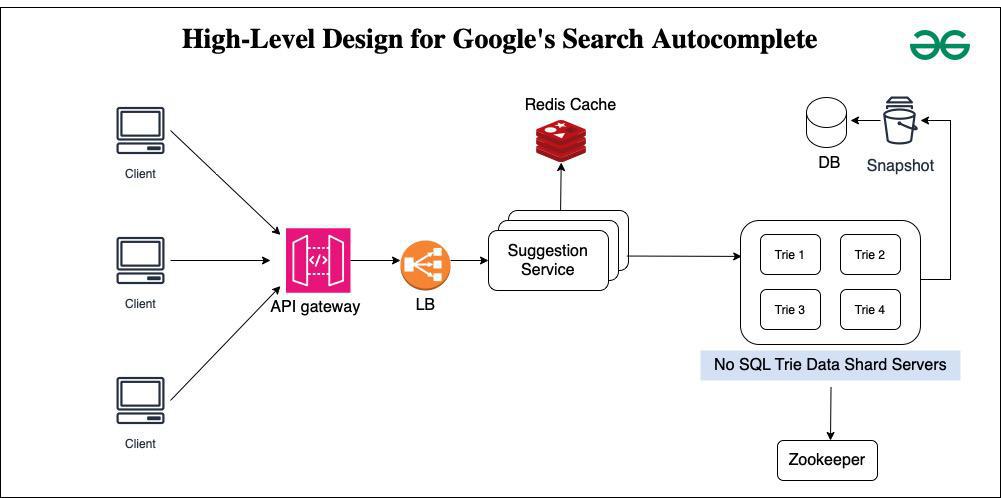
This diagram reveals several "elite-level" insights:
- Tries are the core: The system is built around Tries, validating our analysis.
- Scale requires distribution: A single Trie can't hold Google's entire search history. They use sharding—splitting the Trie data across multiple servers. For instance, prefixes 'a-c' might live on one set of servers, 'd-f' on another.
- Caching is critical: A Redis cache sits in front of the Trie servers to serve extremely common queries (like "weather") without even hitting the core data structure, reducing load.
- Hybrid Systems: While Tries are ideal, high-performance implementations often use other structures internally. For instance, the research paper "A Fast and Memory-Efficient Trie Structure" (LINK) describes an optimized Trie called
NameTriethat uses a hash table to manage the pointers (edges) between Trie nodes. This hybrid approach optimizes for CPU cache performance, demonstrating that in the real world, the answer isn't always "one or the other" but often a clever combination of both.
Conclusion
Today you've dissected the trade-offs between Tries and Hash Tables, a classic system design and algorithms question. You've gone beyond the surface to understand why these trade-offs exist and how they manifest in real-world, high-scale systems.
Key Takeaways:
- Use Case is King: For exact-match lookups, a Hash Table is the go-to. For prefix-based operations, a Trie is structurally and algorithmically superior.
- Time Complexity: The Trie's prefix search time is its killer feature, making it independent of the total dataset size , unlike the Hash Table's .
- Space Complexity: Tries shine when there is significant prefix sharing in the data, often resulting in lower memory usage than a Hash Table which stores every string in full.
- Real-World Application: Elite systems like Google Autocomplete are built on distributed Trie-based architectures, proving their effectiveness at scale.
Preview of the Next Lesson:
We've now completed our analysis of specialized data structures for both numeric and string problems. In the final lesson of this module, we will conduct a capstone comparison of Segment Trees and Fenwick Trees. We'll tackle more complex scenarios and edge cases to solidify your decision-making framework when choosing between these powerful tools for range and prefix query problems.