Hello! Welcome to your daily lesson on distributed systems.
In our last session, we explored vector clocks, a powerful mechanism for tracking causal relationships between events in a highly distributed, eventually consistent system. We saw how they allow us to distinguish concurrent events from causally ordered ones, which is critical for resolving conflicts when nodes can't always communicate.
Today, we shift our focus from a general mechanism for tracking causality to a specific, widely-used system that provides strong ordering guarantees as a service: Apache Kafka. You will learn to explain the architecture of a log-based message queue (e.g., Kafka) and its delivery semantics (at-least-once, exactly-once). This is a cornerstone technology at nearly every large tech company (including Google and Meta) for everything from activity tracking and metrics to stream processing and microservice communication.
We will deconstruct Kafka's architecture and guarantees through these five interrelated concepts:
- The Log-Based Message Queue: What Kafka is and the core architectural components.
- Topics, Partitions, and Ordering: How Kafka organizes and scales data, and what "ordering" really means.
- Consumption and Consumer Groups: The mechanics of reading data and achieving massive parallelism.
- Delivery Semantics: At-Most-Once & At-Least-Once: Understanding the fundamental trade-offs between performance and reliability.
- Elite Interview Deep Dive: Exactly-Once Semantics (EOS): The "under the hood" mechanisms that enable the strongest guarantee.
1. The Log-Based Message Queue (Easy)
In a complex system with many services, you need a reliable way for them to communicate without being tightly coupled. If a service that processes user activity goes down, you don't want the frontend service that generates those activity events to fail or drop data. This is where message queues come in.
-
Technical Explanation:
A message queue is an intermediary that enables asynchronous communication. Services called producers send messages to the queue, and services called consumers read messages from it. This decouples the services; the producer doesn't need to know who the consumer is or if it's currently online.Kafka is not just any message queue; it's a distributed streaming platform built around a partitioned, replicated commit log.
- Log: Data is written to an append-only, ordered sequence. It's immutable.
- Distributed: The log is spread across multiple servers, called brokers, for scalability and fault tolerance.
- Streaming Platform: It's designed for high-throughput, real-time data processing, not just simple task queuing.
The main architectural components are:
- Producers: Client applications that write streams of messages.
- Consumers: Client applications that read streams of messages.
- Brokers: The Kafka servers that form the cluster, store the data, and serve clients.

This diagram illustrates the core components of a Kafka cluster. Producers write data to topics, which are stored in partitions distributed across brokers. Consumers, organized into groups, read from these partitions.
Apache Kafka: a Distributed Messaging System for Log Processing
To start, let's watch a quick introduction from Gaurav Sen that explains what Kafka is and its primary use cases at a high level.
Watch the video from the beginning to 01:44. Focus on understanding the two main use cases: a message queue for decoupling and an event streaming platform for replaying event logs.
-
Metaphor for a 5-Year-Old:
Imagine a giant, ever-growing diary that's shared across several libraries (the brokers). People who want to write stories (producers) go to a library and add their new sentences to the end of the diary. People who want to read the stories (consumers) go to a library and read from the diary, remembering which page they were on. The diary is special because once a sentence is written, it can never be changed. -
Python Code Snippet (Basic Producer):
This snippet shows the simplest form of producing a message. We'll be using theconfluent-kafkalibrary, which is a popular choice for Python.from confluent_kafka import Producer import socket # Basic producer configuration conf = { 'bootstrap.servers': 'localhost:9092', # Assumes Kafka is running locally 'client.id': socket.gethostname() } producer = Producer(conf) # The topic is a category for messages. topic = 'user-activity' # Asynchronously produce a message. # The callback `delivery_report` will be called once the message is # delivered or the attempt fails. def delivery_report(err, msg): if err is not None: print(f'Message delivery failed: {err}') else: print(f'Message delivered to {msg.topic()} [{msg.partition()}]') producer.produce(topic, key='user123', value='clicked-profile-page', callback=delivery_report) # Wait for any outstanding messages to be delivered and delivery reports to be received. producer.flush()
2. Topics, Partitions, and Ordering (Easy)
Kafka's scalability and ordering guarantees stem directly from how it organizes data into topics and partitions.
-
Technical Explanation:
Messages in Kafka are organized into topics. A topic is a logical category or feed name (e.g.,clicks,payments,locations). A topic is further broken down into one or more partitions.A partition is the core unit of storage and parallelism. It is an ordered, immutable sequence of messages—the actual append-only log file. Each message within a partition is assigned a sequential ID number called an offset.
When a producer sends a message, it must be sent to a specific partition of a topic. How is this decided?
- Key-based Partitioning: If the message has a key (e.g.,
user-id,order-id), Kafka will hash the key and use the result to select a partition. This is deterministic: all messages with the same key will always go to the same partition. - No Key (Round-Robin): If the message has no key, Kafka will distribute messages across partitions in a round-robin fashion to balance the load.
This leads to Kafka's fundamental ordering guarantee: Kafka guarantees message order within a partition, but not across partitions of the same topic.
- Key-based Partitioning: If the message has a key (e.g.,
Kafka System Design Deep Dive w/ a Ex-Meta Staff Engineer
The 'Hello Interview' channel has an excellent video that clearly explains how topics, partitions, and message keys work together to achieve scalability while preserving order.
Watch from 08:00 to 14:03. Pay close attention to the distinction between a logical topic and a physical partition, and the explanation of how the partition key is hashed to determine the destination partition.
-
Metaphor for a 5-Year-Old:
Imagine a multi-lane highway is a topic (Highway-101). Each lane is a partition. Cars are messages.- Ordering: Cars in the same lane must stay in order. A car can't just teleport past the one in front of it. However, a car in lane 2 can easily pass a car in lane 1.
- Partitioning: If you have a convoy of trucks that must arrive together (related messages), you tell them all to use the same
convoy-id(the key). The highway system then directs all trucks with that ID into the same lane to keep them in sequence. Cars without a convoy ID are just told "pick a lane, any lane."
-
Python Code Snippet (Producing with Keys):
# ... (producer setup from before) ...

topic = 'order-updates'
order_id = 'ORD-456'

# All messages with the same key 'ORD-456' are guaranteed to go
# to the same partition, preserving their order of production.
producer.produce(topic, key=order_id, value='Order created', callback=delivery_report)
producer.produce(topic, key=order_id, value='Payment received', callback=delivery_report)
producer.produce(topic, key=order_id, value='Order shipped', callback=delivery_report)

# This message for a different order may go to a different partition.
producer.produce(topic, key='ORD-789', value='Order created', callback=delivery_report)

producer.flush()
3. Consumption and Consumer Groups (Medium)
Kafka's consumption model is designed for high-throughput, parallel processing by multiple consumers.
-
Technical Explanation:
Consumers read messages using a pull model; they request data from brokers when they are ready. A key concept for scaling consumption is the consumer group.- Consumer Group: A set of consumers that cooperate to consume messages from one or more topics.
- Partition Assignment: Kafka assigns the partitions of a topic to the consumers in a group. Each partition is consumed by exactly one consumer within the group. If you have a topic with 4 partitions and a consumer group with 4 consumers, each consumer will handle one partition. If you have 2 consumers, each will handle 2 partitions. If you have 5 consumers, one will be idle. This is how Kafka achieves parallel processing.
- Offsets and Commits: A consumer tracks its position in a partition using the offset. After processing messages, the consumer "commits" its offset back to Kafka. This acts as a bookmark. If the consumer crashes and restarts, it will resume reading from the last committed offset, preventing it from reprocessing everything from the beginning.
-
Metaphor for a 5-Year-Old:
Imagine a book club (the consumer group) wants to read a 10-volume encyclopedia (the topic with 10 partitions). To finish fast, they share the work.- If there are 10 members, each person takes one volume and starts reading.
- If there are only 5 members, each person takes two volumes.
- Every time a member finishes a chapter, they place a bookmark (commit the offset) so they know where to start next time.
- If a member leaves the club, another member takes their volume and starts reading from their last bookmark.
Kafka System Design Deep Dive w/ a Ex-Meta Staff Engineer
Let's return to the 'Hello Interview' video to see how consumer groups and offset management enable fault-tolerant, scalable consumption.
Watch from 14:03 to 15:47. Focus on how consumers use offsets to track their progress and how committing offsets to Kafka allows for recovery after a failure.
- Python Code Snippet (Basic Consumer):
from confluent_kafka import Consumer

# Consumer configuration
conf = {
    'bootstrap.servers': 'localhost:9092',
    'group.id': 'order-processors', # All consumers with this ID are in the same group
    'auto.offset.reset': 'earliest' # Start reading from the beginning if no offset is stored
}

consumer = Consumer(conf)
consumer.subscribe(['order-updates']) # Subscribe to the topic

try:
    while True:
        msg = consumer.poll(timeout=1.0) # Wait for 1 second for a message
        if msg is None:
            continue
        if msg.error():
            print(f"Consumer error: {msg.error()}")
            continue

        print(f"Consumed message: key={msg.key().decode('utf-8')}, value={msg.value().decode('utf-8')}")
        # In default mode, offsets are committed automatically in the background.
        # We will see how to control this in the next section.

except KeyboardInterrupt:
    print("Stopping consumer...")
finally:
    consumer.close()
4. Delivery Semantics: At-Most-Once & At-Least-Once (Hard)
When you have producers, a network, brokers, and consumers, things can fail. Delivery semantics define the guarantees a system provides in the face of such failures.
-
Technical Explanation:
There are three primary delivery semantics:- At-Most-Once: A message is delivered 0 or 1 times. Messages may be lost, but are never redelivered. This is achieved by committing the consumer offset before processing the message. If the consumer crashes after committing but before finishing processing, the message is lost forever because the committed offset indicates it was already handled. This prioritizes performance over reliability.
- At-Least-Once: A message is delivered 1 or more times. Messages are never lost, but may be duplicated. This is Kafka's default guarantee and the most common. It's achieved by processing the message first, and then committing the offset. If the consumer crashes after processing but before the commit succeeds, a new consumer will take over, start from the last committed offset, and re-process the same message, leading to a duplicate.
- Exactly-Once: A message is delivered exactly one time. No losses, no duplicates. This is the most desirable but also the most complex to achieve. We'll cover this in the next section.
The Trade-off: The choice of when to commit the offset (
enable.auto.commit=false) is a direct trade-off between the risk of data loss and the risk of data duplication.
Kafka Deep Dive for System Design Interviews
The Hello Interview guide provides a fantastic written explanation of consumer failure modes and the implications of when you commit offsets. This is a critical concept for system design interviews.
Read the section 'Fault Tolerance and Durability', paying special attention to the subsection 'But what happens when a consumer goes down?'. Focus on the explanation of offset management and the trade-off of when to commit.
- Metaphor for a 5-Year-Old:
You're working on a checklist of chores.- At-Most-Once: You check off "clean your room" before you start cleaning. A meteor then hits your house. Your room never gets cleaned, but the list says it's done. The chore was "lost".
- At-Least-Once: You clean your room first, then go to check it off the list. Just before you check it, you get amnesia. You look at the list again and see "clean your room" is not checked. You clean your room again, just to be sure. It gets cleaned twice (a "duplicate").
Test your understanding! (Interview-Style Question)
A consumer application is designed to read a payment event from Kafka, process the payment via an external API, and then write a record to a database. The consumer is configured for at-least-once delivery (it commits offsets after processing).
Describe a specific failure scenario that would result in a customer being charged twice. How would you change your application logic (not the Kafka configuration) to mitigate this, even if the message is delivered twice?
Show answer
Failure Scenario:
- The consumer reads a payment event for
$50from offset100. - The consumer successfully calls the external payment API, charging the customer
$50. - The consumer application crashes before it can commit offset
100to Kafka. - After a restart or rebalance, a new consumer instance is assigned the partition. It sees the last committed offset is
99. - The new consumer reads the same payment event from offset
100again. - It calls the external payment API again, charging the customer another
$50. The customer has been double-charged.
Mitigation (Idempotent Consumer Logic):
The core problem is that the payment processing step is not idempotent. To fix this, you need to make the processing itself resistant to duplicates.
A common pattern is to use a unique identifier from the message (e.g., a transaction_id or event_id) to track what has been processed.
- When processing the payment, first check a database table (or a Redis cache) to see if the
transaction_idfrom the Kafka message has already been processed. - If it has, skip the payment API call and simply acknowledge the message (move to commit the offset).
- If it has not, then:
a. Begin a database transaction.
b. Insert thetransaction_idinto your tracking table.
c. Call the external payment API.
d. Commit the database transaction. - Only after this entire block succeeds should you commit the offset to Kafka.
This makes the consumer idempotent: reprocessing a duplicate message will be detected and safely ignored.
5. Elite Interview Deep Dive: Exactly-Once Semantics (EOS) (Very Hard)
Achieving exactly-once semantics is a notoriously difficult problem in distributed systems. Kafka provides this guarantee by combining two key features: idempotent producers and transactions.
- Technical Explanation:
- Idempotent Producer: This solves the problem of duplicates from producer retries. When a producer tries to send a message and doesn't get an acknowledgment (e.g., due to a network timeout), it will retry. Without idempotency, this could lead to the same message being written twice.
- How it works: When enabled (
enable.idempotence=true), the producer is assigned a unique Producer ID (PID). It also includes a sequence number with each message sent to a specific partition. The broker keeps track of the latest PID-sequence number it has seen for that partition. If it receives a message with a sequence number it has already processed, it discards it as a duplicate.
- How it works: When enabled (
- Idempotent Producer: This solves the problem of duplicates from producer retries. When a producer tries to send a message and doesn't get an acknowledgment (e.g., due to a network timeout), it will retry. Without idempotency, this could lead to the same message being written twice.
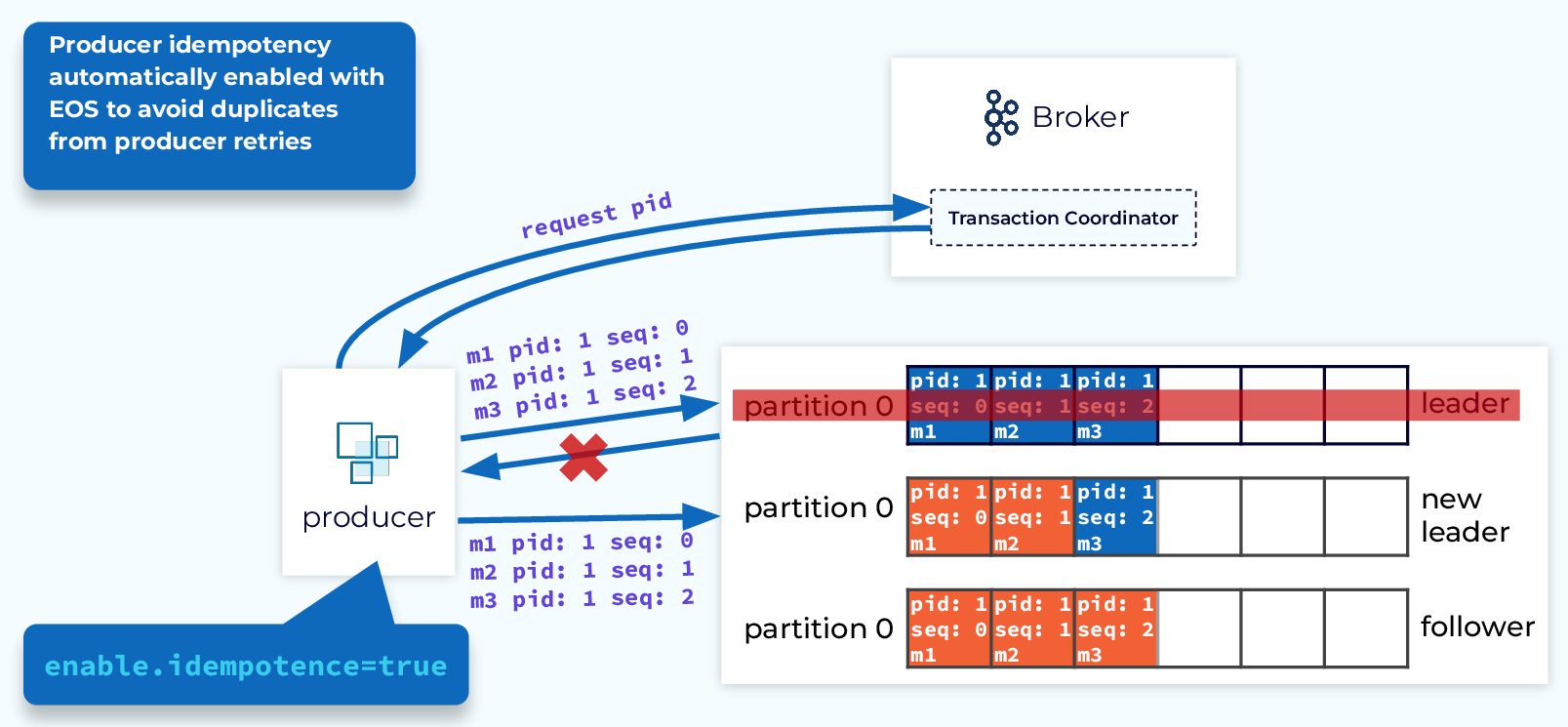
    *This diagram shows how a producer with an assigned PID sends messages with sequence numbers. If a retry occurs, the broker uses the PID and sequence number to detect and discard the duplicate message.*

2.  **Transactions:** Idempotency only covers producer duplicates within a single session. Transactions provide atomicity for operations that span multiple partitions, most notably the **"read-process-write"** pattern.
    *   **How it works:** A producer can begin a transaction, send a batch of messages to one or more topics/partitions, and then commit the transaction. All messages in the transaction are either successfully written and become visible to consumers, or none of them are.
    *   For EOS stream processing, you consume a message, produce a new message as a result, and commit the consumer's offset *within the same transaction*. If any part fails, the entire transaction is aborted. The consumer will not have its offset committed, and the produced message will not be visible. Consumers must be configured with `isolation.level="read_committed"` so they only read messages from committed transactions.
How to Implement Exactly-Once Semantics in Kafka ...
This is a complex topic that requires diving into the implementation details. This article provides an excellent, code-centric guide to implementing exactly-once semantics in Kafka, covering both idempotent producers and the transactional API.
Read the sections 'Idempotent Producers', 'Transactional Producers', and 'Read-Process-Write Pattern'. You don't need to memorize the code, but focus on the configuration properties required (enable.idempotence, transactional.id, isolation.level) and the sequence of API calls (init_transactions, begin_transaction, send_offsets_to_transaction, commit_transaction).
-
Python Code Snippet (Transactional Read-Process-Write):
This conceptual snippet is based on the Java/Python examples in the article and shows the flow for a transactional stream processor.from confluent_kafka import Consumer, Producer, TopicPartition # Consumer must not auto-commit and must read only committed data. consumer_conf = { 'bootstrap.servers': 'localhost:9092', 'group.id': 'eos-processor-group', 'enable.auto.commit': False, 'isolation.level': 'read_committed' } # Producer must be configured with a unique transactional id. # Idempotence is automatically enabled. producer_conf = { 'bootstrap.servers': 'localhost:9092', 'transactional.id': 'my-eos-processor-01' } consumer = Consumer(consumer_conf) producer = Producer(producer_conf) consumer.subscribe(['input-topic']) producer.init_transactions() try: while True: msg = consumer.poll(1.0) if msg is None: continue try: # 1. Begin the transaction producer.begin_transaction() # 2. Process the message and produce to an output topic processed_value = msg.value().decode('utf-8').upper() producer.produce('output-topic', processed_value) # 3. Commit the consumer offset as part of the transaction # This links the input offset with the produced output atomically. # The metadata is required to identify the consumer group coordinator. offsets_to_commit = [TopicPartition(msg.topic(), msg.partition(), msg.offset() + 1)] producer.send_offsets_to_transaction(offsets_to_commit, consumer.consumer_group_metadata()) # 4. Commit the entire transaction producer.commit_transaction() except Exception as e: print(f"Transaction failed: {e}") producer.abort_transaction() # Roll back everything finally: consumer.close() producer.close()
Conclusion
You've now dissected the architecture of Apache Kafka, one of the most important pieces of infrastructure in modern data engineering and distributed systems. Understanding these concepts is non-negotiable for senior roles at top tech companies.
Key Takeaways:
- Architecture: Kafka is a distributed, append-only log, composed of producers, consumers, and brokers. Data is organized into logical topics, which are scaled and parallelized via physical partitions.
- Ordering: Kafka's core guarantee is strict message ordering within a partition, typically achieved by sending related messages with the same key.
- Consumption: Consumer groups enable scalable, parallel processing by ensuring each partition is handled by only one consumer in the group. Offsets are bookmarks that track consumption progress.
- Delivery Semantics: You face a critical trade-off. At-least-once (the default) prevents data loss at the risk of duplicates. At-most-once prioritizes performance but risks data loss.
- Exactly-Once (EOS): The strongest guarantee, achieved through a combination of idempotent producers (to prevent producer-side duplicates) and transactions (to atomically link consumption and production in a read-process-write cycle).
Next Lesson Preview
Kafka's reliability hinges on its ability to replicate partitions across multiple brokers and elect a new leader if one fails. This coordination is vital to prevent a situation where the cluster splits into multiple, uncoordinated groups that can lead to data inconsistency—a problem known as split-brain. In our next lesson, we will examine the split-brain problem and explore how quorum-based strategies are used to prevent it, ensuring a distributed system remains consistent even during network partitions.