Hello! Welcome to your daily lesson on distributed systems.
In our last session, we dissected the Raft consensus algorithm. We saw how it uses a strong leader and a totally ordered log to ensure that all nodes in a cluster agree on a single, consistent history of events. This total ordering is powerful but can be overkill for some systems.
What if we don't need to order every single event relative to every other? What if we only care about preserving direct cause-and-effect relationships? Today, we will explore the mechanism that allows us to do just that. You will learn to implement vector clocks to track causality between distributed events. This is a fundamental technique used in highly available, eventually consistent systems like Amazon's DynamoDB and Riak, where understanding the causal history of data is critical for resolving conflicts.
We'll build up to this by covering five interrelated concepts:
- The "Happens-Before" Relationship & Logical Time: The foundational theory of event ordering.
- Lamport Clocks: A First Attempt: A simpler logical clock that reveals the need for something more powerful.
- Vector Clocks: The Core Algorithm: The "under the hood" mechanics of how vector clocks work.
- Interpreting Vector Clocks: How to use vector clocks to determine if events are causally related or concurrent.
- Elite Interview Deep Dive: Real-World Trade-offs & Advanced Clocks: Exploring the practical challenges and solutions used in industry.
1. The "Happens-Before" Relationship & Logical Time (Easy)
In a distributed system, relying on physical wall-clocks is a recipe for disaster. Clocks on different machines drift, and even with synchronization protocols like NTP, you can't guarantee that the timestamp on a message received is always greater than the timestamp on the message sent. This can break our intuitive understanding of cause and effect.
-
Technical Explanation:
To solve this, we ignore physical time and focus on logical time, which is only concerned with the order of events, not how long they take. The foundation for this is the happens-before relationship, denoted by the symbol . It defines a partial ordering of events in a distributed system based on three simple rules:- Intra-process Order: If event A and event B occur in the same process, and A executes before B, then .
- Inter-process Order: If event A is the sending of a message by one process and event B is the receipt of that same message by another process, then .
- Transitivity: If and , then .
Two events, A and B, are considered concurrent if neither nor is true. This means there is no causal path from one to the other. Logical clocks are counters designed to capture this happens-before relationship.
Distributed Systems 4.1: Logical time
To understand why we need logical clocks in the first place, let's start with a short video from Martin Kleppmann, a leading expert in distributed systems.
Watch the first part of the video from the beginning until 02:25. Focus on the example of the 'moon is made of cheese' and why physical clocks are not sufficient to preserve causality.
- Metaphor for a 5-Year-Old:
Imagine you and your friend are texting.- You send a message "Want to play?" then you send "I have a new ball!". You know the first message happened before the second.
- Your friend receives your "Want to play?" message and then texts back "Yes!". You know your message happened before their reply.
- If your message happened before their reply, and their reply happened before you text "Great!", then your first message also happened before your final "Great!".
Anything else, like a message your friend sends to someone else while waiting for your reply, is concurrent with your actions.
2. Lamport Clocks: A First Attempt (Easy)
The first and simplest logical clock was proposed by Leslie Lamport. It's a single integer counter that tries to assign a number to every event.
-
Technical Explanation:
A Lamport clock is a single counter on each process. The algorithm is:- Initialize to 0 on all processes.
- Before executing a local event, a process increments its own counter: .
- When sending a message, a process first increments its counter and then includes the new value with the message.
- When a process receives a message with a timestamp , it updates its local counter to .
Key Property: Lamport clocks guarantee that if an event , then the clock value .
Key Limitation: The reverse is NOT true. If , you cannot conclude that . The events A and B might be concurrent. This is because Lamport clocks lose information by squashing the knowledge of all processes into a single number.

Distributed Systems 4.1: Logical time
Let's watch the next segment of Martin Kleppmann's video, which explains the Lamport clock algorithm and its crucial limitation.
Watch from 02:25 to 11:50. Pay close attention to the update rules and the final part of the segment where he explains what Lamport clocks cannot tell you (distinguishing causality from concurrency).
-
Metaphor for a 5-Year-Old:
Imagine everyone in your class has a "take-a-number" ticket dispenser. Every time you do something, you take a new number. When you talk to someone, you tell them your number. If their number is lower, they fast-forward their dispenser past your number and then take a new one. This ensures their number is now higher than yours.But, if you have ticket #5 and your friend in another room (who you haven't talked to) has ticket #8, does that mean they did their thing after you? Not necessarily. They might have just been doing a lot of other things on their own. You can't know for sure.
-
Python Code Snippet (Illustrating the Limitation):
# Two independent processes, p1 and p2
p1_clock = 0
p2_clock = 0

# Event A at process 1
p1_clock += 1
event_A_clock = p1_clock # C(A) = 1

# Event B at process 2 (concurrent, no communication)
p2_clock += 1
event_B_clock = p2_clock # C(B) = 1

# Event C at process 2
p2_clock += 1
event_C_clock = p2_clock # C(C) = 2

print(f"Clock for Event A (on P1): {event_A_clock}")
print(f"Clock for Event C (on P2): {event_C_clock}")

# C(A) < C(C), but A and C are concurrent.
# We cannot infer causality from the clock values alone.
if event_A_clock < event_C_clock:
    print("C(A) < C(C), but we can't conclude A happened before C.")
3. Vector Clocks: The Core Algorithm (Medium)
To overcome the limitation of Lamport clocks, we need to stop squashing all information into one number. Vector clocks maintain a separate counter for every process in the system.
-
Technical Explanation:
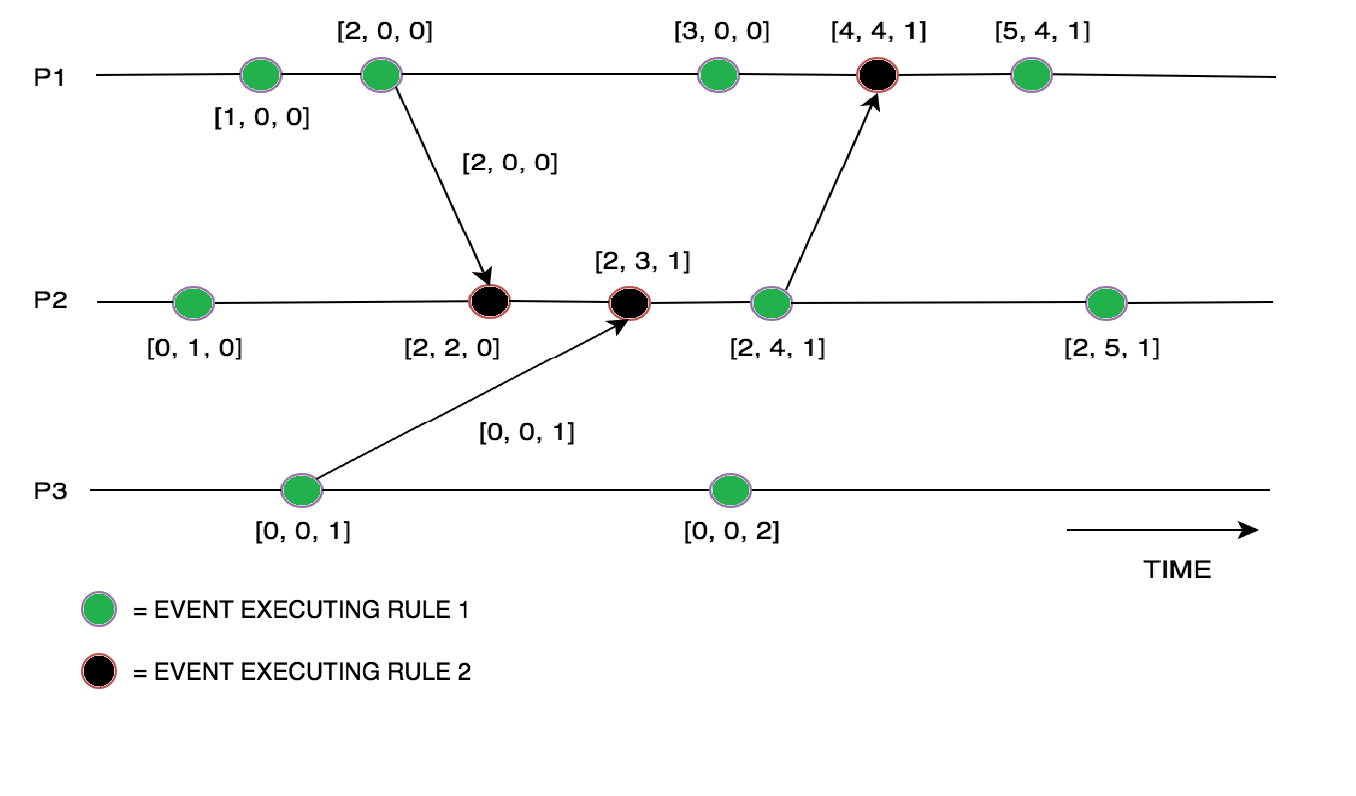
In a system with processes, a vector clock on each process is an array (or vector) of integers. Let's say a process has a vector clock . The element represents the number of events that knows have occurred at process .The algorithm is as follows:
- Initialization: All vectors are initialized to on all processes.
- Local Event: Before executing a local event, process increments its own clock in the vector: .
- Sending a Message: When process sends a message, it first increments its own clock () and then attaches its entire vector to the message.
- Receiving a Message: When process receives a message from with vector , it performs two steps:
a. Merge: Update its own vector by taking the element-wise maximum of its vector and the message's vector. For all from 1 to : .
b. Increment: Increment its own clock in the newly merged vector: .
-
Metaphor for a 5-Year-Old:
Back to our group project. Instead of one number, everyone has a scoreboard with a slot for every person in the group. When you finish a task, you increase your own score on your scoreboard. When you send your work to a friend, you also send your entire scoreboard. Your friend looks at both their board and yours, and for each person, they update their score to be the highest of the two. Then they increase their own score by one for receiving your work. This way, everyone's scoreboard reflects the latest known progress of everyone else. -
Python Code Snippet (Core Implementation):
Let's start building a class to represent a node in our distributed system.class Node: def __init__(self, node_id, total_nodes): self.node_id = node_id self.total_nodes = total_nodes # The core data structure: a vector (list) of integers self.vector_clock = [0] * total_nodes def local_event(self): """Rule 2: On a local event, increment own clock.""" self.vector_clock[self.node_id] += 1 print(f"Node {self.node_id} local event. Clock: {self.vector_clock}") def send_message(self, receiver): """Rule 3: On send, increment own clock and attach the vector.""" self.vector_clock[self.node_id] += 1 print(f"Node {self.node_id} sending message. Clock: {self.vector_clock}") # In a real system, you'd send `self.vector_clock` over the network receiver.receive_message(self.vector_clock) def receive_message(self, received_clock): """Rule 4: On receive, merge and then increment.""" print(f"Node {self.node_id} received clock {received_clock}. Own clock before merge: {self.vector_clock}") # Step 4a: Merge by taking element-wise max for i in range(self.total_nodes): self.vector_clock[i] = max(self.vector_clock[i], received_clock[i]) # Step 4b: Increment own clock self.vector_clock[self.node_id] += 1 print(f"Node {self.node_id} finished receive. Clock: {self.vector_clock}") # Simulation with 3 nodes nodes = [Node(i, 3) for i in range(3)] # P0 sends to P1 nodes[0].send_message(nodes[1]) # P1 sends to P2 nodes[1].send_message(nodes[2]) # P2 has a local event nodes[2].local_event()Code adapted from the GeeksForGeeks article 'Vector Clocks in Distributed Systems'.
4. Interpreting Vector Clocks: Causality and Concurrency (Hard)
Now that we have these vectors, how do we use them to determine the relationship between events? The comparison logic is the key to unlocking the power of vector clocks.
-
Technical Explanation:
Given two vector clocks, and , from two different events A and B:- Equal: if and only if for all components . (This implies they are the same event).
- Happens-Before: (meaning ) if and only if for all , AND there exists at least one component such that . In other words, B's clock is strictly more advanced in at least one dimension and not older in any.
- Concurrent: and are concurrent (written ) if neither nor . This happens when each clock has a component that is larger than the corresponding component in the other. For example,
[2, 1]and[1, 2].
This gives us the bidirectional relationship that Lamport clocks lacked: . We can now definitively distinguish causality from concurrency.
All Things Clock, Time and Order in Distributed Systems
For a detailed breakdown of the algorithm and how to compare vectors, let's turn to this excellent article. It also provides context on where these are used, such as in NoSQL databases.
Read the sections 'Vector Clock' and 'Concurrent Vector Clocks'. Focus on the definitions of how to compare two vector clocks to determine if one is less than, greater than, or concurrent with another.
-
Metaphor for a 5-Year-Old:
Let's compare the scoreboards of two players, Alice and Bob.- Alice's scoreboard
[2, 3, 1]means she's seen 2 of her own tasks, 3 of Bob's, and 1 of Carol's. - Bob's scoreboard is
[2, 4, 1]. - Is Alice's board "before" Bob's? Let's check: all of Alice's scores are less than or equal to Bob's, and at least one is strictly less (her score for Bob is 3, while Bob's is 4). So, YES, Alice's state happened before Bob's.
- Now, Carol's board is
[3, 1, 2]. Let's compare her to Alice. Carol's score for herself is higher (3 vs 2), but her score for Bob is lower (1 vs 3). Since neither scoreboard is entirely "greater than or equal to" the other, Alice and Carol's states are concurrent.
- Alice's scoreboard
-
Python Code Snippet (Comparison Logic):
Let's add the comparison logic to ourNodeclass.from enum import Enum class Relationship(Enum): BEFORE = "before" AFTER = "after" CONCURRENT = "concurrent" EQUAL = "equal" def compare_clocks(vc1, vc2): """Compares two vector clocks to determine their causal relationship.""" vc1_is_smaller = all(x <= y for x, y in zip(vc1, vc2)) vc2_is_smaller = all(y <= x for x, y in zip(vc1, vc2)) if vc1_is_smaller and vc2_is_smaller: return Relationship.EQUAL elif vc1_is_smaller: return Relationship.BEFORE # vc1 happened before vc2 elif vc2_is_smaller: return Relationship.AFTER # vc1 happened after vc2 else: return Relationship.CONCURRENT # --- Example Usage --- vc_A = [2, 3, 1] vc_B = [2, 4, 1] vc_C = [3, 1, 2] print(f"A vs B: {compare_clocks(vc_A, vc_B).value}") # Expected: before print(f"B vs A: {compare_clocks(vc_B, vc_A).value}") # Expected: after print(f"A vs C: {compare_clocks(vc_A, vc_C).value}") # Expected: concurrent print(f"A vs A: {compare_clocks(vc_A, vc_A).value}") # Expected: equal
Test your understanding! (Interview-Style Question)
In a distributed database system with 3 replicas (R1, R2, R3), a client reads a value and gets back the vector clock [4, 7, 2]. Concurrently, another client reads the same value from a different replica and gets the vector clock [5, 6, 2].
- What is the causal relationship between these two versions of the data? Are they causally related or concurrent? Explain your reasoning.
- The first client now writes a new value. What would be the minimal, correct vector clock for this new version?
Show answer
-
Causal Relationship: The two versions are concurrent.
- Let and .
- We cannot say because (7 > 6).
- We cannot say because (5 > 4).
- Since neither clock dominates the other, they represent two divergent histories of the data. They are concurrent.
-
New Vector Clock: The new vector clock would be
[5, 7, 3](assuming the write goes to R3),[6, 7, 2](if to R1), or[5, 8, 2](if to R2).
Let's assume the write is handled by replica R1. The client must first merge its known clock[4, 7, 2]with the concurrent clock[5, 6, 2]to preserve both histories.- Merge:
[max(4,5), max(7,6), max(2,2)] = [5, 7, 2]. This merge operation creates a new clock that causally descends from both parents. - Increment: The write operation is a new event at R1, so we increment the R1 component. The final clock is
[6, 7, 2].
- Merge:
5. Elite Interview Deep Dive: Real-World Trade-offs & Advanced Clocks (Very Hard)
Vector clocks are elegant, but their real-world implementation brings hard trade-offs. The most significant one is: who are the "actors" in the vector?
-
Technical Explanation:
There are two main approaches, each with severe consequences for scalability and correctness.-
Actor = Client ID: Each client that modifies an object gets an entry in the vector clock.
- Pros: Perfectly captures causality. If client A updates a value, and then client B reads it and updates it again, the causal link is clear.
- Cons: Actor Explosion. In a system with millions of clients interacting with a popular object (e.g., a viral post), the vector clock's width becomes enormous, making it slow to transmit and expensive to store.
-
Actor = Server/Replica ID: The vector has a fixed size, equal to the number of server replicas that hold the data (e.g., 3 or 5).
- Pros: Bounded vector width. This scales beautifully.
- Cons: Loses Causality. A single server ID acts as a proxy for thousands of different clients. If two clients concurrently write to the same server, the server just increments its own counter. It can't tell that these were two independent, concurrent events. This can lead to "false concurrency" (where an update is incorrectly seen as a concurrent branch) or, even worse, silent data loss if the system isn't careful. Many systems that do this (like early Riak) create "siblings"—multiple conflicting versions of the data that must be resolved later, leading to sibling explosion.
The Modern Solution: Dotted Version Vectors (DVV)
To solve this, advanced systems like modern Riak use Dotted Version Vectors. Instead of one vector representing a set of conflicting sibling values, each sibling value is stored along with the specific event (the "dot", e.g.,<server_id, counter>) that created it. When an update comes in, the system can check its dot against the list of stored dots to see exactly which sibling it is trying to update, avoiding false concurrency and sibling explosion. -
All Things Clock, Time and Order in Distributed Systems
The article we read earlier has an excellent, in-depth discussion of these real-world trade-offs, using Riak as a case study. This is exactly the level of analysis required in elite system design interviews.
This is a dense but critical read. Skim the sections 'Choosing actor id in Version Vectors' starting with 'Client Side Id' and then 'Server Side (virtual node or vNode) Id'. Focus on understanding the pros and cons of each approach. Finally, read the short introduction to 'Dotted Version Vector (DVV)' to see how modern systems solve these problems.
- Metaphor for a 5-Year-Old (DVV):
Imagine our project scoreboard again. The server-side ID approach is like having just one score for the whole "Red Team" and one for the "Blue Team". You lose track of what individuals did.
Dotted Version Vectors are like putting a sticky note on every piece of work saying exactly who did it and on which turn (e.g., "by Alice, turn #5"). Now, if a new piece of work comes from Alice that says "This replaces my turn #5 work", you know exactly what to replace, even if other people on her team have also submitted work.
Conclusion
You have now mastered a core concept in distributed systems. While Raft uses total ordering for strong consistency, vector clocks provide a more nuanced partial ordering that is essential for building highly available systems that must handle concurrent operations.
Key Takeaways:
- Logical time focuses on event order, not physical time. The happens-before relationship is the formal definition of causality.
- Lamport clocks are a simple scalar clock but cannot distinguish causality from concurrency.
- Vector clocks solve this by maintaining a counter for each process, allowing for a definitive test: .
- In the real world, the choice of actor ID (client vs. server) creates a critical trade-off between causality preservation and scalability.
- Advanced mechanisms like Dotted Version Vectors (DVV) are used in production systems to get the best of both worlds: bounded vector size and precise causality tracking.
Next Lesson Preview
Vector clocks are essential for systems that allow concurrent writes, which often happen during a network partition. When a partition occurs, the cluster can split into two or more groups that cannot communicate, leading to a dangerous situation known as split-brain. In our next lesson, we will examine the split-brain problem and learn how quorum-based strategies are used to prevent it, ensuring the system remains safe even when partitioned.