Hello! Welcome back to your daily lesson on distributed systems.
In our previous session, we explored the spectrum of consistency models and saw how systems must trade off between consistency, availability, and performance. We concluded that achieving strong consistency—where all nodes agree on the state of the system—is non-trivial. It requires a mechanism for a group of servers to agree on a value or a sequence of operations, even when some servers crash or messages get lost. This fundamental challenge is known as the distributed consensus problem.
Today, we'll tackle this problem head-on. You will learn what distributed consensus is, why it's so difficult to solve, and how the Raft algorithm provides an elegant and understandable solution. Raft is the bedrock of many modern distributed systems, including the control plane of Kubernetes (etcd) and databases like CockroachDB, making this a crucial topic for any aspiring high-scale systems engineer.
We will break this down into five core concepts:
- The Distributed Consensus Problem: Defining what we're trying to solve.
- Raft's High-Level Approach: How Raft simplifies the problem with a strong leader.
- Leader Election: How Raft chooses a leader and handles its failure.
- Log Replication: How the leader keeps all nodes in sync.
- Raft's Safety Guarantees: The "under the hood" rules that ensure correctness.
1. The Distributed Consensus Problem
Before solving a problem, we must define it. At its heart, consensus is about getting a group of independent actors to agree on a single decision.
-
Technical Explanation:
In a distributed system, consensus algorithms must ensure three properties, even in the face of non-Byzantine (i.e., crash-stop, not malicious) failures:- Agreement (Safety): All non-faulty nodes that decide on a value must decide on the same value. The system can never have a "split brain" where different nodes think the state is different.
- Validity (Safety): The value that is decided upon must have been proposed by one of the nodes. The algorithm can't just invent a value.
- Termination (Liveness): All non-faulty nodes eventually decide on a value. The algorithm must make progress and can't get stuck indefinitely.
Achieving all three is notoriously difficult due to network partitions, message loss, and server crashes. The famous FLP Impossibility Result proved that in a fully asynchronous system where messages can be delayed indefinitely, there is no algorithm that can guarantee termination. Real-world algorithms like Raft get around this by using timeouts and assuming bounded network delay for liveness, while always guaranteeing safety.
Consensus Algorithms | System Design
To formalize this, let's read the 'Properties of Consensus' section from the 'Consensus Algorithms' article. This will solidify your understanding of Agreement, Validity, and Termination.
Read the first two sections, 'Consensus Algorithms Overview' and 'Properties of Consensus', up to (but not including) 'The Two Generals' Problem'. Focus on the definitions in the table and the distinction between Safety and Liveness properties.
-
Metaphor for a 5-Year-Old:
Imagine a group of friends trying to decide what game to play:tagorhide-and-seek. They can only communicate by sending paper airplanes, but sometimes the planes get lost or take a long time to arrive.- Agreement: Everyone must end up playing the same game. It would be chaos if half played tag and half played hide-and-seek.
- Validity: The chosen game must be either
tagorhide-and-seek. They can't suddenly decide to playcheckers. - Termination: Eventually, everyone figures out which game is being played and starts playing. No one is left waiting forever.
-
Python Code Snippet (Illustrating the Problem):
This naive code shows why consensus is hard. If messages are lost, nodes can end up with different results, violating the Agreement property.import random # A group of servers (nodes) SERVERS = ['server1', 'server2', 'server3'] # A shared log on each server logs = {s: None for s in SERVERS} def naive_propose(value): """A naive proposal function that fails under message loss.""" print(f"LEADER: Proposing value '{value}' to all servers.") for server in SERVERS: # Simulate a 33% chance of message loss to each server if random.random() > 0.33: print(f" -> Message delivered to {server}.") logs[server] = value else: print(f" -> X Message to {server} was lost!") print("\nFinal state of logs:") for server, log_value in logs.items(): print(f" - {server}: {log_value}") # --- Simulation --- # The leader tries to get everyone to agree on 'A' naive_propose('A') # In many runs, the logs will be inconsistent. For example: # server1: A # server2: None # server3: A # This is a consensus failure!
2. Raft's Approach: Decomposition and a Strong Leader
The complexity of previous algorithms like Paxos made them notoriously hard to understand and implement. Raft was designed with understandability as its primary goal. It achieves this by breaking the problem down.
-
Technical Explanation:
Raft decomposes consensus into three mostly independent subproblems:- Leader Election: Electing one server to be the single point of coordination.
- Log Replication: The leader accepts commands from clients, appends them to its log, and replicates that log to the other servers (followers).
- Safety: Ensuring the two rules above are sufficient to guarantee correctness.
The system operates with a strong leader. All client writes go through the leader, which simplifies the system flow. At any given time, each server is in one of three states:
- Leader: Handles all client interaction and log replication. There is at most one leader.
- Follower: Completely passive. Only responds to requests from the leader and candidates.
- Candidate: Used during an election to try to become the new leader.
Raft also divides time into arbitrary-length terms, which act as a logical clock. Each term begins with an election. If an election is successful, a single leader manages the cluster for the rest of the term. This term number is included in every RPC, allowing servers to detect and ignore stale messages.

-
Metaphor for a 5-Year-Old:
Our group of friends decides on a better system. For each game they want to play (a "Term"), they elect one person as the "Game Master" (Leader).- Only the Game Master can decide on new rules (Log entries).
- Everyone else is a "Player" (Follower) and just listens to the Game Master.
- If the Players don't hear from the Game Master for a while, one of them might declare, "I want to be the new Game Master!" (become a Candidate) and ask for votes.
-
Python Code Snippet:
This snippet from a Raft implementation shows the basic structure: the states, term, and other core variables.from enum import Enum import threading class NodeState(Enum): FOLLOWER = "follower" CANDIDATE = "candidate" LEADER = "leader" class RaftNode: def __init__(self, node_id, cluster_nodes): # --- Persistent state (must be saved to disk) --- self.node_id = node_id self.current_term = 0 self.voted_for = None self.log = [] # The replicated log itself # --- Volatile state --- self.commit_index = -1 self.last_applied = -1 self.state = NodeState.FOLLOWER # --- Leader-specific volatile state --- self.next_index = {} # For each follower, index of the next log entry to send self.match_index = {} # For each follower, index of highest log entry known to be replicated self.cluster_nodes = cluster_nodes self.lock = threading.Lock() print(f"Node {self.node_id} initialized in term {self.current_term} as a {self.state.value}") # Raft is all about managing transitions between these states # based on messages and timeouts. node = RaftNode('node_0', ['node_0', 'node_1', 'node_2'])Code adapted from the article 'Advanced Algorithms Every Senior Developer Must Know'.
3. Leader Election in Raft
How does the cluster choose a leader and handle its failure? Raft uses a timeout-based mechanism.
- Technical Explanation:
- Timeouts: Each follower has a randomized election timeout (e.g., 150-300ms). It expects to receive heartbeats (empty
AppendEntriesRPCs) from the leader within this time. - Becoming a Candidate: If a follower's timeout elapses without a heartbeat, it assumes the leader has failed. It transitions to the Candidate state, increments the
current_term, votes for itself, and resets its election timeout. - Requesting Votes: It then sends
RequestVoteRPCs to all other servers. - Voting: Other servers will grant their vote if:
- They haven't already voted in the current term.
- The candidate's log is at least as up-to-date as their own (this is a key safety rule we'll cover in Concept 5).
- Winning the Election: If the candidate receives votes from a majority of the cluster, it becomes the Leader. It immediately starts sending heartbeats to establish its authority.
- Losing or a Split Vote: If another server establishes leadership first, or the candidate doesn't win a majority within its timeout (a "split vote"), it transitions back to a Follower. The randomized timeouts make split votes rare and resolve them quickly in the next term.
- Timeouts: Each follower has a randomized election timeout (e.g., 150-300ms). It expects to receive heartbeats (empty
Tech Talk - Raft, In Search of an Understandable Consensus Algorithm by Diego Ongaro
The creator of Raft, Diego Ongaro, gives an excellent animated explanation of this process. Watching this will make the election mechanism crystal clear.
Watch the segment on Leader Election from 13:24 to 19:46. Pay close attention to how timeouts trigger an election, how votes are gathered, and how randomized timeouts are used to resolve split votes.
-
Metaphor for a 5-Year-Old:
The Game Master is supposed to clap every few seconds to let everyone know they're still there. All Players have a random alarm clock.- If a Player's alarm goes off and they haven't heard a clap, they stand up and shout "I'm the new Game Master! Who votes for me?".
- Each of the other Players will raise their hand for the first person they hear ask, but only once.
- If the candidate gets more than half the hands raised, they become the new Game Master and start clapping. If not, they sit down, and the process repeats. The random alarms make it unlikely for two people to stand up at the exact same time.
-
Python Code Snippet:
This code shows how a follower detects a timeout and transitions to a candidate to start an election.import time import random class RaftNode: # ... (from previous snippet) ... def __init__(self, node_id, cluster_nodes): # ... self.last_heartbeat = time.time() self.election_timeout = random.uniform(0.150, 0.300) # Randomized! self.votes_received = set() def _handle_follower(self): """Follower logic: if timeout elapses, become a candidate.""" if time.time() - self.last_heartbeat > self.election_timeout: print(f"Node {self.node_id}: Election timeout! Becoming candidate for term {self.current_term + 1}.") self._become_candidate() def _become_candidate(self): """Transition to candidate state and start an election.""" with self.lock: self.state = NodeState.CANDIDATE self.current_term += 1 self.voted_for = self.node_id # Vote for self self.votes_received = {self.node_id} self.last_heartbeat = time.time() # Reset timer for new election self.election_timeout = random.uniform(0.150, 0.300) # In a real implementation, this is where you would # send RequestVote RPCs to all other nodes. print(f"Node {self.node_id}: Started election for term {self.current_term}.") # In the full loop, `_handle_follower()` would be called repeatedly.Code adapted from the article 'Advanced Algorithms Every Senior Developer Must Know'.
4. Log Replication in Raft
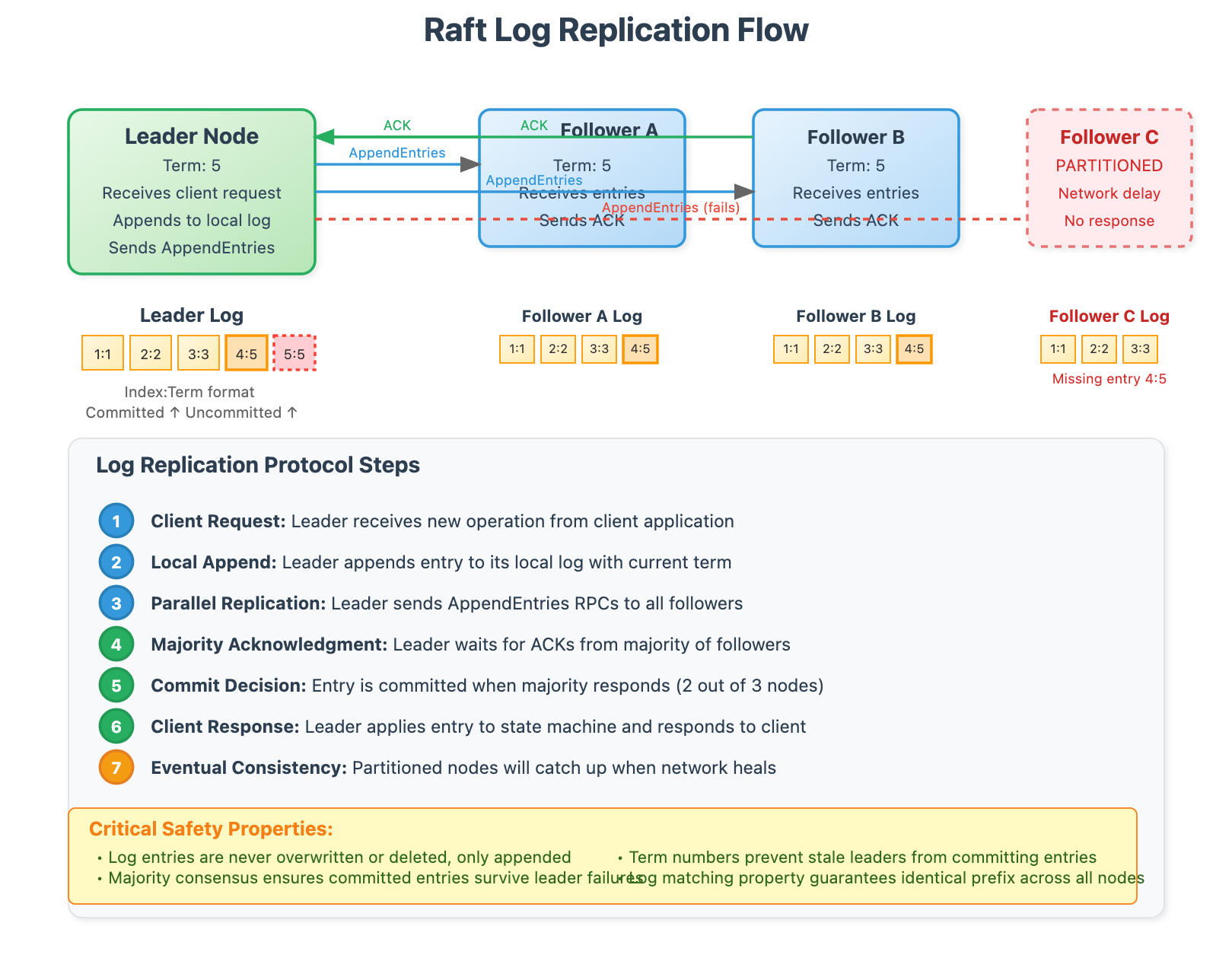
Once a leader is elected, its job is to manage the replicated log, ensuring all followers eventually have an identical copy.
- Technical Explanation:
- A client sends a command to the leader.
- The leader appends the command to its own log as a new entry, marked with the current term number.
- The leader sends
AppendEntriesRPCs to its followers, containing the new entry(ies). - A follower receives the RPC. If the entry immediately preceding the new one in the RPC matches what the follower has in its log (same index, same term), it appends the new entry and replies with success. If not, it rejects the RPC.
- The leader retries with earlier log entries until it finds a point of agreement, then overwrites the follower's log from that point on. This forces consistency.
- An entry is committed when the leader learns it has been replicated on a majority of servers.
- Once an entry is committed, the leader can apply the command to its state machine (e.g., a key-value store) and return the result to the client. The leader also informs followers of the latest commit index in subsequent
AppendEntriesRPCs.
-
Metaphor for a 5-Year-Old:
The Game Master (Leader) wants to add a new rule: "No running on the grass".- They write it on page 5 of their master rulebook.
- They send a copy of page 5 to all Players (Followers).
- When a Player gets the new page, they check if their page 4 matches what the Game Master said page 4 should be. If it does, they add page 5 and tell the Game Master "Got it!".
- Once the Game Master hears back from more than half the Players, they stamp page 5 as "OFFICIAL" (committed).
- If a Player had the wrong page 4, the Game Master would just send them the correct page 4, and then page 5, to fix their book.
-
Python Code Snippet:
Thishandle_append_entriesfunction shows how a follower processes an RPC from a leader, checking for consistency and appending entries.class RaftNode: # ... def handle_append_entries(self, request): with self.lock: # 1. Reply false if term < current_term if request.term < self.current_term: return {"term": self.current_term, "success": False} # If we see a higher term, we step down and become a follower if request.term > self.current_term: self.current_term = request.term self.state = NodeState.FOLLOWER self.voted_for = None # We are a follower in the correct term self.last_heartbeat = time.time() # 2. Reply false if log doesn’t contain an entry at prevLogIndex # whose term matches prevLogTerm if request.prev_log_index >= 0: if (request.prev_log_index >= len(self.log) or self.log[request.prev_log_index].term != request.prev_log_term): return {"term": self.current_term, "success": False} # 3. If an existing entry conflicts with a new one, delete it and all that follow # 4. Append any new entries not already in the log # (This logic is combined in practice) # Find first mismatch and truncate for i, entry in enumerate(request.entries): log_index = request.prev_log_index + 1 + i if log_index < len(self.log) and self.log[log_index].term != entry.term: self.log = self.log[:log_index] # Truncate conflicting entries break # Append new entries self.log.extend(entry for entry in request.entries if entry.index >= len(self.log)) # 5. If leaderCommit > commitIndex, set commitIndex = min(leaderCommit, index of last new entry) if request.leader_commit > self.commit_index: self.commit_index = min(request.leader_commit, len(self.log) - 1) # self._apply_to_state_machine() # Apply newly committed entries return {"term": self.current_term, "success": True}Code logic adapted from the Raft paper and 'Advanced Algorithms Every Senior Developer Must Know'.
5. Elite Interview Deep Dive: Raft's Safety Guarantees
This is the most critical part: why is Raft correct? It comes down to two key properties enforced by the rules we've discussed. Simply replicating to a majority isn't enough; the leader election process itself must be safe.
-
Technical Explanation:
Raft guarantees that no committed entries will ever be lost or overwritten. This is primarily achieved by the Leader Completeness Property, which states: a leader for any given term must contain all entries committed in all previous terms.How is this enforced? Through a simple restriction on voting:
A voter denies its vote if its own log is more up-to-date than the candidate's log.
"More up-to-date" is defined by comparing the index and term of the last entries in the logs. A log is more up-to-date if its last entry has a higher term, or if the terms are the same and the log is longer.
Implication: A server can only win an election if its log contains all entries already committed by a majority of the cluster. This prevents a new leader with a stale log from being elected and overwriting committed history. This single rule is the linchpin of Raft's safety.
Tech Talk - Raft, In Search of an Understandable Consensus Algorithm by Diego Ongaro
Let's return to the talk by Diego Ongaro to see the animated explanation of Raft's safety mechanism. This short segment is vital for understanding why Raft is correct.
Watch the segment on Safety from 32:03 to 35:04. Focus on the example of a server with a stale log trying to become leader and why it fails to get votes.
-
Metaphor for a 5-Year-Old:
When choosing a new Game Master, you wouldn't vote for a kid whose rulebook is missing "OFFICIAL" rules that everyone else already has. You only vote for candidates whose rulebook is at least as complete as your own. This ensures the new Game Master doesn't forget any important, already-decided rules. -
Python Code Snippet (The Safety Check):
This is the most important piece of code for ensuring safety. It's the check inside thehandle_vote_requestRPC handler.class RaftNode: # ... def handle_vote_request(self, request): with self.lock: # ... (check term, etc.) ... vote_granted = False if (request.term == self.current_term and (self.voted_for is None or self.voted_for == request.candidate_id)): # --- THIS IS THE LEADER COMPLETENESS CHECK --- my_last_log_term = self.log[-1].term if self.log else 0 my_last_log_index = len(self.log) - 1 candidate_is_up_to_date = ( request.last_log_term > my_last_log_term or (request.last_log_term == my_last_log_term and request.last_log_index >= my_last_log_index) ) # --- END OF CHECK --- if candidate_is_up_to_date: vote_granted = True self.voted_for = request.candidate_id # Grant vote self.last_heartbeat = time.time() # Reset our own timer return {"term": self.current_term, "vote_granted": vote_granted}This small block of logic is arguably the most crucial part of Raft's safety guarantee.
Test your understanding! (Interview-Style Question)
You have a 5-node Raft cluster. The leader (L) receives a client request, appends it as entry #10 to its log, and successfully replicates it to two followers (F1, F2). Before L can replicate it further or notify the client, L's machine loses power and crashes.
- Is log entry #10 considered committed? Why or why not?
- Which nodes from the remaining cluster (F1, F2, F3, F4) are eligible to be elected as the new leader in the next term? Explain your reasoning based on Raft's safety rules.
Show answer
-
Is log entry #10 committed?
No, entry #10 is not committed. An entry is only committed once it has been successfully replicated on a majority of servers. In a 5-node cluster, a majority is 3. The entry exists on L, F1, and F2 (3 nodes), which is a majority. However, the leader (L) crashed before it could learn this fact and update its owncommitIndex. Since the leader is the only one who can declare an entry committed, and it crashed before doing so, the entry remains uncommitted from the perspective of the cluster. -
Who can become the new leader?
Only nodes F1 and F2 are eligible to be elected as the new leader.Reasoning:
The Leader Completeness Property dictates that a candidate must have a log that is at least as up-to-date as the voter's log to receive a vote.- The logs of F1 and F2 contain entry #10.
- The logs of F3 and F4 do not.
Let's consider an election in the new term.
- If F1 becomes a candidate, it will request votes. When it asks F2 for a vote, F2 will see their logs are equally up-to-date and can grant the vote. When F1 asks F3 or F4, their logs are less up-to-date than F1's, so they can also grant the vote. F1 can easily gather a majority.
- If F3 becomes a candidate, it will request votes. When it asks F1 or F2 for a vote, F1/F2 will see that their own logs (containing entry #10) are more up-to-date than F3's log. They will deny the vote. F3 can only get votes from itself and F4, which is not a majority (2/5). Therefore, F3 cannot become leader. The same applies to F4.
This is Raft's safety mechanism in action. It ensures that any potentially-committed (but not yet officially declared as such) entry like #10 is preserved because only a node that possesses that entry can become the next leader.
Conclusion
Congratulations! You have just worked through one of the most important algorithms in modern distributed systems. You've seen how a problem that is provably impossible to solve perfectly can be solved in practice with an understandable and robust algorithm.
Key Takeaways:
- Consensus is about achieving agreement, validity, and termination among distributed nodes, but it's hard.
- Raft simplifies consensus by decomposing it into Leader Election and Log Replication, centered around a strong leader.
- Leader Election uses randomized timeouts to handle leader failure and prevent split votes.
- Log Replication uses a commit rule based on majority replication to make progress, while the leader forces follower logs to be consistent with its own.
- Raft's safety is guaranteed by the Leader Completeness Property, which is enforced during voting to ensure no committed data is ever lost.
Next Lesson Preview
In this lesson, we saw how Raft uses a totally ordered log to bring all nodes to an identical state. In our previous lesson, we discussed Causal Consistency, which preserves a partial ordering of events that have a cause-and-effect relationship. How do systems track this causality without enforcing a strict total order? In our next lesson, we will dive deep into the implementation of Vector Clocks, the primary mechanism used to track causal dependencies in a distributed system.