Hello! Welcome to your daily lesson on distributed systems.
In our last session, we dove deep into Apache Kafka, exploring its log-based architecture and its different delivery semantics. We learned that Kafka's fault tolerance relies on replicating partitions across multiple brokers and having a designated "leader" for each partition. This naturally leads to a critical question: what happens if the network breaks and nodes can't agree on who the leader is?
Today, we'll answer that question by tackling a classic failure mode in distributed systems. You will learn to explain the split-brain problem and how quorum-based strategies can prevent it. This concept is fundamental to the design of nearly all consistent, fault-tolerant systems, from databases like MongoDB and CockroachDB to coordination services like ZooKeeper and etcd, which are the bedrock of many services at Google and Meta.
We will deconstruct this problem and its solution through five interrelated concepts:
- The Split-Brain Scenario: Understanding what split-brain is and why it's a catastrophic failure.
- The Quorum Principle: The mathematical foundation for preventing split-brain using a majority vote.
- Read/Write Quorums: Generalizing the quorum idea to guarantee data consistency for read and write operations.
- Beyond Quorum: Fencing and STONITH: Exploring other, more forceful, prevention mechanisms.
- Elite Interview Deep Dive: Quorum for Byzantine Faults: Upping the ante to handle malicious nodes, not just failed ones.
1. The Split-Brain Scenario (Easy)
In a leader-based replication system (like Kafka or a primary-replica database), only the leader can accept writes. Followers replicate data from the leader. If the leader fails, the followers hold an election to promote a new one. But what if the leader isn't dead, just isolated?
-
Technical Explanation:
A network partition is a failure where a network splits into two or more disconnected sub-networks. Nodes in one partition can communicate with each other, but not with nodes in other partitions.The "split-brain" scenario occurs when a leader becomes isolated in a minority partition.
- Partition: A network partition separates the leader (L1) from the majority of followers.
- False Failure Detection: The followers can't receive heartbeats from L1, so they assume it has crashed.
- Election: The followers in the majority partition elect a new leader (L2).
- Dual Leaders: The system now has two active leaders: L1 in its partition and L2 in the other. Both think they are in charge and can accept writes.
This is catastrophic. The two leaders will accept conflicting writes, leading to data divergence and permanent inconsistency. When the network partition heals, it becomes nearly impossible to reconcile the two different histories.
Split Brain Problem | System Design
To grasp the severity of this problem, let's read a clear definition from AlgoMaster.io. This article explains what split-brain is and the sequence of events that leads to it.
Read the sections 'What Is Split-Brain?' and 'How Split-Brain Occurs'. Pay close attention to the table of consequences (data corruption, lost transactions) and the explanation for why the old primary doesn't know it's been replaced.
- Metaphor for a 5-Year-Old:
Imagine a ship has one captain (the leader) who gives orders over the intercom. One day, a storm cuts the wire to the captain's cabin. The rest of the crew can talk to each other but can't hear the captain. Thinking the captain is gone, they elect a new captain from among them. Now you have two captains on one ship. The original captain is steering the rudder left, and the new captain is telling the engine room to go full-speed right. The ship is torn apart by the conflicting commands.
2. The Quorum Principle (Medium)
The mathematical cure for split-brain is to ensure that a decision, such as electing a leader or committing a write, can only be made by a majority of nodes. This majority is called a quorum.
-
Technical Explanation:
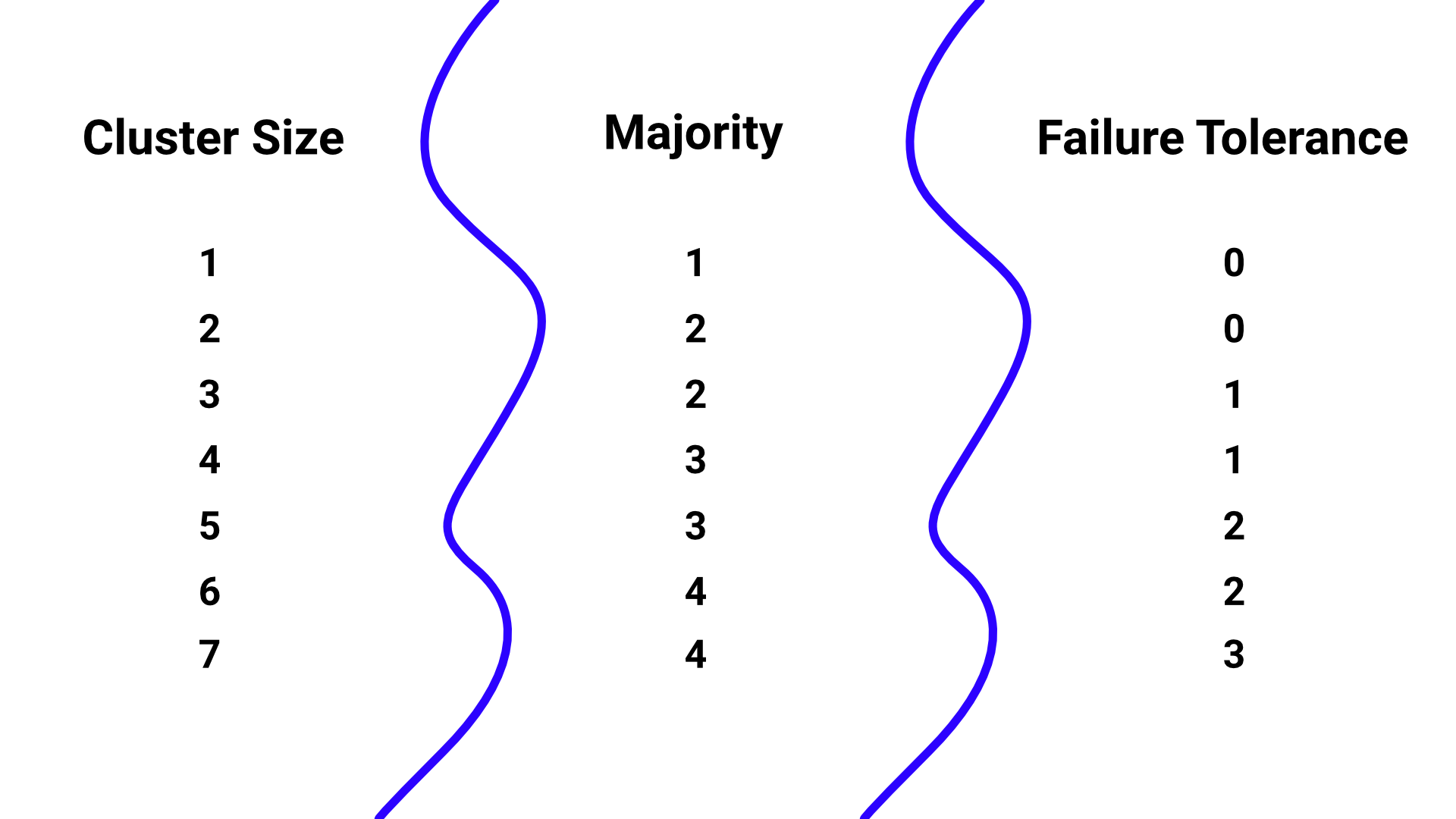
In a cluster of nodes, a quorum is defined as a majority of nodes, calculated as . The fundamental rule is: all critical operations require approval from a quorum of nodes.How does this prevent split-brain?
- A node can only become a leader if it receives votes from a quorum of other nodes.
- When a network partition occurs, the nodes are split into subgroups.
- By mathematical definition, only one subgroup can contain a majority of nodes. Two subgroups cannot simultaneously have a quorum.
- Therefore, only the partition with the quorum can elect a new leader. The nodes in the minority partition cannot form a quorum and are thus unable to elect a leader or accept writes. They effectively become read-only.
For tolerating crash failures (nodes going offline), you need a cluster of size . This ensures that even if nodes fail, the remaining nodes are still sufficient to form a quorum.
Split Brain Problem | System Design
The AlgoMaster article explains this core prevention strategy clearly.
Read the section '1. Quorum-Based Leadership'. Focus on how requiring a majority makes it mathematically impossible for two leaders to exist.
-
Metaphor for a 5-Year-Old:
A club has 5 members. The club rule says you need at least 3 votes (a quorum) to make a new rule. One day, a door slams shut, trapping 2 members in the library and 3 in the main hall. The 3 members in the main hall can still hold a vote and make a new rule. The 2 members in the library want to make a new rule, but they can't, because they don't have enough people to vote. The club can't have two conflicting new rules because only one group is large enough to make decisions. -
Python Code Snippet (Simulating a Quorum Check):
This is a conceptual function, not part of a real distributed system, but it illustrates the logic.def has_quorum(votes_received: int, total_nodes: int) -> bool: """ Checks if the number of votes received constitutes a quorum. A typical cluster uses an odd number of nodes (e.g., 3, 5, 7) to avoid ties. """ if total_nodes % 2 == 0: # In practice, even-sized clusters are avoided. # If used, they effectively have the fault tolerance of the next smallest odd number. print("Warning: Even number of nodes can lead to ties and reduced availability.") quorum_size = (total_nodes // 2) + 1 print(f"Total nodes: {total_nodes}, Quorum required: {quorum_size}, Votes received: {votes_received}") return votes_received >= quorum_size # Simulate a 5-node cluster partitioned into 3 and 2 cluster_size = 5 partition_A_size = 3 partition_B_size = 2 print("Partition A attempts to elect a leader...") can_elect_leader_A = has_quorum(votes_received=partition_A_size, total_nodes=cluster_size) print(f"Partition A can elect leader: {can_elect_leader_A}\n") # True print("Partition B attempts to elect a leader...") can_elect_leader_B = has_quorum(votes_received=partition_B_size, total_nodes=cluster_size) print(f"Partition B can elect leader: {can_elect_leader_B}") # False
3. Read/Write Quorums (Hard)
Quorum isn't just for leader election. It can be used more generally to guarantee consistency for data operations, as seen in "Dynamo-style" databases like Cassandra and Riak.
-
Technical Explanation:
Instead of a single quorum rule, we can define separate quorum sizes for reads () and writes ().- : The number of replicas that must acknowledge a write for it to be considered successful.
- : The number of replicas that must respond to a read request.
- : The total number of replicas for a piece of data.
To guarantee that a read operation always sees the latest successful write (a property called strong consistency), these values must satisfy the quorum condition:
This rule ensures that the set of nodes a client reads from and the set of nodes a client writes to must overlap by at least one node. When a client reads, it gets responses from nodes. Since , at least one of those nodes must have been part of the successful write quorum of nodes. By comparing version numbers (or timestamps) from the responses, the client can identify the most up-to-date value.

Distributed Systems 5.2: Quorums
Martin Kleppmann, a leading expert in distributed systems, provides an excellent and clear explanation of this r + w > n principle.
Watch from 03:47 to 07:38. Focus on how the overlap between the read set and the write set is guaranteed by the r + w > n inequality, and how this ensures a client gets an up-to-date value.
- Metaphor for a 5-Year-Old:
A club of 5 friends wants to decide on a secret password.- The rule is: to change the password (), you must tell 3 friends. To ask what the password is (), you must ask 3 friends.
- Imagine you change the password and tell Friends A, B, and C.
- Later, someone else wants to know the password. They ask Friends C, D, and E.
- Because , their groups must overlap. In this case, they both talked to Friend C. Even if D and E have the old password, C will have the new one, so the correct password will be found.
Test your understanding! (Interview-Style Question)
You are designing a distributed key-value store with replicas for each piece of data. The business requires extremely high availability for reads, even if several nodes are down. Writes can be slower. How would you configure and to meet this requirement, and what is the trade-off?
Show answer
Configuration:
To maximize read availability, you should minimize . The lowest possible value for is 1.
- Set . A read request only needs a response from any single replica to succeed.
To maintain strong consistency (), we must have , which simplifies to . The smallest integer value is 5.
- Set . A write request must be successfully acknowledged by all five replicas.
Trade-off:
- Pro (High Read Availability): Reads are very fast and highly available. A read will succeed as long as at least one replica is online.
- Con (Low Write Availability): Writes are slow and have poor availability. A write will fail if even a single replica is unavailable or slow to respond. This configuration is sometimes called "Read-One-Write-All" (ROWA).
This trade-off makes sense for read-heavy workloads where data changes infrequently but is read very often, such as system configuration data or a product catalog.
4. Beyond Quorum: Fencing and STONITH (Hard)
While quorum is the primary strategy for most modern systems, older High Availability (HA) clusters sometimes use a more brutal method called fencing.
-
Technical Explanation:
Fencing is the act of forcefully blocking an old leader from accessing shared resources. The idea is that when a new leader is promoted, it first "builds a fence" around the old leader before taking over.
There are several types of fencing:- Resource Fencing: The new leader tells a shared storage system (like a SAN) to revoke all write access from the old leader.
- Network Fencing: The new leader tells a network switch to block all traffic from the old leader's IP address.
- Power Fencing: The most extreme method. The new leader uses a special out-of-band network card (like an IPMI controller) to forcibly power off the machine of the old leader. This is famously known as STONITH ("Shoot The Other Node In The Head").
STONITH is the ultimate guarantee against split-brain. No matter what state the old leader is in, it cannot cause data corruption if its power is cut. This is common in traditional active-passive database clusters but less so in cloud-native systems, where terminating a VM instance via an API call serves a similar purpose.
Split Brain Problem | System Design
Let's revisit the AlgoMaster article to learn about these alternative strategies. Understanding them demonstrates a breadth of knowledge in high-availability architectures.
Read the sections '3. Fencing' and '4. STONITH'. Focus on understanding the concept of STONITH as the most definitive but aggressive solution.
- Metaphor for a 5-Year-Old:
Remember the two ship captains? With STONITH, when the new captain is elected, their very first order is not to the engine room, but to a security guard: "Go to the old captain's cabin and lock the door from the outside." The old captain can shout all the orders they want, but no one can hear them, and they can't get out to touch the ship's controls. Power-fencing is even more direct: "Go to the old captain's cabin and cut its power supply."
5. Elite Interview Deep Dive: Quorum for Byzantine Faults (Very Hard)
So far, we've assumed nodes only suffer from crash failures (they stop responding) or network failures. But what if nodes are malicious or buggy? What if they lie? This is known as a Byzantine fault.
-
Technical Explanation:
A Byzantine fault is any fault where a component can behave arbitrarily, such as sending conflicting information to different parts of the system. For example, a faulty node could vote for two different leaders in the same election.The quorum rule is not sufficient to handle this. Why? Consider a 3-node cluster (). One node is Byzantine. The two honest nodes, A and B, see that the leader is down. They both try to become the new leader.
- The Byzantine node tells A: "I vote for you." A sees 2 votes (itself + Byzantine) and thinks it has a quorum.
- The Byzantine node tells B: "I vote for you." B sees 2 votes (itself + Byzantine) and thinks it has a quorum.
- Result: Split-brain.
To tolerate Byzantine faults, a system must have at least total nodes. A decision requires a quorum of approvals. This is a core result from the Practical Byzantine Fault Tolerance (PBFT) algorithm.
Let's re-run the scenario with the correct math. Wait, if , we need nodes.
In a 4-node cluster with 1 faulty node, a quorum is . A single Byzantine node can't create a split-brain because it can't be in two places at once. To form two separate quorums of 3, you'd need 6 total votes, but there are only 4 nodes. The Byzantine node can only give its one vote to one side.
Implementing PBFT in Blockchain
This concept is foundational to permissioned blockchains and advanced consensus protocols. This article provides a concise mathematical proof for the N = 3F + 1 requirement.
Read the sections 'Practical Byzantine Fault Tolerance' and 'Mathematical Proof of PBFT'. Focus on understanding the definitions of Liveness and Safety, and how combining them leads to the N=3F+1 result for Byzantine failures.
- Metaphor for a 5-Year-Old:
The club of 5 now has a spy who wants to cause chaos. The old rule was 3 votes to make a decision. What if an honest person (A) proposes "Snack time is at 3 PM" and another (B) proposes "Snack time is at 4 PM"? The spy could tell A's group "I vote for 3 PM" and B's group "I vote for 4 PM", potentially causing two different rules to pass.
To prevent this, the club makes a new, stronger rule: you need 4 votes to pass anything. Now, even if the spy lies, they can only give their one vote to one group. It's impossible for two groups to each get 4 votes from a total of 5 people. The honest majority will always win.
Conclusion
Today you've tackled one of the most fundamental problems in distributed systems. Understanding split-brain and quorums isn't just about theory; it's about making concrete design decisions that ensure data consistency and system reliability in the face of network failures.
Key Takeaways:
- Split-Brain: A critical failure mode where a network partition leads to two or more parts of a system acting independently and inconsistently, often by electing multiple leaders.
- Crash-Fault Quorum: To tolerate nodes crashing, you need total nodes. Decisions require a majority vote (), making it mathematically impossible to have two active leaders.
- Read/Write Quorum: The rule guarantees that the set of nodes read from overlaps with the set of nodes written to, ensuring a client can find the latest value. This allows tuning for read-heavy or write-heavy workloads.
- Byzantine Quorum (PBFT): To tolerate malicious or arbitrary failures, you need a much larger cluster of nodes, with decisions requiring approvals.
Next Lesson Preview
We've now learned about leader-based replication (from the Kafka lesson) and how quorums prevent split-brain. But how do these pieces fit together into a complete, robust algorithm for managing a replicated log? In our next lesson, we will explore Raft, a consensus algorithm designed for understandability. You will learn the role of the Raft algorithm in solving the distributed consensus problem, seeing exactly how it uses leader election, log replication, and quorum rules to keep a distributed system in a consistent state.