Hello! In our last lesson, we tackled the Knapsack family of problems, mastering how to make optimal choices under a fixed capacity. You saw how the state dp[i][w] elegantly captured the maximum value using the first i items within a capacity w.
Today, we're taking our DP skills to a new level by exploring problems where the state itself is a subset of elements. When the number of elements is small, we can use a clever technique called bitmasking to compress the representation of this subset into a single integer. This unlocks a powerful method known as Dynamic Programming with Bitmasking, which is essential for solving certain complex combinatorial problems that frequently appear in top-tier interviews.
Today's Concepts
- The Core Idea: What is a Bitmask?
- Bitmask DP Applied: The Traveling Salesman Problem (TSP)
- An Interview-Style Problem: Maximizing Score with Pairings
- Implementing a Top-Down Solution
- Complexity, Trade-offs, and The Golden Rule for Interviews
Concept 1: The Core Idea: What is a Bitmask?
At its heart, bitmasking is a technique to use the binary representation of an integer to represent a set or a subset. This is a form of state compression.
Technical Explanation
Given n items, indexed from 0 to n-1, we can use an n-bit integer called a mask to represent any subset of these items.
- If the
i-th bit of the mask is1, it means thei-th item is included in the subset. - If the
i-th bit is0, it means thei-th item is excluded.
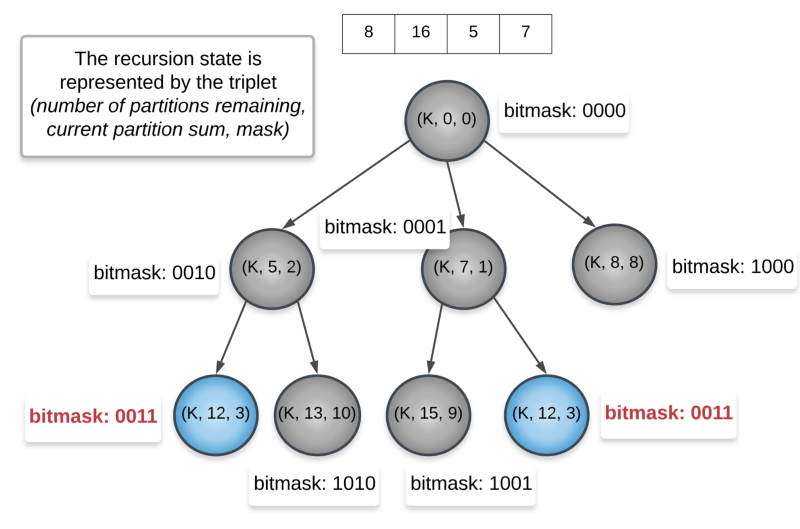
For n=4 items {A, B, C, D} (indexed 3, 2, 1, 0), the subset {A, C} would be represented by the binary number 1010, which is the integer 10. The empty set is 0000 (0), and the set of all items is 1111 (15).
This compact representation allows us to use the mask as an index in our DP table, e.g., dp[mask], where mask uniquely identifies a subset of items that have been processed.
Metaphor: The Light Switch Panel
Think of a panel with n light switches, one for each item. A subset is simply a specific configuration of these switches. An 'on' switch means the item is in the subset; an 'off' switch means it's not. Instead of describing the state of every single switch ("switch 0 is on, switch 1 is off..."), you can represent the entire panel's state with a single number. This number is the bitmask. Changing the set (adding or removing an item) is as fast as flipping a switch—a single bitwise operation.
To effectively use bitmasks, you must be comfortable with bitwise operations. The following article provides a great overview and Python examples for these essential operations.
Bitmask Dynamic Programming (DP) Overview
The article 'Bitmask Dynamic Programming (DP) Overview' gives a concise introduction to the topic. We'll start by focusing on the building blocks it presents.
Please read the section titled 'Bitmask Operations'. It provides clear Python functions for the four fundamental operations you'll need: checking if a bit is set, setting a bit, clearing a bit, and toggling a bit. Internalize these patterns, as they are the tools we'll use to manipulate our DP state.
Concept 2: Bitmask DP Applied: The Traveling Salesman Problem (TSP)
The Traveling Salesman Problem is the canonical example of a problem that is computationally hard but can be solved optimally for small inputs using bitmask DP.
Technical Explanation
Problem: Given a set of n cities and the distances between every pair of cities, find the shortest possible tour that visits each city exactly once and returns to the origin city.
A brute-force solution would be to try all permutations of cities, which has a time complexity of . This becomes infeasible very quickly (for n=15, 15! is over a trillion).
With bitmask DP, we can solve it in time. While still exponential, this is a massive improvement and makes the problem tractable for n up to around 20.
-
State Definition: Let
dp[mask][i]be the minimum cost of a path that starts at a designated city (say, city 0), visits all cities specified in themask, and ends at cityi. -
Recurrence Relation: To calculate
dp[mask][i], we consider all possible citiesjthat could have been the city visited just beforei. Cityjmust be in the set of visited cities represented bymask, but it cannot be cityiitself.
The path tojwould have visited the cities inmaskexcludingi. Let's call thisprev_mask = mask XOR (1 << i).
So, to finddp[mask][i], we try all validj's and find the minimum: -
Base Case:
dp[1 << 0][0] = 0. This represents a path starting and ending at city 0, having only visited city 0, with a cost of 0.
The following video provides an outstanding, step-by-step explanation of this logic.
Traveling Salesman Problem | Dynamic Programming | Graph Theory
WilliamFiset's video on TSP is a masterclass in explaining bitmask DP. He clearly breaks down the state representation and the transitions.
Please watch the following segments: State Representation (5:02 - 7:15): This is the most crucial part. Understand how the two components—the set of visited nodes (as a bitmask) and the last visited node—form the DP state. The Solve Method (11:29 - 15:10): Pay close attention to how he iterates through masks of increasing size and uses the recurrence relation to build up the solution from smaller subproblems. Finding the Final Answer (16:49 - 18:00): See how the completed DP table is used to calculate the final tour cost by adding the distance back to the starting city.
Implementation (Bottom-Up)
Here is a Python implementation that follows the logic from the video.
import math

def tsp_bitmask(dist_matrix):
    """
    Solves TSP using bitmask DP.
    Time Complexity: O(n^2 * 2^n)
    Space Complexity: O(n * 2^n)
    """
    n = len(dist_matrix)

    # dp[mask][i]: min cost to visit cities in mask, ending at city i
    dp = [[math.inf] * n for _ in range(1 << n)]

    # Base case: start at city 0, mask is 0...0001
    dp[1][0] = 0

    # Iterate over all subsets (masks) of cities
    for mask in range(1, 1 << n):
        # For each city 'u' that is the endpoint of the path defined by 'mask'
        for u in range(n):
            # If city 'u' is not in the current set of visited cities, skip
            if not (mask & (1 << u)):
                continue

            # From 'u', try to go to every other city 'v'
            for v in range(n):
                # We can't go to a city we've already visited, or stay at the same city
                if (mask & (1 << v)) or u == v:
                    continue

                # The new mask represents visiting city 'v' after the path to 'u'
                next_mask = mask | (1 << v)

                # Update the cost for the new path
                new_cost = dp[mask][u] + dist_matrix[u][v]
                dp[next_mask][v] = min(dp[next_mask][v], new_cost)

    # Final step: find the minimum cost tour by returning to the start city (0)
    final_mask = (1 << n) - 1  # Mask with all bits set (all cities visited)
    min_tour_cost = math.inf

    for i in range(1, n):
        # Cost of tour ending at 'i' + cost to return to start (0) from 'i'
        tour_cost = dp[final_mask][i] + dist_matrix[i][0]
        min_tour_cost = min(min_tour_cost, tour_cost)

    return min_tour_cost if min_tour_cost != math.inf else 0

# Example
distances = [
    [0, 10, 15, 20],
    [10, 0, 35, 25],
    [15, 35, 0, 30],
    [20, 25, 30, 0]
]
print(f"Minimum TSP cost: {tsp_bitmask(distances)}") # Expected: 80 (0 -> 1 -> 3 -> 2 -> 0)
Concept 3: An Interview-Style Problem: Maximizing Score with Pairings
While TSP is a classic, interview problems often present bitmask DP in less obvious forms. Let's analyze a problem from LeetCode: "Maximize Score After N Operations".
Problem: You are given an array nums of 2*n positive integers. You must perform n operations. In the i-th operation (1-indexed), you:
- Choose two elements
xandyfromnums. - Receive a score of
i * gcd(x, y). - Remove
xandyfromnums.
Return the maximum score you can achieve afternoperations.
Why Bitmask DP?
- The core of the problem is choosing pairs of numbers. This is a subset/permutation problem.
- The constraints are small (
n <= 7, so2*n <= 14). This is a huge hint! A complexity involving is acceptable. - We need to keep track of which numbers have already been used. A bitmask is perfect for this.
This next video walks through how to derive the DP solution from scratch.
Maximize Score After N Operations of Leetcode || DP with Bitmasking || C++/Java/Python || DP
This video by Aryan Mittal on LeetCode's 'Maximize Score After N Operations' is a perfect example of how bitmask DP is used in modern interview questions. He does an excellent job explaining the thought process.
Please focus on these key ideas as you watch: From Brute Force to DP (00:59 - 12:13): Understand why a greedy approach fails and how exploring all possibilities leads to a recursive structure with overlapping subproblems. Why Use a Mask? (15:05 - 19:14): He compares using arrays or hash maps to a bitmask for tracking used elements, highlighting the efficiency of bitwise operations. The DP State and Recursion (25:42 - 33:07): This is the core logic. Pay close attention to how the mask is the only state you need for memoization. The number of operations can be calculated from the number of set bits in the mask, a brilliant optimization!
Concept 4: Implementing a Top-Down Solution
The video uses a top-down (memoized recursion) approach, which is often more intuitive for this type of problem. Let's formalize that implementation.
-
State Definition: A function
solve(mask)will return the maximum score achievable using the elements not yet picked (i.e., the elements corresponding to the0s in themask). -
State Transition:
- Inside
solve(mask), first find which operation number this is. Ifkelements have been used (k =number of set bits inmask), then we have performedk/2operations. This is operation numberop = (k/2) + 1. - Iterate through all pairs of unused elements
(i, j). - For each pair, the score for this step is
op * gcd(nums[i], nums[j]). - The total score for this path is that score plus the result of the recursive call with an updated mask:
solve(new_mask), wherenew_maskhas bitsiandjset. - We take the maximum over all possible pairs
(i, j).
- Inside
-
Base Case: If the
maskhas all bits set, all numbers have been used. We can't make any more pairs, so the score is 0.
from math import gcd
from functools import lru_cache

def max_score(nums):
    """
    Solves 'Maximize Score After N Operations' using top-down DP with bitmasking.
    Time Complexity: O(m^2 * 2^m) where m = 2*n
    Space Complexity: O(2^m) for memoization
    """
    m = len(nums)
    n_ops = m // 2

    # memo[mask] stores the max score for the subproblem defined by mask
    memo = {}

    def solve(mask):
        if mask in memo:
            return memo[mask]

        # Count how many numbers have been used
        used_count = bin(mask).count('1')

        # If all numbers are used, we are done with this path
        if used_count == m:
            return 0

        # Determine the current operation number (1-indexed)
        op_num = (used_count // 2) + 1

        max_val = 0
        # Find the first unused number 'i'
        for i in range(m):
            if not (mask & (1 << i)):
                # Find the second unused number 'j'
                for j in range(i + 1, m):
                    if not (mask & (1 << j)):
                        # Create the new mask for the recursive call
                        new_mask = mask | (1 << i) | (1 << j)

                        current_score = op_num * gcd(nums[i], nums[j])

                        # Recurse on the remaining numbers
                        remaining_score = solve(new_mask)

                        max_val = max(max_val, current_score + remaining_score)

        memo[mask] = max_val
        return max_val

    # Start with an empty mask (no numbers used)
    return solve(0)

# Example
nums = [1, 2, 3, 4, 5, 6]
print(f"Maximum score: {max_score(nums)}") # Expected: 14
Test your understanding!
In the max_score problem, the DP state dp[mask] stores the max score for the remaining elements. An alternative could be dp[mask] = max score using the elements already picked. Why is the first definition (score for remaining) more natural for a top-down recursive solution?
Show answer
A top-down recursive solution naturally breaks a problem into smaller, similar subproblems. solve(mask) asks "what is the best I can do from this state forward?". The "state" is the set of available numbers, represented by the unset bits in the mask. The score from the current step is added to the optimal score of the future subproblem.
If the state were dp[mask] = score from elements already picked, the recursive call would need to pass information "down" about the current score, which complicates the DP state definition. The function signature would need to be solve(mask, current_score), but current_score is path-dependent and cannot be memoized with just the mask. The chosen definition makes the mask the sufficient and sole identifier of a subproblem.
Concept 5: Complexity, Trade-offs, and The Golden Rule for Interviews
Understanding when to use bitmask DP is as important as knowing how.
Complexity Analysis
- Time Complexity: The general formula is .
- For TSP: . States: . Transition: From each state, we can iterate to
nother cities. - For Max Score: . States: . Transition: From each state, we iterate through pairs.
- For TSP: . States: . Transition: From each state, we can iterate to
- Space Complexity: This is determined by the size of the DP table or memoization cache.
- For TSP:
- For Max Score:
The Golden Rule
This complexity analysis leads to a critical interview heuristic:
If a problem involves finding an optimal solution on subsets, permutations, or assignments, and the number of elements n is very small (typically n <= 20), you should immediately consider Dynamic Programming with Bitmasking.
The small constraint is a deliberate signal from the interviewer that an exponential time complexity in n is acceptable and expected.
Conclusion
You've now unlocked one of the most powerful advanced DP techniques. By representing subsets as integers, you can solve a class of problems that would otherwise be computationally intractable.
Key Takeaways:
- State Compression: Bitmasks are a form of state compression, allowing you to encode a subset of
nitems into a single integer. - The
dp[mask]Pattern: The bitmask is used as the key index for your DP state, representing the subproblem on that subset. The state might also include the last element visited, e.g.,dp[mask][i]. - Exponential but Feasible: Bitmask DP algorithms have exponential time complexity, but they are vastly better than factorial-time brute-force approaches.
- The Interview Signal: A small constraint (
n <= 20) on a combinatorial problem is a strong hint to use bitmasking.
Preview of the Next Lesson:
We will shift gears away from dynamic programming's exhaustive search for optimality. In the next lesson, we will explore Greedy Algorithms. You'll learn how making the locally optimal choice at each step can sometimes lead to a globally optimal solution, and more importantly, you'll learn how to prove when such a strategy is correct.