Hello! In our last lesson, we mastered a powerful dynamic programming technique: DP with Bitmasking. You learned how to solve complex combinatorial problems by compressing subset information into an integer, enabling solutions with complexities like for problems that would otherwise be intractable. This exhaustive, optimal-path-finding approach is a cornerstone of advanced algorithm design.
Today, we pivot to a completely different algorithmic paradigm: Greedy Algorithms. Unlike DP, which meticulously explores all possibilities to guarantee an optimal solution, greedy algorithms take a more direct, myopic approach. They make the choice that seems best at the moment and stick with it. While this strategy is often fast and simple, its correctness is not guaranteed. Our focus today will be on a classic problem where a greedy strategy does work, and more importantly, how to rigorously prove that it is optimal.
Today's Concepts
- The Greedy Philosophy: Local vs. Global Optimum
- The Interval Scheduling Problem: Defining the Goal
- Exploring Heuristics: Why Intuitive Greedy Choices Fail
- The Winning Strategy: Earliest Finish Time
- Proving Correctness: The Exchange Argument
Concept 1: The Greedy Philosophy: Local vs. Global Optimum
Before we dive into a specific problem, let's establish the mindset behind greedy algorithms.
Technical Explanation
A greedy algorithm builds up a solution piece by piece, always choosing the next piece that offers the most obvious and immediate benefit. It makes a locally optimal choice in the hope that this sequence of local optima will lead to a globally optimal solution.
The main advantages are speed and simplicity. The main disadvantage is that they often don't work. For this reason, as the UIUC lecture notes emphasize, every greedy algorithm requires a proof of correctness. Without a proof, a greedy approach is just a heuristic—a rule of thumb that might give a good-enough solution, but not necessarily the best one.
Greedy Algorithms: Examples and Proof Techniques
To formalize this, let's look at the lecture notes from the University of Illinois.
Please read the sections 'What is a Greedy Algorithm?' and 'Pros and Cons of Greedy Algorithms' (pages 7-8). This will give you a solid definition and frame the critical importance of proving correctness, which we'll focus on today.
Metaphor: The Blindfolded Hill Climber
Imagine you are blindfolded and placed somewhere on a mountain range. Your goal is to reach the highest possible point. A greedy strategy would be to feel the ground around you at every step and always move in the direction that is steepest upwards.
This might lead you to the top of a small hill (a local optimum), but you might miss the much taller peak right next to it (the global optimum). Greedy algorithms work only for special "mountain ranges" where every local peak is also the highest peak. Our job today is to show that the Interval Scheduling problem has such a special structure.
Concept 2: The Interval Scheduling Problem: Defining the Goal
Let's apply this greedy thinking to a foundational problem that appears frequently in scheduling systems, resource allocation, and, of course, technical interviews.
Technical Explanation
The problem is simple to state:
- Input: A set of
nrequests (jobs, meetings, classes), each with a specific start time and finish time . - Constraint: A single resource (a conference room, a CPU, a person) can only handle one request at a time. Two requests
iandjare compatible if they don't overlap (i.e., if or ). - Goal: Find a subset of mutually compatible requests of the maximum possible size.
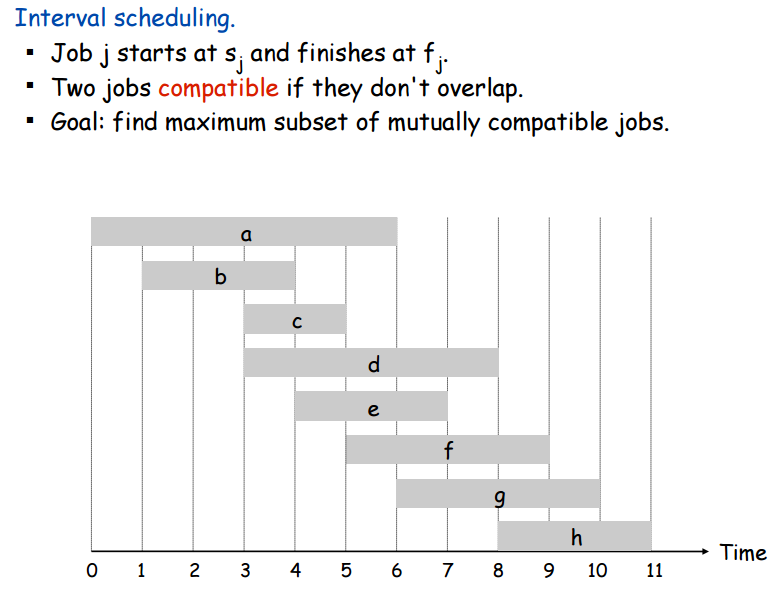
This problem is also known as the Activity Selection Problem. In LeetCode, it often appears as "Non-overlapping Intervals" (#435), where the goal is framed as finding the minimum number of intervals to remove to make the rest non-overlapping. This is exactly the inverse of our goal: Total Intervals - Max Compatible Intervals = Min Removals.
Concept 3: Exploring Heuristics: Why Intuitive Greedy Choices Fail
The first step in designing a greedy algorithm is to propose a "greedy choice" or heuristic. Let's explore a few intuitive but flawed ideas. Developing the skill to find counter-examples is crucial for interviews.
To see these failures in action, the MIT OpenCourseWare lecture provides excellent visual counter-examples.
1. Course Overview, Interval Scheduling
Professor Srini Devadas from MIT masterfully walks through several intuitive but incorrect greedy strategies for interval scheduling. Watching this will build your intuition for why the problem is trickier than it first appears.
Please watch the segment from 23:03 to 37:16. The professor discusses and refutes several tempting heuristics. Pay close attention to the visual counter-examples for each strategy.
Here's a summary of the failed heuristics discussed in the video:
-
Greedy Choice: Earliest Start Time.
-
Heuristic: Pick the interval that starts first.
-
Why it fails: A very long interval might start earliest but block out many other shorter, compatible intervals.
Caption: Choosing the long interval that starts at t=0 prevents us from choosing the four shorter intervals. The optimal solution of size 4 is missed.
-
-
Greedy Choice: Shortest Interval.
-
Heuristic: Pick the interval with the smallest duration ().
-
Why it fails: A very short interval can be strategically placed to conflict with two other intervals that would otherwise be compatible.
Caption: Choosing the shortest interval in the middle prevents us from picking the two longer intervals on either side, leading to a suboptimal solution of size 1 instead of 2.
-
-
Greedy Choice: Fewest Conflicts.
- Heuristic: For each interval, count how many other intervals it overlaps with. Pick the one with the minimum number of conflicts.
- Why it fails: This is a very tempting but complex heuristic that also fails. A carefully constructed example can show that picking the "least conflicting" interval can eliminate a large, dense group of compatible intervals.
Concept 4: The Winning Strategy: Earliest Finish Time
As revealed in the MIT video, the correct greedy choice is surprisingly simple.
Technical Explanation
The Algorithm: Earliest Finish Time (EFT)
- Sort all intervals in increasing order of their finish times.
- Initialize an empty solution set,
A. - Pick the first interval from the sorted list and add it to
A. Let's say its finish time islast_finish_time. - Iterate through the rest of the sorted intervals. For each interval
i, if its start times_iis greater than or equal tolast_finish_time, it means it's compatible. - If it's compatible, add interval
itoAand updatelast_finish_timetoi's finish time. - Return
A.
The Intuition:
Why does this work? By always picking the interval that finishes earliest, we free up the resource as soon as possible. This maximizes the remaining time for other requests to be scheduled. It's the most "resource-considerate" choice you can make at any point.
435. Non-overlapping Intervals - In-Depth Explanation
The article 'Non-overlapping Intervals - In-Depth Explanation' on Algo.monster provides a fantastic, practical perspective on this intuition.
Please read the 'Intuition' section. It uses a great analogy of scheduling meetings and explains why sorting by end time is superior to sorting by start time.
Concept 5: Proving Correctness: The Exchange Argument
Stating the algorithm is easy. Proving it's optimal is what separates a good engineer from an elite one. The most common technique for proving greedy algorithms is the exchange argument.
The core idea is to show that the greedy solution is just as good as any arbitrary optimal solution.
Interval Scheduling Maximization (Proof w/ Exchange Argument)
The proof can be dense, so watching a visual walkthrough is extremely helpful. This video from Back To Back SWE is dedicated entirely to proving the correctness of the EFT strategy using an exchange argument.
This is the most important part of the lesson. Please watch from 05:16 to 20:19. The speaker does an excellent job of: Setting up the proof (5:16): Defining the greedy solution G and an optimal solution O. The first point of difference (7:00): Identifying the first interval where G and O disagree. The 'exchange' (11:30): Showing how you can swap the greedy choice into the optimal solution without breaking it. Concluding the argument (15:41): Arguing that if you can do this repeatedly, the greedy solution must have the same size as the optimal one.
Proof Summary (Exchange Argument)
Let's formalize the argument from the video:
- Let be the solution from our greedy algorithm, sorted by finish times.
- Let be any optimal solution, also sorted by finish times. We want to prove .
- The "Greedy Stays Ahead" Lemma: The greedy algorithm stays ahead in the sense that for any , the finish time of the -th greedy choice is no later than the finish time of the -th choice in the optimal solution. That is, .
- Base Case (i=1): The greedy algorithm picks the interval with the absolute earliest finish time, so must be true.
- Inductive Step: Assume . is the first interval in the sorted list that starts after . must start after . Since , is a valid candidate for the greedy algorithm after . The greedy algorithm will pick the one with the earliest finish time, so it will pick something at least as good as . Thus, .
- The Contradiction: Now, assume for contradiction that the optimal solution has more intervals than the greedy one (). This would mean there is an interval in the optimal solution. By our lemma, we know . Since is compatible with , its start time must be . Therefore, . This means is a compatible interval that the greedy algorithm could have chosen after . But the greedy algorithm stopped at intervals, meaning it found no more compatible intervals. This is a contradiction.
- Conclusion: Therefore, our assumption that must be false. Since is optimal, we know . Together, this means . The greedy algorithm produces a solution of optimal size.
Test your understanding!
Imagine a variant of the problem: Weighted Interval Scheduling. Each interval now has a "weight" or "value", and the goal is to find a set of non-overlapping intervals with the maximum total weight, not the maximum count.
Would the 'earliest finish time' greedy strategy still work? Why or why not?
Show answer
No, the 'earliest finish time' strategy would not work for the weighted version.
Consider these three intervals:
[1, 10], weight100[1, 3], weight10[4, 6], weight10
The greedy algorithm would sort by finish time: [1, 3], [4, 6], [1, 10].
- It would first pick
[1, 3](weight 10). - Then, it would pick
[4, 6](weight 10) because it's compatible. - It cannot pick
[1, 10].
The greedy solution is{[1, 3], [4, 6]}with a total weight of 20.
However, the optimal solution is to just pick the single interval [1, 10] with a weight of 100.
This demonstrates that a simple greedy choice is insufficient. Weighted Interval Scheduling is a classic problem that requires Dynamic Programming to solve correctly.
Implementation and Complexity
Finally, let's translate this into clean, interview-ready code.
def max_compatible_intervals(intervals):
    """
    Solves the Interval Scheduling problem using a greedy approach.

    Time Complexity: O(n log n) due to sorting.
    Space Complexity: O(1) if sorting in-place, or O(n) if a copy is made.

    Args:
        intervals: A list of lists, where each inner list is [start, end].

    Returns:
        A list of the maximum set of compatible intervals.
    """
    if not intervals:
        return []

    # Step 1: Sort intervals by their finish times
    # The key is a lambda function that tells sort() to use the second element (index 1)
    intervals.sort(key=lambda x: x[1])

    # Step 2: Initialize the solution set and track the last finish time
    solution = []

    # Add the first interval (the one with the earliest finish time) to the solution
    solution.append(intervals[0])
    last_finish_time = intervals[0][1]

    # Step 3: Iterate through the rest of the intervals
    for i in range(1, len(intervals)):
        current_start_time = intervals[i][0]

        # Step 4: If the current interval is compatible, add it to the solution
        if current_start_time >= last_finish_time:
            solution.append(intervals[i])
            last_finish_time = intervals[i][1] # Update the last finish time

    return solution

# Example
requests = [[1, 4], [3, 5], [0, 6], [5, 7], [3, 8], [5, 9], [6, 10], [8, 11], [8, 12], [2, 13], [12, 14]]
optimal_schedule = max_compatible_intervals(requests)
print(f"Maximum number of compatible intervals: {len(optimal_schedule)}")
print(f"Optimal schedule: {optimal_schedule}")
# Expected output: [[1, 4], [5, 7], [8, 11], [12, 14]]
Conclusion
Today you transitioned from the exhaustive world of DP to the fast-but-risky world of Greedy Algorithms. You learned that while many greedy ideas seem plausible, they often fail. The key is to find the right greedy choice and, most importantly, to be able to prove its optimality.
Key Takeaways:
- Greedy vs. DP: Greedy algorithms make locally optimal choices, while DP solves subproblems to find a globally optimal one. Greedy is faster but requires a correctness proof.
- Interval Scheduling: This classic problem is optimally solved by a greedy algorithm.
- The Right Heuristic: For interval scheduling, the winning strategy is to always pick the compatible activity that finishes earliest. This frees up the resource quickly, maximizing future options.
- The Exchange Argument: This is a fundamental proof technique. You show that any optimal solution can be transformed, step-by-step, into the greedy solution without losing optimality, proving they are equivalent in quality.
Preview of the Next Lesson:
We will continue our exploration of greedy algorithms with another canonical problem: Huffman Coding. You will learn how to use a priority queue to implement a greedy strategy that builds an optimal prefix code for data compression. This will reinforce your understanding of greedy choices and their proofs in a completely different context.